

in revising the standard to 0.075 ppm. The
CASAC Ozone Panel expressed its displeasure
at the Administrator’s setting the NAAQS at a
level higher than they recommended. In my opinion, the science alone can never be sufficient for
establishing a specific numerical standard. The
setting of the standard also involves judgment as
to acceptable risk, a judgment call I viewed as
being delegated to the Administrator, not the
Advisory Committee, by the Clean Air Act.
After the revised standard was promulgated, the
EPA’s statistical reanalysis [13] was published
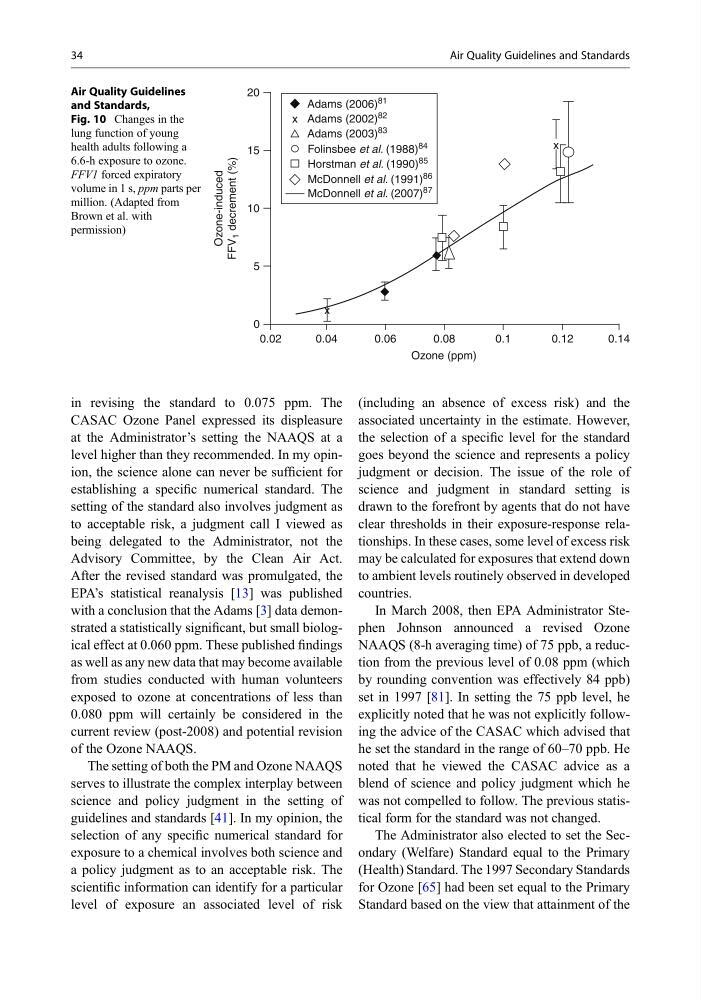
with a conclusion that the Adams [3] data demonstrated a statistically significant, but small biological effect at 0.060 ppm. These published findings
as well as any new data that may become available
from studies conducted with human volunteers
exposed to ozone at concentrations of less than
0.080 ppm will certainly be considered in the
current review (post-2008) and potential revision
of the Ozone NAAQS.
The setting of both the PM and Ozone NAAQS
serves to illustrate the complex interplay between
science and policy judgment in the setting of
guidelines and standards [41]. In my opinion, the
selection of any specific numerical standard for
exposure to a chemical involves both science and
a policy judgment as to an acceptable risk. The
scientific information can identify for a particular
level of exposure an associated level of risk
(including an absence of excess risk) and the
associated uncertainty in the estimate. However,
the selection of a specific level for the standard
goes beyond the science and represents a policy
judgment or decision. The issue of the role of
science and judgment in standard setting is
drawn to the forefront by agents that do not have
clear thresholds in their exposure-response relationships. In these cases, some level of excess risk
may be calculated for exposures that extend down
to ambient levels routinely observed in developed
countries.
In March 2008, then EPA Administrator Stephen Johnson announced a revised Ozone
NAAQS (8-h averaging time) of 75 ppb, a reduction from the previous level of 0.08 ppm (which
by rounding convention was effectively 84 ppb)
set in 1997 [81]. In setting the 75 ppb level, he
explicitly noted that he was not explicitly following the advice of the CASAC which advised that
he set the standard in the range of 60–70 ppb. He
noted that he viewed the CASAC advice as a
blend of science and policy judgment which he
was not compelled to follow. The previous statistical form for the standard was not changed.
The Administrator also elected to set the Secondary (Welfare) Standard equal to the Primary
(Health) Standard. The 1997 Secondary Standards
for Ozone [65] had been set equal to the Primary
Standard based on the view that attainment of the
10
5
Ozone-induced
FFV
1 decrement (%)
0
0.02
0.04
0.06
0.08
Ozone (ppm)
0.1
0.12
0.14
x
x
15
20
x
Adams (2006)
81
Adams (2002)
82
Adams (2003)
83
Folinsbee et al. (1988)
84
Horstman et al. (1990)
85
McDonnell et al. (1991) 86
McDonnell et al. (2007) 87
Air Quality Guidelines
and Standards,
Fig. 10 Changes in the
lung function of young
health adults following a
6.6-h exposure to ozone.
FFV1 forced expiratory
volume in 1 s, ppm parts per
million. (Adapted from
Brown et al. with
permission)
34
Air Quality Guidelines and Standards
CASAC Ozone Panel expressed its displeasure
at the Administrator’s setting the NAAQS at a
level higher than they recommended. In my opinion, the science alone can never be sufficient for
establishing a specific numerical standard. The
setting of the standard also involves judgment as
to acceptable risk, a judgment call I viewed as
being delegated to the Administrator, not the
Advisory Committee, by the Clean Air Act.
After the revised standard was promulgated, the
EPA’s statistical reanalysis [13] was published
with a conclusion that the Adams [3] data demonstrated a statistically significant, but small biological effect at 0.060 ppm. These published findings
as well as any new data that may become available
from studies conducted with human volunteers
exposed to ozone at concentrations of less than
0.080 ppm will certainly be considered in the
current review (post-2008) and potential revision
of the Ozone NAAQS.
The setting of both the PM and Ozone NAAQS
serves to illustrate the complex interplay between
science and policy judgment in the setting of
guidelines and standards [41]. In my opinion, the
selection of any specific numerical standard for
exposure to a chemical involves both science and
a policy judgment as to an acceptable risk. The
scientific information can identify for a particular
level of exposure an associated level of risk
(including an absence of excess risk) and the
associated uncertainty in the estimate. However,
the selection of a specific level for the standard
goes beyond the science and represents a policy
judgment or decision. The issue of the role of
science and judgment in standard setting is
drawn to the forefront by agents that do not have
clear thresholds in their exposure-response relationships. In these cases, some level of excess risk
may be calculated for exposures that extend down
to ambient levels routinely observed in developed
countries.
In March 2008, then EPA Administrator Stephen Johnson announced a revised Ozone
NAAQS (8-h averaging time) of 75 ppb, a reduction from the previous level of 0.08 ppm (which
by rounding convention was effectively 84 ppb)
set in 1997 [81]. In setting the 75 ppb level, he
explicitly noted that he was not explicitly following the advice of the CASAC which advised that
he set the standard in the range of 60–70 ppb. He
noted that he viewed the CASAC advice as a
blend of science and policy judgment which he
was not compelled to follow. The previous statistical form for the standard was not changed.
The Administrator also elected to set the Secondary (Welfare) Standard equal to the Primary
(Health) Standard. The 1997 Secondary Standards
for Ozone [65] had been set equal to the Primary
Standard based on the view that attainment of the
10
5
Ozone-induced
FFV
1 decrement (%)
0
0.02
0.04
0.06
0.08
Ozone (ppm)
0.1
0.12
0.14
x
x
15
20
x
Adams (2006)
81
Adams (2002)
82
Adams (2003)
83
Folinsbee et al. (1988)
84
Horstman et al. (1990)
85
McDonnell et al. (1991) 86
McDonnell et al. (2007) 87
Air Quality Guidelines
and Standards,
Fig. 10 Changes in the
lung function of young
health adults following a
6.6-h exposure to ozone.
FFV1 forced expiratory
volume in 1 s, ppm parts per
million. (Adapted from
Brown et al. with
permission)
34
Air Quality Guidelines and Standards