

ability, which may lead to changes in the oxygen
stoichiometry [9].
The metal oxide surface is usually a thin film of
an oxide of a transition or heavy metal. The specific metal that is used will depend on the application, for example, SnO 2 or WO 3 . The film
overlies a layer of silicon and is heated to
200–400
C (depending on application). The
best performance is obtained using a large surface
area to increase interaction with the gas.
An extensively used gas sensor material SnO 2
is. It has well-known advantages that include low
cost and high sensitivity; however, the disadvantages concern lack of stability and selectivity. In
practical applications, several attempts have been
made to overcome these disadvantages, for example, by using chromatographic columns to separate the components, or by operating at different
temperatures, with different dopants, or by measuring at different frequencies.
For many sensor applications, single crystal
silicon (Si) is an attractive substrate based on its
mechanical stability and the feasibility of integrating sensing and signal processing electronics on
the same substrate. For chemical sensors, although
Si is merely the substrate, the choice is not always
straightforward. Silicon has a high material cost per
unit area, but this cost can often be offset by the
small feature size that can be achieved. Silicon,
with or without passivating layers, due to its
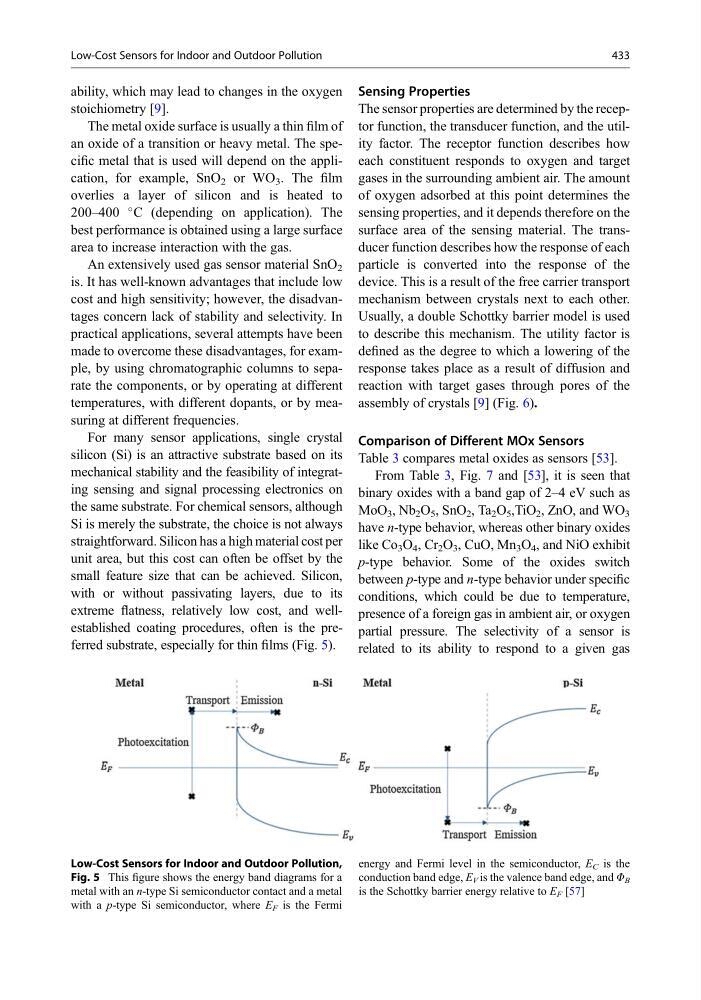
extreme flatness, relatively low cost, and wellestablished coating procedures, often is the preferred substrate, especially for thin films (Fig. 5).
Sensing Properties
The sensor properties are determined by the receptor function, the transducer function, and the utility factor. The receptor function describes how
each constituent responds to oxygen and target
gases in the surrounding ambient air. The amount
of oxygen adsorbed at this point determines the
sensing properties, and it depends therefore on the
surface area of the sensing material. The transducer function describes how the response of each
particle is converted into the response of the
device. This is a result of the free carrier transport
mechanism between crystals next to each other.
Usually, a double Schottky barrier model is used
to describe this mechanism. The utility factor is
defined as the degree to which a lowering of the
response takes place as a result of diffusion and
reaction with target gases through pores of the
assembly of crystals [9] (Fig. 6).
Comparison of Different MOx Sensors
Table 3 compares metal oxides as sensors [53].
From Table 3, Fig. 7 and [53], it is seen that
binary oxides with a band gap of 2–4 eV such as
MoO 3 , Nb 2 O 5 , SnO 2 , Ta 2 O 5 ,TiO 2 , ZnO, and WO 3
have n-type behavior, whereas other binary oxides
like Co 3 O 4 , Cr 2 O 3 , CuO, Mn 3 O 4 , and NiO exhibit
p-type behavior. Some of the oxides switch
between p-type and n-type behavior under specific
conditions, which could be due to temperature,
presence of a foreign gas in ambient air, or oxygen
partial pressure. The selectivity of a sensor is
related to its ability to respond to a given gas
Low-Cost Sensors for Indoor and Outdoor Pollution,
Fig. 5 This figure shows the energy band diagrams for a
metal with an n-type Si semiconductor contact and a metal
with a p-type Si semiconductor, where E F is the Fermi
energy and Fermi level in the semiconductor, E C is the
conduction band edge, E V is the valence band edge, and F B
is the Schottky barrier energy relative to E F [57]
Low-Cost Sensors for Indoor and Outdoor Pollution
433
stoichiometry [9].
The metal oxide surface is usually a thin film of
an oxide of a transition or heavy metal. The specific metal that is used will depend on the application, for example, SnO 2 or WO 3 . The film
overlies a layer of silicon and is heated to
200–400
C (depending on application). The
best performance is obtained using a large surface
area to increase interaction with the gas.
An extensively used gas sensor material SnO 2
is. It has well-known advantages that include low
cost and high sensitivity; however, the disadvantages concern lack of stability and selectivity. In
practical applications, several attempts have been
made to overcome these disadvantages, for example, by using chromatographic columns to separate the components, or by operating at different
temperatures, with different dopants, or by measuring at different frequencies.
For many sensor applications, single crystal
silicon (Si) is an attractive substrate based on its
mechanical stability and the feasibility of integrating sensing and signal processing electronics on
the same substrate. For chemical sensors, although
Si is merely the substrate, the choice is not always
straightforward. Silicon has a high material cost per
unit area, but this cost can often be offset by the
small feature size that can be achieved. Silicon,
with or without passivating layers, due to its
extreme flatness, relatively low cost, and wellestablished coating procedures, often is the preferred substrate, especially for thin films (Fig. 5).
Sensing Properties
The sensor properties are determined by the receptor function, the transducer function, and the utility factor. The receptor function describes how
each constituent responds to oxygen and target
gases in the surrounding ambient air. The amount
of oxygen adsorbed at this point determines the
sensing properties, and it depends therefore on the
surface area of the sensing material. The transducer function describes how the response of each
particle is converted into the response of the
device. This is a result of the free carrier transport
mechanism between crystals next to each other.
Usually, a double Schottky barrier model is used
to describe this mechanism. The utility factor is
defined as the degree to which a lowering of the
response takes place as a result of diffusion and
reaction with target gases through pores of the
assembly of crystals [9] (Fig. 6).
Comparison of Different MOx Sensors
Table 3 compares metal oxides as sensors [53].
From Table 3, Fig. 7 and [53], it is seen that
binary oxides with a band gap of 2–4 eV such as
MoO 3 , Nb 2 O 5 , SnO 2 , Ta 2 O 5 ,TiO 2 , ZnO, and WO 3
have n-type behavior, whereas other binary oxides
like Co 3 O 4 , Cr 2 O 3 , CuO, Mn 3 O 4 , and NiO exhibit
p-type behavior. Some of the oxides switch
between p-type and n-type behavior under specific
conditions, which could be due to temperature,
presence of a foreign gas in ambient air, or oxygen
partial pressure. The selectivity of a sensor is
related to its ability to respond to a given gas
Low-Cost Sensors for Indoor and Outdoor Pollution,
Fig. 5 This figure shows the energy band diagrams for a
metal with an n-type Si semiconductor contact and a metal
with a p-type Si semiconductor, where E F is the Fermi
energy and Fermi level in the semiconductor, E C is the
conduction band edge, E V is the valence band edge, and F B
is the Schottky barrier energy relative to E F [57]
Low-Cost Sensors for Indoor and Outdoor Pollution
433