

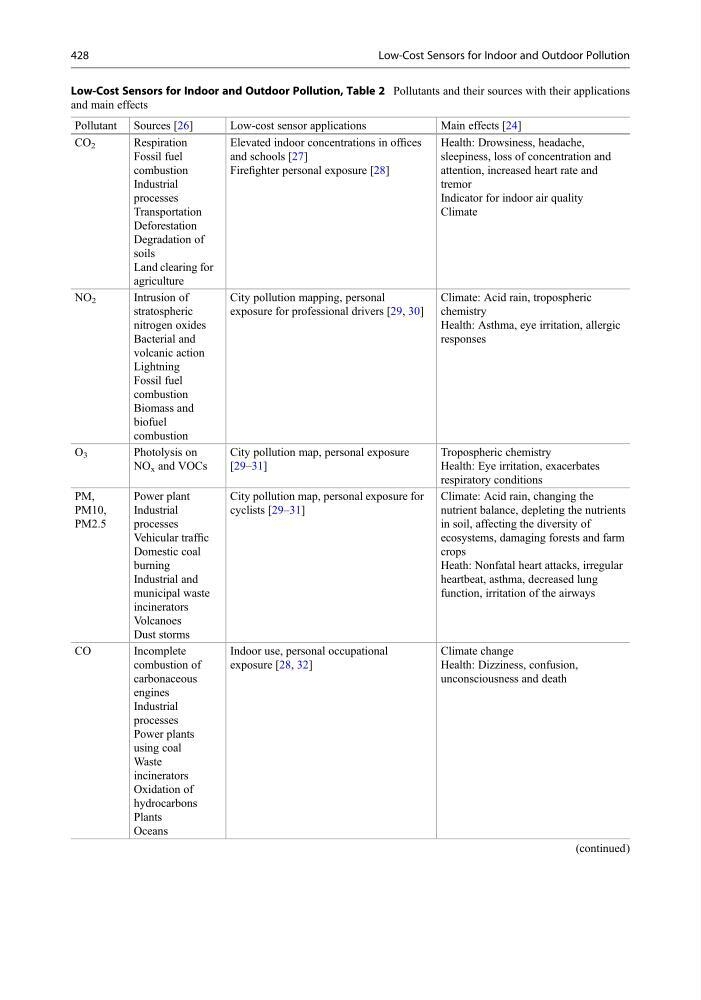
Low-Cost Sensors for Indoor and Outdoor Pollution, Table 2 Pollutants and their sources with their applications
and main effects
Pollutant Sources [26]
Low-cost sensor applications
Main effects [24]
CO 2
Respiration
Fossil fuel
combustion
Industrial
processes
Transportation
Deforestation
Degradation of
soils
Land clearing for
agriculture
Elevated indoor concentrations in offices
and schools [27]
Firefighter personal exposure [28]
Health: Drowsiness, headache,
sleepiness, loss of concentration and
attention, increased heart rate and
tremor
Indicator for indoor air quality
Climate
NO 2
Intrusion of
stratospheric
nitrogen oxides
Bacterial and
volcanic action
Lightning
Fossil fuel
combustion
Biomass and
biofuel
combustion
City pollution mapping, personal
exposure for professional drivers [29, 30]
Climate: Acid rain, tropospheric
chemistry
Health: Asthma, eye irritation, allergic
responses
O 3
Photolysis on
NO x and VOCs
City pollution map, personal exposure
[29–31]
Tropospheric chemistry
Health: Eye irritation, exacerbates
respiratory conditions
PM,
PM10,
PM2.5
Power plant
Industrial
processes
Vehicular traffic
Domestic coal
burning
Industrial and
municipal waste
incinerators
Volcanoes
Dust storms
City pollution map, personal exposure for
cyclists [29–31]
Climate: Acid rain, changing the
nutrient balance, depleting the nutrients
in soil, affecting the diversity of
ecosystems, damaging forests and farm
crops
Heath: Nonfatal heart attacks, irregular
heartbeat, asthma, decreased lung
function, irritation of the airways
CO
Incomplete
combustion of
carbonaceous
engines
Industrial
processes
Power plants
using coal
Waste
incinerators
Oxidation of
hydrocarbons
Plants
Oceans
Indoor use, personal occupational
exposure [28, 32]
Climate change
Health: Dizziness, confusion,
unconsciousness and death
(continued)
428
Low-Cost Sensors for Indoor and Outdoor Pollution
and main effects
Pollutant Sources [26]
Low-cost sensor applications
Main effects [24]
CO 2
Respiration
Fossil fuel
combustion
Industrial
processes
Transportation
Deforestation
Degradation of
soils
Land clearing for
agriculture
Elevated indoor concentrations in offices
and schools [27]
Firefighter personal exposure [28]
Health: Drowsiness, headache,
sleepiness, loss of concentration and
attention, increased heart rate and
tremor
Indicator for indoor air quality
Climate
NO 2
Intrusion of
stratospheric
nitrogen oxides
Bacterial and
volcanic action
Lightning
Fossil fuel
combustion
Biomass and
biofuel
combustion
City pollution mapping, personal
exposure for professional drivers [29, 30]
Climate: Acid rain, tropospheric
chemistry
Health: Asthma, eye irritation, allergic
responses
O 3
Photolysis on
NO x and VOCs
City pollution map, personal exposure
[29–31]
Tropospheric chemistry
Health: Eye irritation, exacerbates
respiratory conditions
PM,
PM10,
PM2.5
Power plant
Industrial
processes
Vehicular traffic
Domestic coal
burning
Industrial and
municipal waste
incinerators
Volcanoes
Dust storms
City pollution map, personal exposure for
cyclists [29–31]
Climate: Acid rain, changing the
nutrient balance, depleting the nutrients
in soil, affecting the diversity of
ecosystems, damaging forests and farm
crops
Heath: Nonfatal heart attacks, irregular
heartbeat, asthma, decreased lung
function, irritation of the airways
CO
Incomplete
combustion of
carbonaceous
engines
Industrial
processes
Power plants
using coal
Waste
incinerators
Oxidation of
hydrocarbons
Plants
Oceans
Indoor use, personal occupational
exposure [28, 32]
Climate change
Health: Dizziness, confusion,
unconsciousness and death
(continued)
428
Low-Cost Sensors for Indoor and Outdoor Pollution