

The conductance is limited by the Schottky
barrier for large crystallites, where the grain size
is D >> 2L. Here, L is the thickness of the depletion layer. When the crystallites are larger than 2L,
the sensitivity is basically independent of D. When
the grains become smaller, gas sensitivity becomes
size-dependent. Experiments show that nanostructured metal oxides have a large increase in sensitivity when the grain size is reduced to a few
nanometers. Sensitivity can also be changed by
adjusting the microstructure and porosity. Several
metal oxides show an increase in gas sensitivity
with porosity. Another strategy is to dope the surface. By distributing a low concentration of a compound like Pd, Pt, or Au, the sensitivity can be
considerably improved. Furthermore, doping the
surface with metal nanoparticles influences the
selectivity of the sensors [38]. Stability is an issue
for metal oxide sensors, and this leads to uncertain
results and false alarms, and these sensors often
need to be recalibrated or replaced frequently. The
stability can be somewhat increased by calcination
and annealing [38].
It is important to consider the minimum detectable signal, which depends on the signal-to-noise
ratio (S/N). To describe the optimization of signalto-noise ratio, a system consisting of an amplifier
A 0 is considered, see Fig. 2. The amplifier has
voltage and current noise terms which are independent of each other; where n n and i n represent
the rms voltage and current noise per Hz
½
.
The signal-to-noise ratio can be expressed as
the signal, n s , divided by the total output voltage
[40]
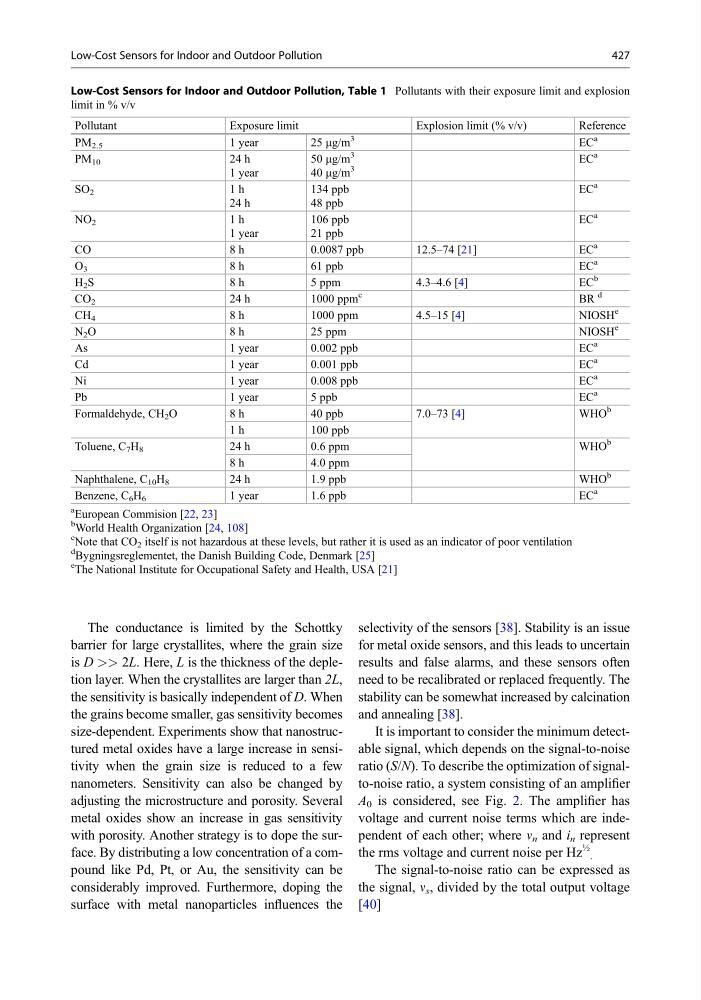
Low-Cost Sensors for Indoor and Outdoor Pollution, Table 1 Pollutants with their exposure limit and explosion
limit in % v/v
Pollutant
Exposure limit
Explosion limit (% v/v)
Reference
PM 2.5
1 year
25 mg/m
3
EC
a
PM 10
24 h
1 year
50 mg/m
3
40 mg/m
3
EC
a
SO 2
1 h
24 h
134 ppb
48 ppb
EC
a
NO 2
1 h
1 year
106 ppb
21 ppb
EC
a
CO
8 h
0.0087 ppb
12.5–74 [21]
E C
a
O 3
8 h
61 ppb
EC
a
H 2 S
8 h
5 ppm
4.3–4.6 [4]
E C
b
CO 2
24 h
1000 ppm
c
BR
d
CH 4
8 h
1000 ppm
4.5–15 [4]
NIOSH
e
N 2 O
8 h
25 ppm
NIOSH
e
As
1 year
0.002 ppb
EC
a
Cd
1 year
0.001 ppb
EC
a
Ni
1 year
0.008 ppb
EC
a
Pb
1 year
5 ppb
EC
a
Formaldehyde, CH 2 O
8 h
40 ppb
7.0–73 [4]
WHO
b
1 h
100 ppb
Toluene, C 7 H 8
24 h
0.6 ppm
WHO
b
8 h
4.0 ppm
Naphthalene, C 10 H 8
24 h
1.9 ppb
WHO
b
Benzene, C 6 H 6
1 year
1.6 ppb
EC
a
a European Commision [22, 23]
b
World Health Organization [24, 108]
c Note that CO 2 itself is not hazardous at these levels, but rather it is used as an indicator of poor ventilation
d
Bygningsreglementet, the Danish Building Code, Denmark [25]
e The National Institute for Occupational Safety and Health, USA [21]
Low-Cost Sensors for Indoor and Outdoor Pollution
427
barrier for large crystallites, where the grain size
is D >> 2L. Here, L is the thickness of the depletion layer. When the crystallites are larger than 2L,
the sensitivity is basically independent of D. When
the grains become smaller, gas sensitivity becomes
size-dependent. Experiments show that nanostructured metal oxides have a large increase in sensitivity when the grain size is reduced to a few
nanometers. Sensitivity can also be changed by
adjusting the microstructure and porosity. Several
metal oxides show an increase in gas sensitivity
with porosity. Another strategy is to dope the surface. By distributing a low concentration of a compound like Pd, Pt, or Au, the sensitivity can be
considerably improved. Furthermore, doping the
surface with metal nanoparticles influences the
selectivity of the sensors [38]. Stability is an issue
for metal oxide sensors, and this leads to uncertain
results and false alarms, and these sensors often
need to be recalibrated or replaced frequently. The
stability can be somewhat increased by calcination
and annealing [38].
It is important to consider the minimum detectable signal, which depends on the signal-to-noise
ratio (S/N). To describe the optimization of signalto-noise ratio, a system consisting of an amplifier
A 0 is considered, see Fig. 2. The amplifier has
voltage and current noise terms which are independent of each other; where n n and i n represent
the rms voltage and current noise per Hz
½
.
The signal-to-noise ratio can be expressed as
the signal, n s , divided by the total output voltage
[40]
Low-Cost Sensors for Indoor and Outdoor Pollution, Table 1 Pollutants with their exposure limit and explosion
limit in % v/v
Pollutant
Exposure limit
Explosion limit (% v/v)
Reference
PM 2.5
1 year
25 mg/m
3
EC
a
PM 10
24 h
1 year
50 mg/m
3
40 mg/m
3
EC
a
SO 2
1 h
24 h
134 ppb
48 ppb
EC
a
NO 2
1 h
1 year
106 ppb
21 ppb
EC
a
CO
8 h
0.0087 ppb
12.5–74 [21]
E C
a
O 3
8 h
61 ppb
EC
a
H 2 S
8 h
5 ppm
4.3–4.6 [4]
E C
b
CO 2
24 h
1000 ppm
c
BR
d
CH 4
8 h
1000 ppm
4.5–15 [4]
NIOSH
e
N 2 O
8 h
25 ppm
NIOSH
e
As
1 year
0.002 ppb
EC
a
Cd
1 year
0.001 ppb
EC
a
Ni
1 year
0.008 ppb
EC
a
Pb
1 year
5 ppb
EC
a
Formaldehyde, CH 2 O
8 h
40 ppb
7.0–73 [4]
WHO
b
1 h
100 ppb
Toluene, C 7 H 8
24 h
0.6 ppm
WHO
b
8 h
4.0 ppm
Naphthalene, C 10 H 8
24 h
1.9 ppb
WHO
b
Benzene, C 6 H 6
1 year
1.6 ppb
EC
a
a European Commision [22, 23]
b
World Health Organization [24, 108]
c Note that CO 2 itself is not hazardous at these levels, but rather it is used as an indicator of poor ventilation
d
Bygningsreglementet, the Danish Building Code, Denmark [25]
e The National Institute for Occupational Safety and Health, USA [21]
Low-Cost Sensors for Indoor and Outdoor Pollution
427