

quality goals, and they provide the necessary
baseline measurements for judging whether progress is occurring [78]. Despite there being over
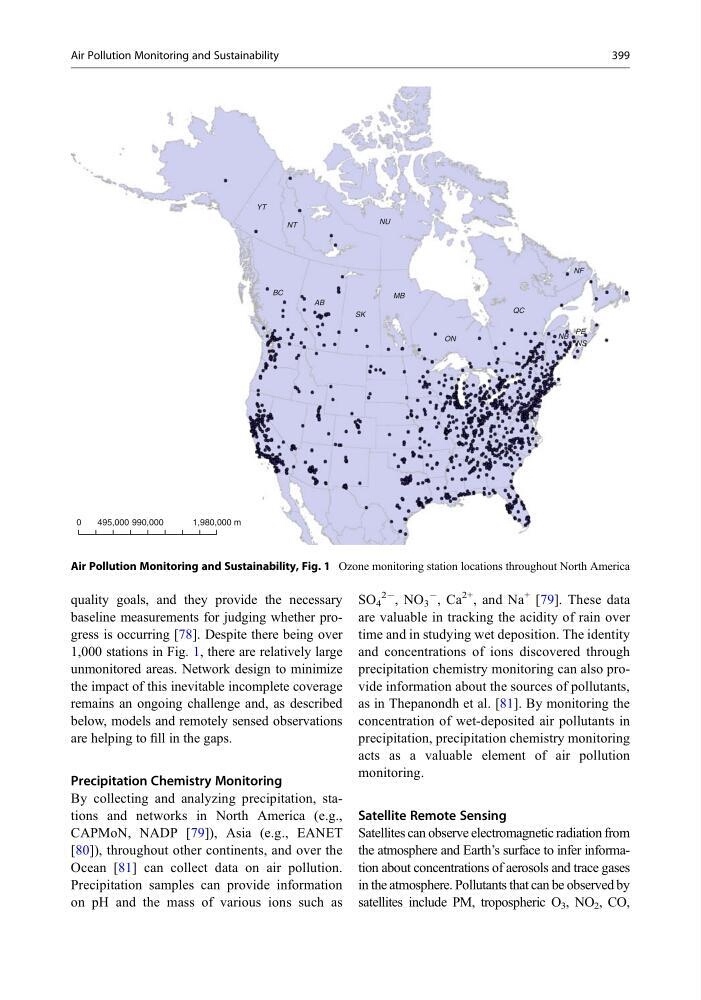
1,000 stations in Fig. 1, there are relatively large
unmonitored areas. Network design to minimize
the impact of this inevitable incomplete coverage
remains an ongoing challenge and, as described
below, models and remotely sensed observations
are helping to fill in the gaps.
Precipitation Chemistry Monitoring
By collecting and analyzing precipitation, stations and networks in North America (e.g.,
CAPMoN, NADP [79]), Asia (e.g., EANET
[80]), throughout other continents, and over the
Ocean [81] can collect data on air pollution.
Precipitation samples can provide information
on pH and the mass of various ions such as
SO 4
2À , NO 3
À , Ca
2+ , and Na
+ [79]. These data
are valuable in tracking the acidity of rain over
time and in studying wet deposition. The identity
and concentrations of ions discovered through
precipitation chemistry monitoring can also provide information about the sources of pollutants,
as in Thepanondh et al. [81]. By monitoring the
concentration of wet-deposited air pollutants in
precipitation, precipitation chemistry monitoring
acts as a valuable element of air pollution
monitoring.
Satellite Remote Sensing
Satellites can observe electromagnetic radiation from
the atmosphere and Earth’s surface to infer information about concentrations of aerosols and trace gases
in the atmosphere. Pollutants that can be observed by
satellites include PM, tropospheric O 3 , NO 2 , CO,
0
495,000 990,000
1,980,000 m
YT
NT
BC
AB
SK
MB
ON
QC
NB
PE
NS
NF
NU
Air Pollution Monitoring and Sustainability, Fig. 1 Ozone monitoring station locations throughout North America
Air Pollution Monitoring and Sustainability
399
baseline measurements for judging whether progress is occurring [78]. Despite there being over
1,000 stations in Fig. 1, there are relatively large
unmonitored areas. Network design to minimize
the impact of this inevitable incomplete coverage
remains an ongoing challenge and, as described
below, models and remotely sensed observations
are helping to fill in the gaps.
Precipitation Chemistry Monitoring
By collecting and analyzing precipitation, stations and networks in North America (e.g.,
CAPMoN, NADP [79]), Asia (e.g., EANET
[80]), throughout other continents, and over the
Ocean [81] can collect data on air pollution.
Precipitation samples can provide information
on pH and the mass of various ions such as
SO 4
2À , NO 3
À , Ca
2+ , and Na
+ [79]. These data
are valuable in tracking the acidity of rain over
time and in studying wet deposition. The identity
and concentrations of ions discovered through
precipitation chemistry monitoring can also provide information about the sources of pollutants,
as in Thepanondh et al. [81]. By monitoring the
concentration of wet-deposited air pollutants in
precipitation, precipitation chemistry monitoring
acts as a valuable element of air pollution
monitoring.
Satellite Remote Sensing
Satellites can observe electromagnetic radiation from
the atmosphere and Earth’s surface to infer information about concentrations of aerosols and trace gases
in the atmosphere. Pollutants that can be observed by
satellites include PM, tropospheric O 3 , NO 2 , CO,
0
495,000 990,000
1,980,000 m
YT
NT
BC
AB
SK
MB
ON
QC
NB
PE
NS
NF
NU
Air Pollution Monitoring and Sustainability, Fig. 1 Ozone monitoring station locations throughout North America
Air Pollution Monitoring and Sustainability
399