

What Are the Criteria Pollutants?
Criteria pollutants include carbon monoxide
(CO), nitrogen oxides (NO x ), and sulfur dioxide
(SO 2 ) [2]. Tropospheric ozone (O 3 ) and Particulate Matter (PM) are also criteria pollutants. Most
species of harmful Volatile Organic Compounds
(VOCs) that are not acutely toxic enough to be
specifically identified as HAPs are included in the
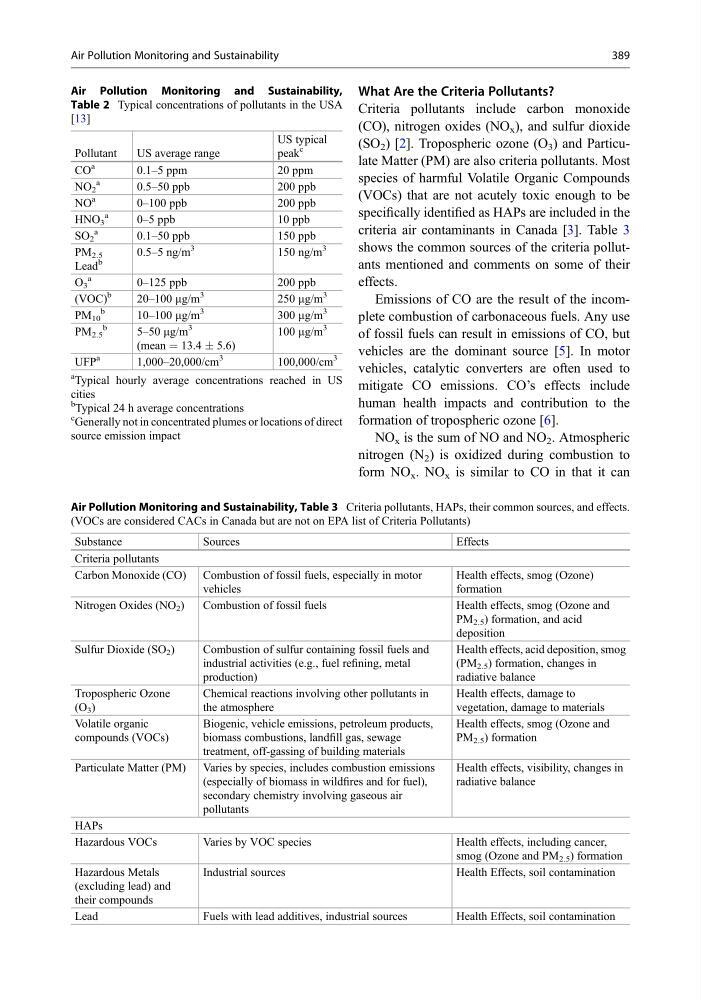
criteria air contaminants in Canada [3]. Table 3
shows the common sources of the criteria pollutants mentioned and comments on some of their
effects.
Emissions of CO are the result of the incomplete combustion of carbonaceous fuels. Any use
of fossil fuels can result in emissions of CO, but
vehicles are the dominant source [5]. In motor
vehicles, catalytic converters are often used to
mitigate CO emissions. CO’s effects include
human health impacts and contribution to the
formation of tropospheric ozone [6].
NO x is the sum of NO and NO 2 . Atmospheric
nitrogen (N 2 ) is oxidized during combustion to
form NO x . NO x is similar to CO in that it can
Air Pollution Monitoring and Sustainability,
Table 2 Typical concentrations of pollutants in the USA
[13]
Pollutant
US average range
US typical
peak
c
CO
a
0.1–5 ppm
20 ppm
NO 2
a
0.5–50 ppb
200 ppb
NO
a
0–100 ppb
200 ppb
HNO 3
a
0–5 ppb
10 ppb
SO 2
a
0.1–50 ppb
150 ppb
PM 2.5
Lead
b
0.5–5 ng/m
3
150 ng/m
3
O 3
a
0–125 ppb
200 ppb
(VOC)
b
20–100 mg/m
3
250 mg/m
3
PM 10
b
10–100 mg/m
3
300 mg/m
3
PM 2.5
b
5–50 mg/m
3
(mean ¼ 13.4 Æ 5.6)
100 mg/m
3
UFP
a
1,000–20,000/cm
3
100,000/cm
3
a Typical hourly average concentrations reached in US
cities
b
Typical 24 h average concentrations
c Generally not in concentrated plumes or locations of direct
source emission impact
Air Pollution Monitoring and Sustainability, Table 3 Criteria pollutants, HAPs, their common sources, and effects.
(VOCs are considered CACs in Canada but are not on EPA list of Criteria Pollutants)
Substance
Sources
Effects
Criteria pollutants
Carbon Monoxide (CO) Combustion of fossil fuels, especially in motor
vehicles
Health effects, smog (Ozone)
formation
Nitrogen Oxides (NO 2 )
Combustion of fossil fuels
Health effects, smog (Ozone and
PM 2.5 ) formation, and acid
deposition
Sulfur Dioxide (SO 2 )
Combustion of sulfur containing fossil fuels and
industrial activities (e.g., fuel refining, metal
production)
Health effects, acid deposition, smog
(PM 2.5 ) formation, changes in
radiative balance
Tropospheric Ozone
(O 3 )
Chemical reactions involving other pollutants in
the atmosphere
Health effects, damage to
vegetation, damage to materials
Volatile organic
compounds (VOCs)
Biogenic, vehicle emissions, petroleum products,
biomass combustions, landfill gas, sewage
treatment, off-gassing of building materials
Health effects, smog (Ozone and
PM 2.5 ) formation
Particulate Matter (PM) Varies by species, includes combustion emissions
(especially of biomass in wildfires and for fuel),
secondary chemistry involving gaseous air
pollutants
Health effects, visibility, changes in
radiative balance
HAPs
Hazardous VOCs
Varies by VOC species
Health effects, including cancer,
smog (Ozone and PM 2.5 ) formation
Hazardous Metals
(excluding lead) and
their compounds
Industrial sources
Health Effects, soil contamination
Lead
Fuels with lead additives, industrial sources
Health Effects, soil contamination
Air Pollution Monitoring and Sustainability
389
Criteria pollutants include carbon monoxide
(CO), nitrogen oxides (NO x ), and sulfur dioxide
(SO 2 ) [2]. Tropospheric ozone (O 3 ) and Particulate Matter (PM) are also criteria pollutants. Most
species of harmful Volatile Organic Compounds
(VOCs) that are not acutely toxic enough to be
specifically identified as HAPs are included in the
criteria air contaminants in Canada [3]. Table 3
shows the common sources of the criteria pollutants mentioned and comments on some of their
effects.
Emissions of CO are the result of the incomplete combustion of carbonaceous fuels. Any use
of fossil fuels can result in emissions of CO, but
vehicles are the dominant source [5]. In motor
vehicles, catalytic converters are often used to
mitigate CO emissions. CO’s effects include
human health impacts and contribution to the
formation of tropospheric ozone [6].
NO x is the sum of NO and NO 2 . Atmospheric
nitrogen (N 2 ) is oxidized during combustion to
form NO x . NO x is similar to CO in that it can
Air Pollution Monitoring and Sustainability,
Table 2 Typical concentrations of pollutants in the USA
[13]
Pollutant
US average range
US typical
peak
c
CO
a
0.1–5 ppm
20 ppm
NO 2
a
0.5–50 ppb
200 ppb
NO
a
0–100 ppb
200 ppb
HNO 3
a
0–5 ppb
10 ppb
SO 2
a
0.1–50 ppb
150 ppb
PM 2.5
Lead
b
0.5–5 ng/m
3
150 ng/m
3
O 3
a
0–125 ppb
200 ppb
(VOC)
b
20–100 mg/m
3
250 mg/m
3
PM 10
b
10–100 mg/m
3
300 mg/m
3
PM 2.5
b
5–50 mg/m
3
(mean ¼ 13.4 Æ 5.6)
100 mg/m
3
UFP
a
1,000–20,000/cm
3
100,000/cm
3
a Typical hourly average concentrations reached in US
cities
b
Typical 24 h average concentrations
c Generally not in concentrated plumes or locations of direct
source emission impact
Air Pollution Monitoring and Sustainability, Table 3 Criteria pollutants, HAPs, their common sources, and effects.
(VOCs are considered CACs in Canada but are not on EPA list of Criteria Pollutants)
Substance
Sources
Effects
Criteria pollutants
Carbon Monoxide (CO) Combustion of fossil fuels, especially in motor
vehicles
Health effects, smog (Ozone)
formation
Nitrogen Oxides (NO 2 )
Combustion of fossil fuels
Health effects, smog (Ozone and
PM 2.5 ) formation, and acid
deposition
Sulfur Dioxide (SO 2 )
Combustion of sulfur containing fossil fuels and
industrial activities (e.g., fuel refining, metal
production)
Health effects, acid deposition, smog
(PM 2.5 ) formation, changes in
radiative balance
Tropospheric Ozone
(O 3 )
Chemical reactions involving other pollutants in
the atmosphere
Health effects, damage to
vegetation, damage to materials
Volatile organic
compounds (VOCs)
Biogenic, vehicle emissions, petroleum products,
biomass combustions, landfill gas, sewage
treatment, off-gassing of building materials
Health effects, smog (Ozone and
PM 2.5 ) formation
Particulate Matter (PM) Varies by species, includes combustion emissions
(especially of biomass in wildfires and for fuel),
secondary chemistry involving gaseous air
pollutants
Health effects, visibility, changes in
radiative balance
HAPs
Hazardous VOCs
Varies by VOC species
Health effects, including cancer,
smog (Ozone and PM 2.5 ) formation
Hazardous Metals
(excluding lead) and
their compounds
Industrial sources
Health Effects, soil contamination
Lead
Fuels with lead additives, industrial sources
Health Effects, soil contamination
Air Pollution Monitoring and Sustainability
389