

of available design methodologies in the design of
monitoring networks, adhering to suggestions in
existing literature to improve routine practice, and
beginning to address some of the previously necessary oversimplifications involved in conventional
monitoring. While the air pollution monitoring community has a historical record of promoting sustainability and should be applauded, a paradigm shift is
needed if it is to address these expanded goals.
Air Pollutants
Air pollution monitoring is concerned with air
pollutants, substances which have negative
effects on life. Some air pollutants are prevalent
in most urban areas, and their effects are widespread. Other air pollutants tend to be less concentrated, or are only concentrated in specific
areas, but have gained attention for being especially problematic or acutely toxic. In the USA
and in Canada, pollutants of this first type are
classified as “criteria” pollutants. (In the USA,
the label “criteria” is applied to common pollutants. The EPA regulates these pollutants by setting permissible levels based on human health
or environmental considerations [2], whereas in
Canada, pollutants fall into the “criteria” category as a result of sharing common sources,
mostly notably, fossil-fuel combustion [3].)
The second type of air pollutant, the type capable of causing problems despite relatively low
average emissions rates, have been classified by
the US EPA (US Environmental Protection
Agency) as “Hazardous Air Pollutants”
(HAPs) for the particular hazards they present.
One hundred and eighty-nine HAPs are officially recognized by the US EPA [4]. Criteria
pollutants and HAPs are discussed below, and
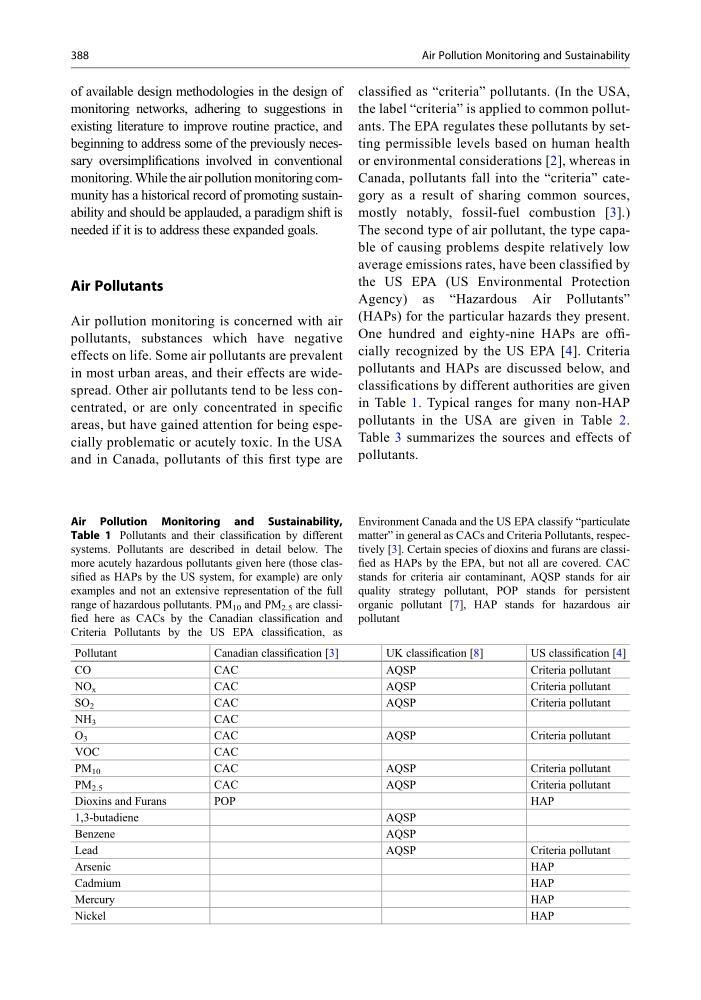
classifications by different authorities are given
in Table 1. Typical ranges for many non-HAP
pollutants in the USA are given in Table 2.
Table 3 summarizes the sources and effects of
pollutants.
Air Pollution Monitoring and Sustainability,
Table 1 Pollutants and their classification by different
systems. Pollutants are described in detail below. The
more acutely hazardous pollutants given here (those classified as HAPs by the US system, for example) are only
examples and not an extensive representation of the full
range of hazardous pollutants. PM 10 and PM 2.5 are classified here as CACs by the Canadian classification and
Criteria Pollutants by the US EPA classification, as
Environment Canada and the US EPA classify “particulate
matter” in general as CACs and Criteria Pollutants, respectively [3]. Certain species of dioxins and furans are classified as HAPs by the EPA, but not all are covered. CAC
stands for criteria air contaminant, AQSP stands for air
quality strategy pollutant, POP stands for persistent
organic pollutant [7], HAP stands for hazardous air
pollutant
Pollutant
Canadian classification [3]
UK classification [8]
US classification [4]
CO
CAC
AQSP
Criteria pollutant
NO x
CAC
AQSP
Criteria pollutant
SO 2
CAC
AQSP
Criteria pollutant
NH 3
CAC
O 3
CAC
AQSP
Criteria pollutant
VOC
CAC
PM 10
CAC
AQSP
Criteria pollutant
PM 2.5
CAC
AQSP
Criteria pollutant
Dioxins and Furans
POP
HAP
1,3-butadiene
AQSP
Benzene
AQSP
Lead
AQSP
Criteria pollutant
Arsenic
HAP
Cadmium
HAP
Mercury
HAP
Nickel
HAP
388
Air Pollution Monitoring and Sustainability
monitoring networks, adhering to suggestions in
existing literature to improve routine practice, and
beginning to address some of the previously necessary oversimplifications involved in conventional
monitoring. While the air pollution monitoring community has a historical record of promoting sustainability and should be applauded, a paradigm shift is
needed if it is to address these expanded goals.
Air Pollutants
Air pollution monitoring is concerned with air
pollutants, substances which have negative
effects on life. Some air pollutants are prevalent
in most urban areas, and their effects are widespread. Other air pollutants tend to be less concentrated, or are only concentrated in specific
areas, but have gained attention for being especially problematic or acutely toxic. In the USA
and in Canada, pollutants of this first type are
classified as “criteria” pollutants. (In the USA,
the label “criteria” is applied to common pollutants. The EPA regulates these pollutants by setting permissible levels based on human health
or environmental considerations [2], whereas in
Canada, pollutants fall into the “criteria” category as a result of sharing common sources,
mostly notably, fossil-fuel combustion [3].)
The second type of air pollutant, the type capable of causing problems despite relatively low
average emissions rates, have been classified by
the US EPA (US Environmental Protection
Agency) as “Hazardous Air Pollutants”
(HAPs) for the particular hazards they present.
One hundred and eighty-nine HAPs are officially recognized by the US EPA [4]. Criteria
pollutants and HAPs are discussed below, and
classifications by different authorities are given
in Table 1. Typical ranges for many non-HAP
pollutants in the USA are given in Table 2.
Table 3 summarizes the sources and effects of
pollutants.
Air Pollution Monitoring and Sustainability,
Table 1 Pollutants and their classification by different
systems. Pollutants are described in detail below. The
more acutely hazardous pollutants given here (those classified as HAPs by the US system, for example) are only
examples and not an extensive representation of the full
range of hazardous pollutants. PM 10 and PM 2.5 are classified here as CACs by the Canadian classification and
Criteria Pollutants by the US EPA classification, as
Environment Canada and the US EPA classify “particulate
matter” in general as CACs and Criteria Pollutants, respectively [3]. Certain species of dioxins and furans are classified as HAPs by the EPA, but not all are covered. CAC
stands for criteria air contaminant, AQSP stands for air
quality strategy pollutant, POP stands for persistent
organic pollutant [7], HAP stands for hazardous air
pollutant
Pollutant
Canadian classification [3]
UK classification [8]
US classification [4]
CO
CAC
AQSP
Criteria pollutant
NO x
CAC
AQSP
Criteria pollutant
SO 2
CAC
AQSP
Criteria pollutant
NH 3
CAC
O 3
CAC
AQSP
Criteria pollutant
VOC
CAC
PM 10
CAC
AQSP
Criteria pollutant
PM 2.5
CAC
AQSP
Criteria pollutant
Dioxins and Furans
POP
HAP
1,3-butadiene
AQSP
Benzene
AQSP
Lead
AQSP
Criteria pollutant
Arsenic
HAP
Cadmium
HAP
Mercury
HAP
Nickel
HAP
388
Air Pollution Monitoring and Sustainability