

such as cities in the USA, Canada, Europe, and
China [29–34]. These exceedances often affect
rural areas as well [35]. Ozone has adverse
impacts on human health, as well as vegetation.
Surface ozone is associated with respiratory problems and premature human mortality. In addition,
it can damage plants, reduce photosynthesis and
growth, leading to reduced crop yields [36].
Many of the pollutants discussed above,
including carbon monoxide, sulfur oxides, nitrogen oxides, and ozone, as well as particulate matter (see below), are classified as “criteria
pollutants” by the US EPA. These criteria pollutants are among the most common air pollutants
and are used as indicators of air quality [37].
Particulate Matter/Aerosol Pollutants
Particulate matter is an air quality concern
because of its adverse health effects, as well as
its contribution to reductions in visibility. Particulate matter is currently monitored, in the air
quality area, based on size-resolved fractions.
These are typically PM 10 (particles with an aerodynamic diameter of 10 mm or smaller) and PM 2.5
(particles with an aerodynamic diameter of 2.5 mm
or smaller). This size fractionation is also typically
referred to as the coarse mode (the fraction
between PM 10 and PM 2.5 ) and the fine mode
(equivalent to PM 2.5 ). Particles in the fine mode
are a more significant health concern than those in
the coarse mode because of their ability to
penetrate deeper into the lungs than particles in
the coarse mode, remain in the air longer, transport over longer distances, and penetrate more
easily into indoor environments [38]. The scale
of the possible impact of adverse health effects
from particulate matter is shown in Fig. 7 which
depicts the estimated loss of life expectancy attributable to PM 2.5 from anthropogenic emissions in
2000 and 2020 in Europe [39].
Particulate matter (PM) is composed of many
different species, including carbonaceous aerosols,
inorganic species (sulfate, nitrate, ammonium,
chloride), trace metals, and crustal elements from
dust and water [5]. The relative contribution of
aerosol components to the total aerosol burden for
the present atmosphere, based on a model simulation for 1990 using emission estimates from 1990
and later, is shown in Fig. 8 [40]. Aerosols technically refer to the suspension of fine solid or liquid
particles in a gas; however, the term aerosols is
more commonly used to refer to just the particulate/nongaseous component, which is how it will
be used here [5]. There are anthropogenic and
natural sources of particulate matter. Natural
sources of PM include volcanic eruptions, sea
spray, biological debris, and dust. These types of
PM emissions tend to fall into the coarse mode
(PM 10 –PM 2.5 ) and are emitted owing to mechanical processes [5]. Anthropogenic particulate matter
is emitted primarily from combustion sources and
falls largely into the fine mode (PM 2.5 ) [38]. In
many locations the majority of these anthropogenic
emissions stem from fossil fuel combustion use by
the transportation sector [18, 41], but other sources
include stationary fuel combustion (e.g., power
plants), industry, and biomass burning. The schematic representation in Fig. 9 summarizes aerosol
sources, sinks, and transformations in the atmosphere, by particle size [5, 42].
In addition to primary aerosols, secondary
aerosols, i.e., those formed in the atmosphere by
gas-to-particle conversion and/or condensation of
gaseous compounds onto preexisting aerosol particles can be a significant fraction of the
PM. Secondary aerosols can be organic or inorganic, formed primarily from (photo)chemical
reaction of VOC precursor emissions or the oxidation of NO x and SO 2 [43]. Secondary organic
aerosols (SOAs) are formed in a two-step process:
NO 2
NO 2
O 2
O 2
O 2
O 2
hν
hν
NO
NO
O 3
O 3
R −H O
RO
OH
RO 2
HO 2
RH
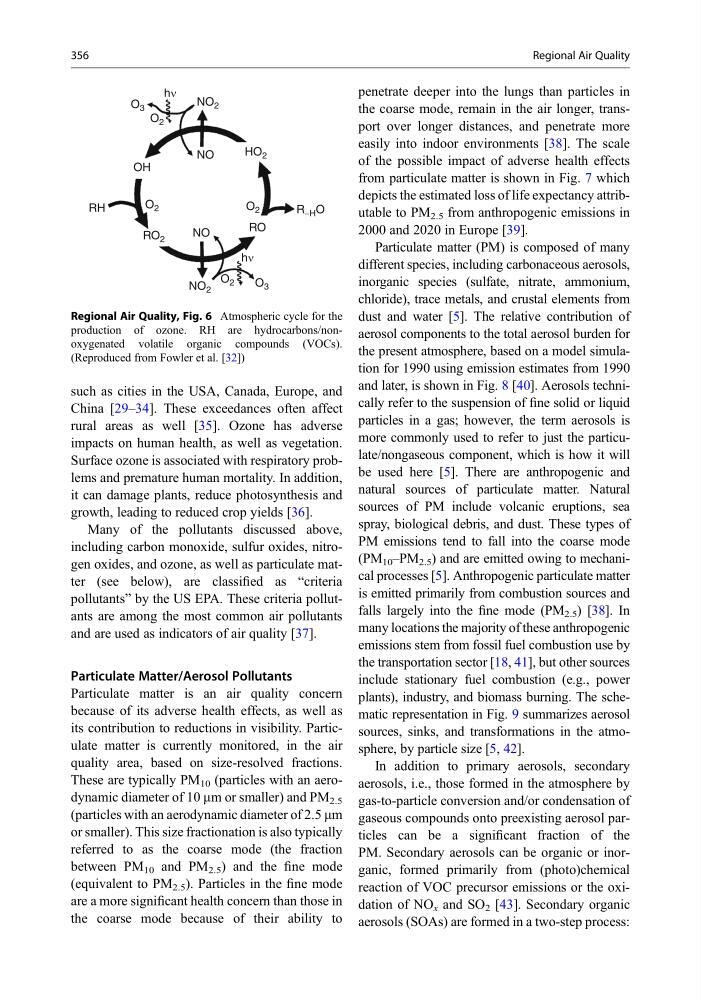
Regional Air Quality, Fig. 6 Atmospheric cycle for the
production of ozone. RH are hydrocarbons/nonoxygenated volatile organic compounds (VOCs).
(Reproduced from Fowler et al. [32])
356
Regional Air Quality
China [29–34]. These exceedances often affect
rural areas as well [35]. Ozone has adverse
impacts on human health, as well as vegetation.
Surface ozone is associated with respiratory problems and premature human mortality. In addition,
it can damage plants, reduce photosynthesis and
growth, leading to reduced crop yields [36].
Many of the pollutants discussed above,
including carbon monoxide, sulfur oxides, nitrogen oxides, and ozone, as well as particulate matter (see below), are classified as “criteria
pollutants” by the US EPA. These criteria pollutants are among the most common air pollutants
and are used as indicators of air quality [37].
Particulate Matter/Aerosol Pollutants
Particulate matter is an air quality concern
because of its adverse health effects, as well as
its contribution to reductions in visibility. Particulate matter is currently monitored, in the air
quality area, based on size-resolved fractions.
These are typically PM 10 (particles with an aerodynamic diameter of 10 mm or smaller) and PM 2.5
(particles with an aerodynamic diameter of 2.5 mm
or smaller). This size fractionation is also typically
referred to as the coarse mode (the fraction
between PM 10 and PM 2.5 ) and the fine mode
(equivalent to PM 2.5 ). Particles in the fine mode
are a more significant health concern than those in
the coarse mode because of their ability to
penetrate deeper into the lungs than particles in
the coarse mode, remain in the air longer, transport over longer distances, and penetrate more
easily into indoor environments [38]. The scale
of the possible impact of adverse health effects
from particulate matter is shown in Fig. 7 which
depicts the estimated loss of life expectancy attributable to PM 2.5 from anthropogenic emissions in
2000 and 2020 in Europe [39].
Particulate matter (PM) is composed of many
different species, including carbonaceous aerosols,
inorganic species (sulfate, nitrate, ammonium,
chloride), trace metals, and crustal elements from
dust and water [5]. The relative contribution of
aerosol components to the total aerosol burden for
the present atmosphere, based on a model simulation for 1990 using emission estimates from 1990
and later, is shown in Fig. 8 [40]. Aerosols technically refer to the suspension of fine solid or liquid
particles in a gas; however, the term aerosols is
more commonly used to refer to just the particulate/nongaseous component, which is how it will
be used here [5]. There are anthropogenic and
natural sources of particulate matter. Natural
sources of PM include volcanic eruptions, sea
spray, biological debris, and dust. These types of
PM emissions tend to fall into the coarse mode
(PM 10 –PM 2.5 ) and are emitted owing to mechanical processes [5]. Anthropogenic particulate matter
is emitted primarily from combustion sources and
falls largely into the fine mode (PM 2.5 ) [38]. In
many locations the majority of these anthropogenic
emissions stem from fossil fuel combustion use by
the transportation sector [18, 41], but other sources
include stationary fuel combustion (e.g., power
plants), industry, and biomass burning. The schematic representation in Fig. 9 summarizes aerosol
sources, sinks, and transformations in the atmosphere, by particle size [5, 42].
In addition to primary aerosols, secondary
aerosols, i.e., those formed in the atmosphere by
gas-to-particle conversion and/or condensation of
gaseous compounds onto preexisting aerosol particles can be a significant fraction of the
PM. Secondary aerosols can be organic or inorganic, formed primarily from (photo)chemical
reaction of VOC precursor emissions or the oxidation of NO x and SO 2 [43]. Secondary organic
aerosols (SOAs) are formed in a two-step process:
NO 2
NO 2
O 2
O 2
O 2
O 2
hν
hν
NO
NO
O 3
O 3
R −H O
RO
OH
RO 2
HO 2
RH
Regional Air Quality, Fig. 6 Atmospheric cycle for the
production of ozone. RH are hydrocarbons/nonoxygenated volatile organic compounds (VOCs).
(Reproduced from Fowler et al. [32])
356
Regional Air Quality