

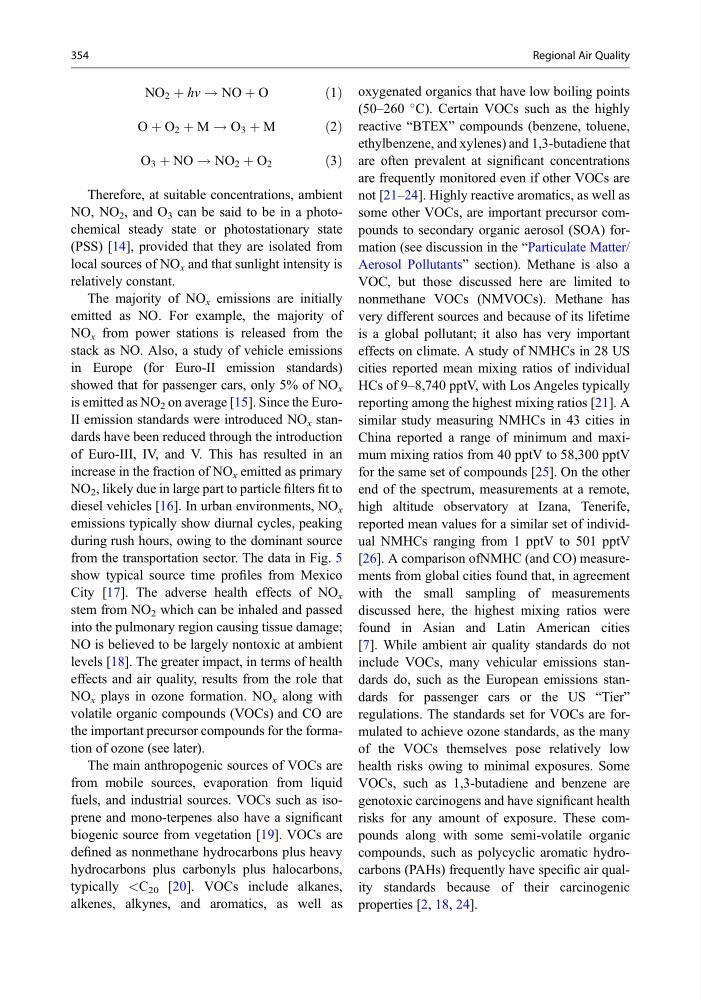
NO 2 þ hv ! NO þ O
ð1Þ
O þ O 2 þ M ! O 3 þ M
ð2Þ
O 3 þ NO ! NO 2 þ O 2
ð3Þ
Therefore, at suitable concentrations, ambient
NO, NO 2 , and O 3 can be said to be in a photochemical steady state or photostationary state
(PSS) [14], provided that they are isolated from
local sources of NO x and that sunlight intensity is
relatively constant.
The majority of NO x emissions are initially
emitted as NO. For example, the majority of
NO x from power stations is released from the
stack as NO. Also, a study of vehicle emissions
in Europe (for Euro-II emission standards)
showed that for passenger cars, only 5% of NO x
is emitted as NO 2 on average [15]. Since the EuroII emission standards were introduced NO x standards have been reduced through the introduction
of Euro-III, IV, and V. This has resulted in an
increase in the fraction of NO x emitted as primary
NO 2 , likely due in large part to particle filters fit to
diesel vehicles [16]. In urban environments, NO x
emissions typically show diurnal cycles, peaking
during rush hours, owing to the dominant source
from the transportation sector. The data in Fig. 5
show typical source time profiles from Mexico
City [17]. The adverse health effects of NO x
stem from NO 2 which can be inhaled and passed
into the pulmonary region causing tissue damage;
NO is believed to be largely nontoxic at ambient
levels [18]. The greater impact, in terms of health
effects and air quality, results from the role that
NO x plays in ozone formation. NO x along with
volatile organic compounds (VOCs) and CO are
the important precursor compounds for the formation of ozone (see later).
The main anthropogenic sources of VOCs are
from mobile sources, evaporation from liquid
fuels, and industrial sources. VOCs such as isoprene and mono-terpenes also have a significant
biogenic source from vegetation [19]. VOCs are
defined as nonmethane hydrocarbons plus heavy
hydrocarbons plus carbonyls plus halocarbons,
typically
oxygenated organics that have low boiling points
(50–260
C). Certain VOCs such as the highly
reactive “BTEX” compounds (benzene, toluene,
ethylbenzene, and xylenes) and 1,3-butadiene that
are often prevalent at significant concentrations
are frequently monitored even if other VOCs are
not [21–24]. Highly reactive aromatics, as well as
some other VOCs, are important precursor compounds to secondary organic aerosol (SOA) formation (see discussion in the “Particulate Matter/
Aerosol Pollutants” section). Methane is also a
VOC, but those discussed here are limited to
nonmethane VOCs (NMVOCs). Methane has
very different sources and because of its lifetime
is a global pollutant; it also has very important
effects on climate. A study of NMHCs in 28 US
cities reported mean mixing ratios of individual
HCs of 9–8,740 pptV, with Los Angeles typically
reporting among the highest mixing ratios [21]. A
similar study measuring NMHCs in 43 cities in
China reported a range of minimum and maximum mixing ratios from 40 pptV to 58,300 pptV
for the same set of compounds [25]. On the other
end of the spectrum, measurements at a remote,
high altitude observatory at Izana, Tenerife,
reported mean values for a similar set of individual NMHCs ranging from 1 pptV to 501 pptV
[26]. A comparison ofNMHC (and CO) measurements from global cities found that, in agreement
with the small sampling of measurements
discussed here, the highest mixing ratios were
found in Asian and Latin American cities
[7]. While ambient air quality standards do not
include VOCs, many vehicular emissions standards do, such as the European emissions standards for passenger cars or the US “Tier”
regulations. The standards set for VOCs are formulated to achieve ozone standards, as the many
of the VOCs themselves pose relatively low
health risks owing to minimal exposures. Some
VOCs, such as 1,3-butadiene and benzene are
genotoxic carcinogens and have significant health
risks for any amount of exposure. These compounds along with some semi-volatile organic
compounds, such as polycyclic aromatic hydrocarbons (PAHs) frequently have specific air quality standards because of their carcinogenic
properties [2, 18, 24].
354
Regional Air Quality
ð1Þ
O þ O 2 þ M ! O 3 þ M
ð2Þ
O 3 þ NO ! NO 2 þ O 2
ð3Þ
Therefore, at suitable concentrations, ambient
NO, NO 2 , and O 3 can be said to be in a photochemical steady state or photostationary state
(PSS) [14], provided that they are isolated from
local sources of NO x and that sunlight intensity is
relatively constant.
The majority of NO x emissions are initially
emitted as NO. For example, the majority of
NO x from power stations is released from the
stack as NO. Also, a study of vehicle emissions
in Europe (for Euro-II emission standards)
showed that for passenger cars, only 5% of NO x
is emitted as NO 2 on average [15]. Since the EuroII emission standards were introduced NO x standards have been reduced through the introduction
of Euro-III, IV, and V. This has resulted in an
increase in the fraction of NO x emitted as primary
NO 2 , likely due in large part to particle filters fit to
diesel vehicles [16]. In urban environments, NO x
emissions typically show diurnal cycles, peaking
during rush hours, owing to the dominant source
from the transportation sector. The data in Fig. 5
show typical source time profiles from Mexico
City [17]. The adverse health effects of NO x
stem from NO 2 which can be inhaled and passed
into the pulmonary region causing tissue damage;
NO is believed to be largely nontoxic at ambient
levels [18]. The greater impact, in terms of health
effects and air quality, results from the role that
NO x plays in ozone formation. NO x along with
volatile organic compounds (VOCs) and CO are
the important precursor compounds for the formation of ozone (see later).
The main anthropogenic sources of VOCs are
from mobile sources, evaporation from liquid
fuels, and industrial sources. VOCs such as isoprene and mono-terpenes also have a significant
biogenic source from vegetation [19]. VOCs are
defined as nonmethane hydrocarbons plus heavy
hydrocarbons plus carbonyls plus halocarbons,
typically
oxygenated organics that have low boiling points
(50–260
C). Certain VOCs such as the highly
reactive “BTEX” compounds (benzene, toluene,
ethylbenzene, and xylenes) and 1,3-butadiene that
are often prevalent at significant concentrations
are frequently monitored even if other VOCs are
not [21–24]. Highly reactive aromatics, as well as
some other VOCs, are important precursor compounds to secondary organic aerosol (SOA) formation (see discussion in the “Particulate Matter/
Aerosol Pollutants” section). Methane is also a
VOC, but those discussed here are limited to
nonmethane VOCs (NMVOCs). Methane has
very different sources and because of its lifetime
is a global pollutant; it also has very important
effects on climate. A study of NMHCs in 28 US
cities reported mean mixing ratios of individual
HCs of 9–8,740 pptV, with Los Angeles typically
reporting among the highest mixing ratios [21]. A
similar study measuring NMHCs in 43 cities in
China reported a range of minimum and maximum mixing ratios from 40 pptV to 58,300 pptV
for the same set of compounds [25]. On the other
end of the spectrum, measurements at a remote,
high altitude observatory at Izana, Tenerife,
reported mean values for a similar set of individual NMHCs ranging from 1 pptV to 501 pptV
[26]. A comparison ofNMHC (and CO) measurements from global cities found that, in agreement
with the small sampling of measurements
discussed here, the highest mixing ratios were
found in Asian and Latin American cities
[7]. While ambient air quality standards do not
include VOCs, many vehicular emissions standards do, such as the European emissions standards for passenger cars or the US “Tier”
regulations. The standards set for VOCs are formulated to achieve ozone standards, as the many
of the VOCs themselves pose relatively low
health risks owing to minimal exposures. Some
VOCs, such as 1,3-butadiene and benzene are
genotoxic carcinogens and have significant health
risks for any amount of exposure. These compounds along with some semi-volatile organic
compounds, such as polycyclic aromatic hydrocarbons (PAHs) frequently have specific air quality standards because of their carcinogenic
properties [2, 18, 24].
354
Regional Air Quality