

Health Consequences of Climate Change
Areas that are food-insecure are most likely to suffer
negative environmental effects due to climate change.
Climate change will cause a higher probability of
illness and death due to extreme heat waves, inhalation of pollutants, food shortages, and an increased
risk of water- and foodborne diseases [169].
Increasing temperatures from climate change
will also affect human populations, directly and
indirectly. It is estimated that by 2100, surface
temperatures could increase by 7
C, which will
affect the ability to work outdoors and will affect
agriculture and crops [47].
Energy and the Development of Human
Society
Energy is closely related to our daily life and is an
important driver of the development of human
society. Energy is fundamental to the economy
and is easily correlated with economic output.
Before the industrial revolution, traditional societies relied on physical labor, biofuels, and wind
and water power [48]. After the discovery of the
steam engine, coal became the dominant fuel, and
subsequently oil and natural gas, and nuclear
energy [5]. The share of renewable energy (i.e.,
solar, wind, tidal, hydropower) is growing quickly
but is still small relative to fossil fuel (Fig. 7).
Development of human societies is only achieved
with development of energy sources.
The Status of Energy Consumption
Since energy is central to our society, it is critical
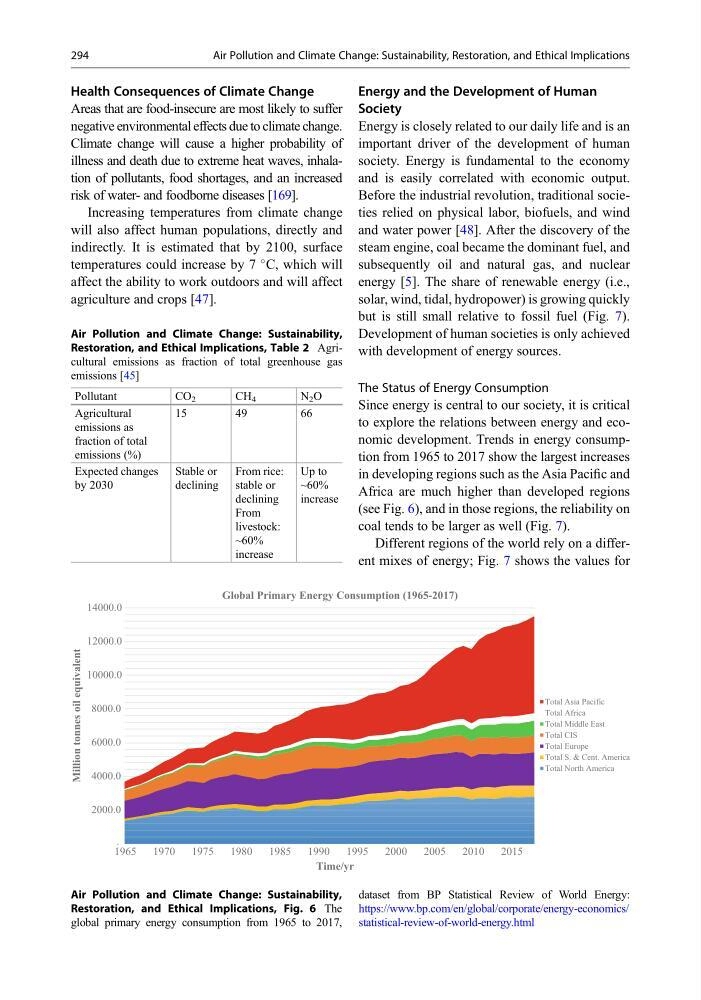
to explore the relations between energy and economic development. Trends in energy consumption from 1965 to 2017 show the largest increases
in developing regions such as the Asia Pacific and
Africa are much higher than developed regions
(see Fig. 6), and in those regions, the reliability on
coal tends to be larger as well (Fig. 7).
Different regions of the world rely on a different mixes of energy; Fig. 7 shows the values for
-
2000.0
4000.0
6000.0
8000.0
10000.0
12000.0
14000.0
1965
1970
1975
1980
1985
1990
1995
2000
2005
2010
2015
Million tonnes oil equivalent
Time/yr
Global Primary Energy Consumption (1965-2017)
Total Asia Pacific
Total Africa
Total Middle East
Total CIS
Total Europe
Total S. & Cent. America
Total North America
Air Pollution and Climate Change: Sustainability,
Restoration, and Ethical Implications, Fig. 6 The
global primary energy consumption from 1965 to 2017,
dataset from BP Statistical Review of World Energy:
https://www.bp.com/en/global/corporate/energy-economics/
statistical-review-of-world-energy.html
Air Pollution and Climate Change: Sustainability,
Restoration, and Ethical Implications, Table 2 Agricultural emissions as fraction of total greenhouse gas
emissions [45]
Pollutant
CO 2
CH 4
N 2 O
Agricultural
emissions as
fraction of total
emissions (%)
15
49
66
Expected changes
by 2030
Stable or
declining
From rice:
stable or
declining
From
livestock:
~60%
increase
Up to
~60%
increase
294
Air Pollution and Climate Change: Sustainability, Restoration, and Ethical Implications
Areas that are food-insecure are most likely to suffer
negative environmental effects due to climate change.
Climate change will cause a higher probability of
illness and death due to extreme heat waves, inhalation of pollutants, food shortages, and an increased
risk of water- and foodborne diseases [169].
Increasing temperatures from climate change
will also affect human populations, directly and
indirectly. It is estimated that by 2100, surface
temperatures could increase by 7
C, which will
affect the ability to work outdoors and will affect
agriculture and crops [47].
Energy and the Development of Human
Society
Energy is closely related to our daily life and is an
important driver of the development of human
society. Energy is fundamental to the economy
and is easily correlated with economic output.
Before the industrial revolution, traditional societies relied on physical labor, biofuels, and wind
and water power [48]. After the discovery of the
steam engine, coal became the dominant fuel, and
subsequently oil and natural gas, and nuclear
energy [5]. The share of renewable energy (i.e.,
solar, wind, tidal, hydropower) is growing quickly
but is still small relative to fossil fuel (Fig. 7).
Development of human societies is only achieved
with development of energy sources.
The Status of Energy Consumption
Since energy is central to our society, it is critical
to explore the relations between energy and economic development. Trends in energy consumption from 1965 to 2017 show the largest increases
in developing regions such as the Asia Pacific and
Africa are much higher than developed regions
(see Fig. 6), and in those regions, the reliability on
coal tends to be larger as well (Fig. 7).
Different regions of the world rely on a different mixes of energy; Fig. 7 shows the values for
-
2000.0
4000.0
6000.0
8000.0
10000.0
12000.0
14000.0
1965
1970
1975
1980
1985
1990
1995
2000
2005
2010
2015
Million tonnes oil equivalent
Time/yr
Global Primary Energy Consumption (1965-2017)
Total Asia Pacific
Total Africa
Total Middle East
Total CIS
Total Europe
Total S. & Cent. America
Total North America
Air Pollution and Climate Change: Sustainability,
Restoration, and Ethical Implications, Fig. 6 The
global primary energy consumption from 1965 to 2017,
dataset from BP Statistical Review of World Energy:
https://www.bp.com/en/global/corporate/energy-economics/
statistical-review-of-world-energy.html
Air Pollution and Climate Change: Sustainability,
Restoration, and Ethical Implications, Table 2 Agricultural emissions as fraction of total greenhouse gas
emissions [45]
Pollutant
CO 2
CH 4
N 2 O
Agricultural
emissions as
fraction of total
emissions (%)
15
49
66
Expected changes
by 2030
Stable or
declining
From rice:
stable or
declining
From
livestock:
~60%
increase
Up to
~60%
increase
294
Air Pollution and Climate Change: Sustainability, Restoration, and Ethical Implications