

[40]. Scientists concur there is a sixth ongoing
mass extinction, driven by humanity’s domination
of the Earth system and multiple interacting factors including habitat loss, emerging infectious
diseases, overexploitation, pollution, invasive
species, and climate change. A mass extinction
can be defined as >75% of species disappearing
within a geologically short timeframe (< two
million years). The normal background rate of
extinction is 10–100 times less than the rate of
species having gone extinct in last 100 years
[41]. Climate changes such as higher temperatures, rainfall extremes, sea level dynamics, and
CO 2 concentrations directly impact biodiversity
in many ways (e.g., thermal threshold exceeded,
inundation, phenology, etc.) [42, 166].
More than 40% of insect species are declining
and threatened with imminent extinction, and the
total mass of insects is falling at the calamitous
rate of 2.5% per year [43]. Human impacts, both
directly and indirectly, are almost entirely the cause
due to synergies of overharvesting, habitat loss, climate change, and pollution from intensive agriculture and consumerism. Habitat loss (a consequence
of intensive agriculture and urbanization) and pollution from fertilizers and pesticides have massive
impacts on insect biodiversity. Of many proposed
solutions, using sustainable and less harmful fertilizers and pesticides could be very effective if not
economically popular or feasible [43].
Sustainability and Climate Change
Food Security
Feeding the world’s growing human population
(currently estimated at 7.6 billion people [5]) in a
sustainable way is one of the problems facing
society. If all people lived with a high standard
of living, including a “Western” diet with more
meat, fats, and processed foods, it would require
an additional gigahectare of land currently not
available. Food production worldwide is currently
estimated to be 2750 kcal/person [44], but due to
waste, it is more likely to be around 2200 kcal/
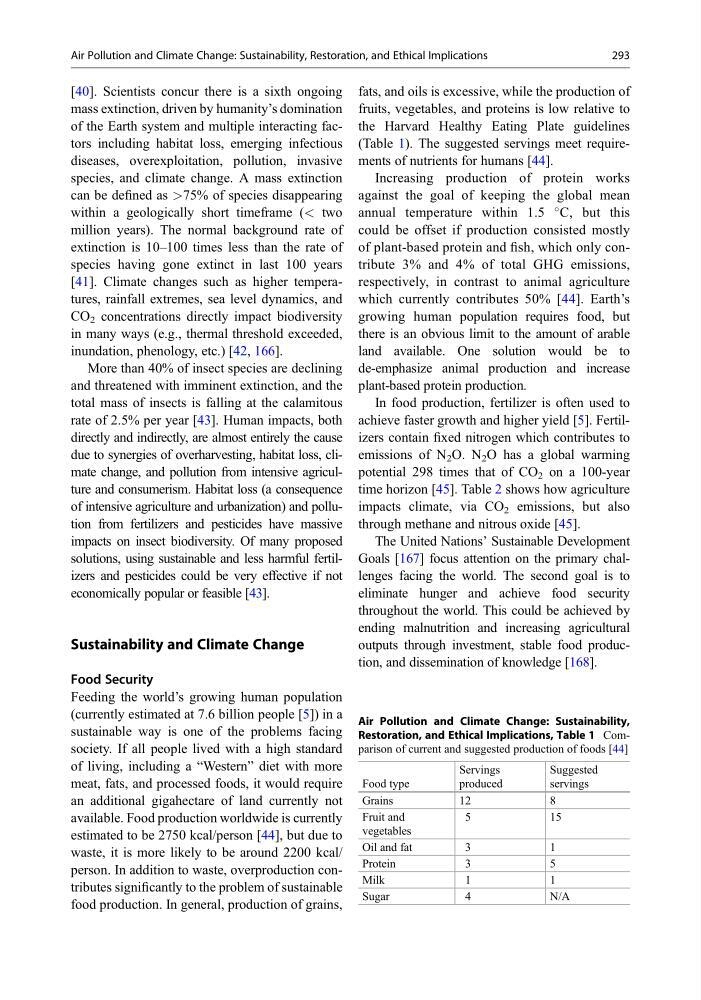
person. In addition to waste, overproduction contributes significantly to the problem of sustainable
food production. In general, production of grains,
fats, and oils is excessive, while the production of
fruits, vegetables, and proteins is low relative to
the Harvard Healthy Eating Plate guidelines
(Table 1). The suggested servings meet requirements of nutrients for humans [44].
Increasing production of protein works
against the goal of keeping the global mean
annual temperature within 1.5
C, but this
could be offset if production consisted mostly
of plant-based protein and fish, which only contribute 3% and 4% of total GHG emissions,
respectively, in contrast to animal agriculture
which currently contributes 50% [44]. Earth’s
growing human population requires food, but
there is an obvious limit to the amount of arable
land available. One solution would be to
de-emphasize animal production and increase
plant-based protein production.
In food production, fertilizer is often used to
achieve faster growth and higher yield [5]. Fertilizers contain fixed nitrogen which contributes to
emissions of N 2 O. N 2 O has a global warming
potential 298 times that of CO 2 on a 100-year
time horizon [45]. Table 2 shows how agriculture
impacts climate, via CO 2 emissions, but also
through methane and nitrous oxide [45].
The United Nations’ Sustainable Development
Goals [167] focus attention on the primary challenges facing the world. The second goal is to
eliminate hunger and achieve food security
throughout the world. This could be achieved by
ending malnutrition and increasing agricultural
outputs through investment, stable food production, and dissemination of knowledge [168].
Air Pollution and Climate Change: Sustainability,
Restoration, and Ethical Implications, Table 1 Comparison of current and suggested production of foods [44]
Food type
Servings
produced
Suggested
servings
Grains
12
8
Fruit and
vegetables
5
1 5
Oil and fat
3
1
Protein
3
5
Milk
1
1
Sugar
4
N/A
Air Pollution and Climate Change: Sustainability, Restoration, and Ethical Implications
293
mass extinction, driven by humanity’s domination
of the Earth system and multiple interacting factors including habitat loss, emerging infectious
diseases, overexploitation, pollution, invasive
species, and climate change. A mass extinction
can be defined as >75% of species disappearing
within a geologically short timeframe (< two
million years). The normal background rate of
extinction is 10–100 times less than the rate of
species having gone extinct in last 100 years
[41]. Climate changes such as higher temperatures, rainfall extremes, sea level dynamics, and
CO 2 concentrations directly impact biodiversity
in many ways (e.g., thermal threshold exceeded,
inundation, phenology, etc.) [42, 166].
More than 40% of insect species are declining
and threatened with imminent extinction, and the
total mass of insects is falling at the calamitous
rate of 2.5% per year [43]. Human impacts, both
directly and indirectly, are almost entirely the cause
due to synergies of overharvesting, habitat loss, climate change, and pollution from intensive agriculture and consumerism. Habitat loss (a consequence
of intensive agriculture and urbanization) and pollution from fertilizers and pesticides have massive
impacts on insect biodiversity. Of many proposed
solutions, using sustainable and less harmful fertilizers and pesticides could be very effective if not
economically popular or feasible [43].
Sustainability and Climate Change
Food Security
Feeding the world’s growing human population
(currently estimated at 7.6 billion people [5]) in a
sustainable way is one of the problems facing
society. If all people lived with a high standard
of living, including a “Western” diet with more
meat, fats, and processed foods, it would require
an additional gigahectare of land currently not
available. Food production worldwide is currently
estimated to be 2750 kcal/person [44], but due to
waste, it is more likely to be around 2200 kcal/
person. In addition to waste, overproduction contributes significantly to the problem of sustainable
food production. In general, production of grains,
fats, and oils is excessive, while the production of
fruits, vegetables, and proteins is low relative to
the Harvard Healthy Eating Plate guidelines
(Table 1). The suggested servings meet requirements of nutrients for humans [44].
Increasing production of protein works
against the goal of keeping the global mean
annual temperature within 1.5
C, but this
could be offset if production consisted mostly
of plant-based protein and fish, which only contribute 3% and 4% of total GHG emissions,
respectively, in contrast to animal agriculture
which currently contributes 50% [44]. Earth’s
growing human population requires food, but
there is an obvious limit to the amount of arable
land available. One solution would be to
de-emphasize animal production and increase
plant-based protein production.
In food production, fertilizer is often used to
achieve faster growth and higher yield [5]. Fertilizers contain fixed nitrogen which contributes to
emissions of N 2 O. N 2 O has a global warming
potential 298 times that of CO 2 on a 100-year
time horizon [45]. Table 2 shows how agriculture
impacts climate, via CO 2 emissions, but also
through methane and nitrous oxide [45].
The United Nations’ Sustainable Development
Goals [167] focus attention on the primary challenges facing the world. The second goal is to
eliminate hunger and achieve food security
throughout the world. This could be achieved by
ending malnutrition and increasing agricultural
outputs through investment, stable food production, and dissemination of knowledge [168].
Air Pollution and Climate Change: Sustainability,
Restoration, and Ethical Implications, Table 1 Comparison of current and suggested production of foods [44]
Food type
Servings
produced
Suggested
servings
Grains
12
8
Fruit and
vegetables
5
1 5
Oil and fat
3
1
Protein
3
5
Milk
1
1
Sugar
4
N/A
Air Pollution and Climate Change: Sustainability, Restoration, and Ethical Implications
293