

OH þ NO 2 þ M ! HNO 3 þ M
ð5Þ
The OH radical is formed primarily through
sunlight-driven photolysis processes, so has a
very low abundance at night; in the absence of
sunlight, the NO 2 photolysis reaction also ceases,
and a separate chain of reactions dominate NO x :
NO þ O 3 ! NO 2 þ O 2
ð2Þ
NO 2 þ O 3 ! NO 3 þ O 2
ð6Þ
NO 2 þ NO 3 þ M , N 2 O 5 þ M
ð7Þ
The nitrate radical, NO 3 , is rapidly photolysed
during the day, effectively suppressing reactions 6
and 7. At night however NO and NO 2 may be
converted into N 2 O 5 on a timescale of hours;
N 2 O 5 is then removed from the urban atmosphere
through wet and dry deposition, and uptake into
aerosol particles (it is also photolysed slowly during the day). In both cases, following removal
from the gas phase HNO 3 and N 2 O 5 contribute
to the nitrate (NO 3
À ) content of aerosol particles
(see below), and to the acidity of precipitation.
The combination of reactions 5 and 7 determine a
chemical lifetime for NO x (strictly, time for concentrations to fall to 1/e of their initial value) of
the order of 12–24 h in urban environments.
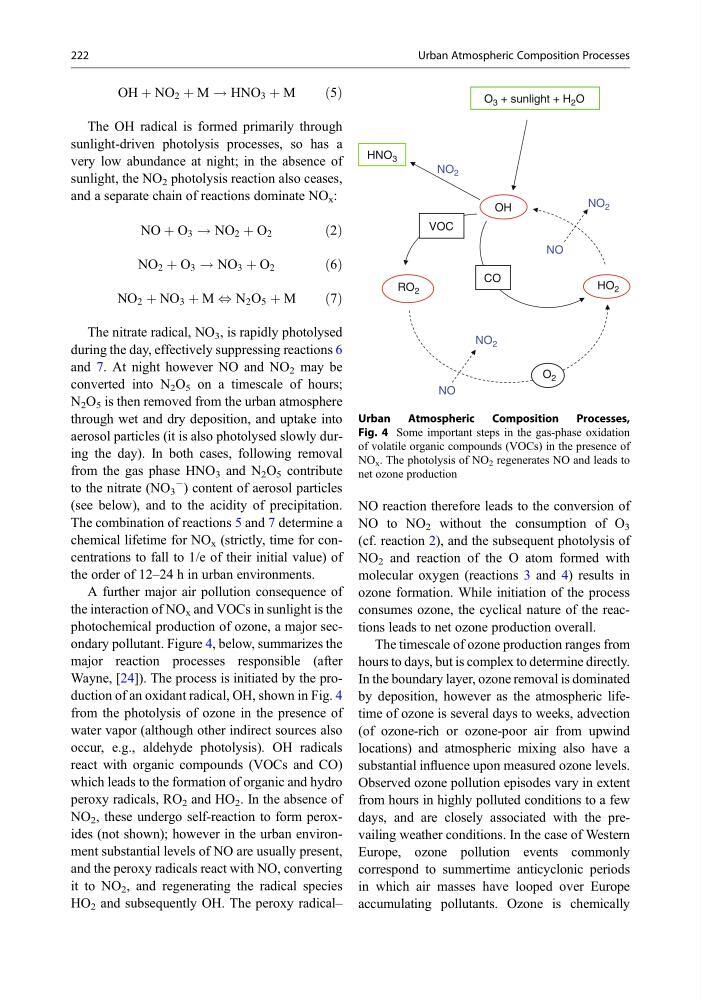
A further major air pollution consequence of
the interaction of NO x and VOCs in sunlight is the
photochemical production of ozone, a major secondary pollutant. Figure 4, below, summarizes the
major reaction processes responsible (after
Wayne, [24]). The process is initiated by the production of an oxidant radical, OH, shown in Fig. 4
from the photolysis of ozone in the presence of
water vapor (although other indirect sources also
occur, e.g., aldehyde photolysis). OH radicals
react with organic compounds (VOCs and CO)
which leads to the formation of organic and hydro
peroxy radicals, RO 2 and HO 2 . In the absence of
NO 2 , these undergo self-reaction to form peroxides (not shown); however in the urban environment substantial levels of NO are usually present,
and the peroxy radicals react with NO, converting
it to NO 2 , and regenerating the radical species
HO 2 and subsequently OH. The peroxy radical–
NO reaction therefore leads to the conversion of
NO to NO 2 without the consumption of O 3
(cf. reaction 2), and the subsequent photolysis of
NO 2 and reaction of the O atom formed with
molecular oxygen (reactions 3 and 4) results in
ozone formation. While initiation of the process
consumes ozone, the cyclical nature of the reactions leads to net ozone production overall.
The timescale of ozone production ranges from
hours to days, but is complex to determine directly.
In the boundary layer, ozone removal is dominated
by deposition, however as the atmospheric lifetime of ozone is several days to weeks, advection
(of ozone-rich or ozone-poor air from upwind
locations) and atmospheric mixing also have a
substantial influence upon measured ozone levels.
Observed ozone pollution episodes vary in extent
from hours in highly polluted conditions to a few
days, and are closely associated with the prevailing weather conditions. In the case of Western
Europe, ozone pollution events commonly
correspond to summertime anticyclonic periods
in which air masses have looped over Europe
accumulating pollutants. Ozone is chemically
O 3 + sunlight + H 2 O
RO 2
OH
HO 2
NO
VOC
NO 2
NO
NO 2
CO
O 2
NO 2
HNO 3
Urban Atmospheric
Composition Processes,
Fig. 4 Some important steps in the gas-phase oxidation
of volatile organic compounds (VOCs) in the presence of
NO x . The photolysis of NO 2 regenerates NO and leads to
net ozone production
222
Urban Atmospheric Composition Processes
ð5Þ
The OH radical is formed primarily through
sunlight-driven photolysis processes, so has a
very low abundance at night; in the absence of
sunlight, the NO 2 photolysis reaction also ceases,
and a separate chain of reactions dominate NO x :
NO þ O 3 ! NO 2 þ O 2
ð2Þ
NO 2 þ O 3 ! NO 3 þ O 2
ð6Þ
NO 2 þ NO 3 þ M , N 2 O 5 þ M
ð7Þ
The nitrate radical, NO 3 , is rapidly photolysed
during the day, effectively suppressing reactions 6
and 7. At night however NO and NO 2 may be
converted into N 2 O 5 on a timescale of hours;
N 2 O 5 is then removed from the urban atmosphere
through wet and dry deposition, and uptake into
aerosol particles (it is also photolysed slowly during the day). In both cases, following removal
from the gas phase HNO 3 and N 2 O 5 contribute
to the nitrate (NO 3
À ) content of aerosol particles
(see below), and to the acidity of precipitation.
The combination of reactions 5 and 7 determine a
chemical lifetime for NO x (strictly, time for concentrations to fall to 1/e of their initial value) of
the order of 12–24 h in urban environments.
A further major air pollution consequence of
the interaction of NO x and VOCs in sunlight is the
photochemical production of ozone, a major secondary pollutant. Figure 4, below, summarizes the
major reaction processes responsible (after
Wayne, [24]). The process is initiated by the production of an oxidant radical, OH, shown in Fig. 4
from the photolysis of ozone in the presence of
water vapor (although other indirect sources also
occur, e.g., aldehyde photolysis). OH radicals
react with organic compounds (VOCs and CO)
which leads to the formation of organic and hydro
peroxy radicals, RO 2 and HO 2 . In the absence of
NO 2 , these undergo self-reaction to form peroxides (not shown); however in the urban environment substantial levels of NO are usually present,
and the peroxy radicals react with NO, converting
it to NO 2 , and regenerating the radical species
HO 2 and subsequently OH. The peroxy radical–
NO reaction therefore leads to the conversion of
NO to NO 2 without the consumption of O 3
(cf. reaction 2), and the subsequent photolysis of
NO 2 and reaction of the O atom formed with
molecular oxygen (reactions 3 and 4) results in
ozone formation. While initiation of the process
consumes ozone, the cyclical nature of the reactions leads to net ozone production overall.
The timescale of ozone production ranges from
hours to days, but is complex to determine directly.
In the boundary layer, ozone removal is dominated
by deposition, however as the atmospheric lifetime of ozone is several days to weeks, advection
(of ozone-rich or ozone-poor air from upwind
locations) and atmospheric mixing also have a
substantial influence upon measured ozone levels.
Observed ozone pollution episodes vary in extent
from hours in highly polluted conditions to a few
days, and are closely associated with the prevailing weather conditions. In the case of Western
Europe, ozone pollution events commonly
correspond to summertime anticyclonic periods
in which air masses have looped over Europe
accumulating pollutants. Ozone is chemically
O 3 + sunlight + H 2 O
RO 2
OH
HO 2
NO
VOC
NO 2
NO
NO 2
CO
O 2
NO 2
HNO 3
Urban Atmospheric
Composition Processes,
Fig. 4 Some important steps in the gas-phase oxidation
of volatile organic compounds (VOCs) in the presence of
NO x . The photolysis of NO 2 regenerates NO and leads to
net ozone production
222
Urban Atmospheric Composition Processes