

M denotes the involvement of a third body, nitrogen
or oxygen, which removes some of the excess
energy from the nascent ozone molecule.
O þ O 2 þ M ! O 3 þ M
ð4Þ
As these reactions dominate the NO/NO 2 /O 3
interconversion, it is possible to define two further
quantities, NO x (¼ NO + NO 2 ), and total oxidant O x
(¼ NO 2 + O 3 ), which, in the absence of further
processes, are conserved. NO x and O x provide useful
metrics for assessing variations in the sum of NO and
NO 2 , and of NO 2 and O 3 , without need to consider
the partitioning between these species. The reaction
of fresh, vehicle-emitted NO with O 3 reduces ozone
levels in many urban areas compared with the surrounding regions, leading to an urban decrement in
ozone (compare O 3 concentrations for the MR and
NK sites in Table 1) – discussed further below.
The timescales of reactions 2 and 3 in the boundary layer under sunlit conditions is of the order of
1–2 min, while reaction 4 proceeds in milliseconds;
consequently away from direct emission sources
NO, NO 2 and O 3 are found in equilibrium defined
by the Leighton Relationship [22]:
NO 2
½
NO
½
¼
k 2 O 3
½
j 3
where k 2 is the rate constant for the NO + O 3
reaction, and j 3 is the (solar radiation intensitydependent) rate of photolysis of NO 2 . It follows
that for a given abundance of NO x and O 3 , in the
absence of other processes, NO x will exist primarily as NO 2 when light levels are lower (i.e., at
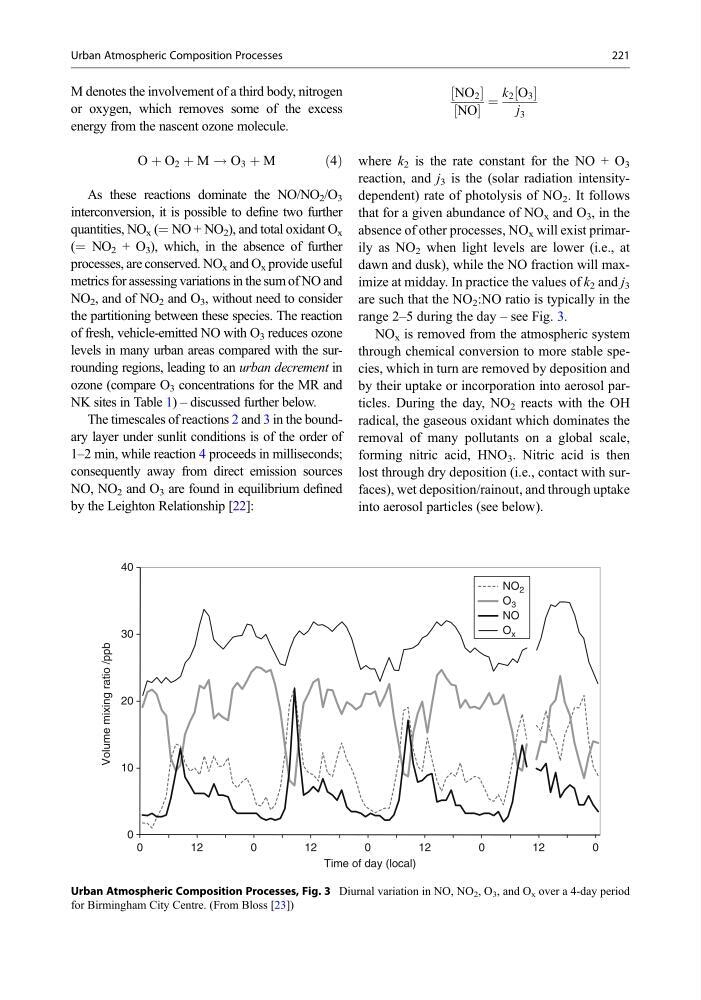
dawn and dusk), while the NO fraction will maximize at midday. In practice the values of k 2 and j 3
are such that the NO 2 :NO ratio is typically in the
range 2–5 during the day – see Fig. 3.
NO x is removed from the atmospheric system
through chemical conversion to more stable species, which in turn are removed by deposition and
by their uptake or incorporation into aerosol particles. During the day, NO 2 reacts with the OH
radical, the gaseous oxidant which dominates the
removal of many pollutants on a global scale,
forming nitric acid, HNO 3 . Nitric acid is then
lost through dry deposition (i.e., contact with surfaces), wet deposition/rainout, and through uptake
into aerosol particles (see below).
0
10
20
30
40
0
1 2
0
1 2
0
1 2
0
1 2
0
Volume mixing ratio /ppb
Time of day (local)
NO 2
O 3
NO
O x
Urban Atmospheric Composition Processes, Fig. 3 Diurnal variation in NO, NO 2 , O 3 , and O x over a 4-day period
for Birmingham City Centre. (From Bloss [23])
Urban Atmospheric Composition Processes
221
or oxygen, which removes some of the excess
energy from the nascent ozone molecule.
O þ O 2 þ M ! O 3 þ M
ð4Þ
As these reactions dominate the NO/NO 2 /O 3
interconversion, it is possible to define two further
quantities, NO x (¼ NO + NO 2 ), and total oxidant O x
(¼ NO 2 + O 3 ), which, in the absence of further
processes, are conserved. NO x and O x provide useful
metrics for assessing variations in the sum of NO and
NO 2 , and of NO 2 and O 3 , without need to consider
the partitioning between these species. The reaction
of fresh, vehicle-emitted NO with O 3 reduces ozone
levels in many urban areas compared with the surrounding regions, leading to an urban decrement in
ozone (compare O 3 concentrations for the MR and
NK sites in Table 1) – discussed further below.
The timescales of reactions 2 and 3 in the boundary layer under sunlit conditions is of the order of
1–2 min, while reaction 4 proceeds in milliseconds;
consequently away from direct emission sources
NO, NO 2 and O 3 are found in equilibrium defined
by the Leighton Relationship [22]:
NO 2
½
NO
½
¼
k 2 O 3
½
j 3
where k 2 is the rate constant for the NO + O 3
reaction, and j 3 is the (solar radiation intensitydependent) rate of photolysis of NO 2 . It follows
that for a given abundance of NO x and O 3 , in the
absence of other processes, NO x will exist primarily as NO 2 when light levels are lower (i.e., at
dawn and dusk), while the NO fraction will maximize at midday. In practice the values of k 2 and j 3
are such that the NO 2 :NO ratio is typically in the
range 2–5 during the day – see Fig. 3.
NO x is removed from the atmospheric system
through chemical conversion to more stable species, which in turn are removed by deposition and
by their uptake or incorporation into aerosol particles. During the day, NO 2 reacts with the OH
radical, the gaseous oxidant which dominates the
removal of many pollutants on a global scale,
forming nitric acid, HNO 3 . Nitric acid is then
lost through dry deposition (i.e., contact with surfaces), wet deposition/rainout, and through uptake
into aerosol particles (see below).
0
10
20
30
40
0
1 2
0
1 2
0
1 2
0
1 2
0
Volume mixing ratio /ppb
Time of day (local)
NO 2
O 3
NO
O x
Urban Atmospheric Composition Processes, Fig. 3 Diurnal variation in NO, NO 2 , O 3 , and O x over a 4-day period
for Birmingham City Centre. (From Bloss [23])
Urban Atmospheric Composition Processes
221