

the principle urban atmospheric components and
their sources are introduced, followed by an
account of the predominant atmospheric composition (chemistry) processes which affect urban air
quality. The article concludes with a brief consideration of the potential impacts of future changes in
emissions, physical and political climates upon
urban atmospheric composition.
Introduction
Increasing population density implies an increasing
human exposure to urban atmospheric pollutants.
Countering this basic trend, growing scientific
understanding of atmospheric composition processes, coupled with technological developments
in emissions control and policy measures to limit
pollution, have led to improved urban air quality
over the past several decades in many cities,
although this conclusion is dependent upon the species measured and metric chosen. The predominant
air quality conditions are therefore a strong function
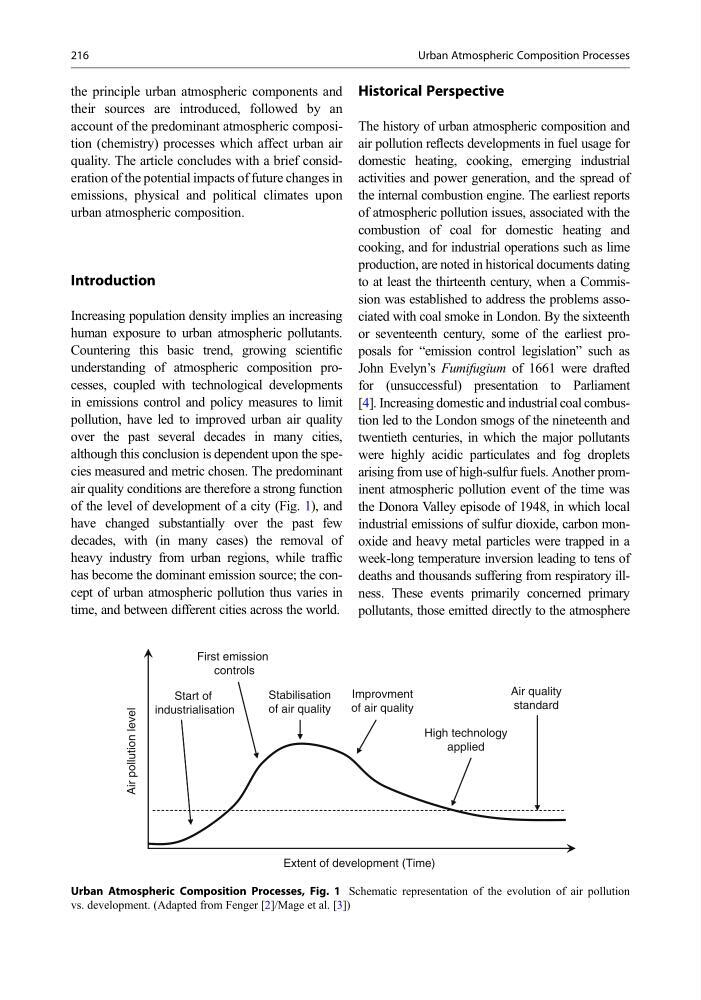
of the level of development of a city (Fig. 1), and
have changed substantially over the past few
decades, with (in many cases) the removal of
heavy industry from urban regions, while traffic
has become the dominant emission source; the concept of urban atmospheric pollution thus varies in
time, and between different cities across the world.
Historical Perspective
The history of urban atmospheric composition and
air pollution reflects developments in fuel usage for
domestic heating, cooking, emerging industrial
activities and power generation, and the spread of
the internal combustion engine. The earliest reports
of atmospheric pollution issues, associated with the
combustion of coal for domestic heating and
cooking, and for industrial operations such as lime
production, are noted in historical documents dating
to at least the thirteenth century, when a Commission was established to address the problems associated with coal smoke in London. By the sixteenth
or seventeenth century, some of the earliest proposals for “emission control legislation” such as
John Evelyn’s Fumifugium of 1661 were drafted
for (unsuccessful) presentation to Parliament
[4]. Increasing domestic and industrial coal combustion led to the London smogs of the nineteenth and
twentieth centuries, in which the major pollutants
were highly acidic particulates and fog droplets
arising from use of high-sulfur fuels. Another prominent atmospheric pollution event of the time was
the Donora Valley episode of 1948, in which local
industrial emissions of sulfur dioxide, carbon monoxide and heavy metal particles were trapped in a
week-long temperature inversion leading to tens of
deaths and thousands suffering from respiratory illness. These events primarily concerned primary
pollutants, those emitted directly to the atmosphere
Extent of development (Time)
Air pollution level
Start of
industrialisation
First emission
controls
Stabilisation
of air quality
High technology
applied
Air quality
standard
Improvment
of air quality
Urban Atmospheric Composition Processes, Fig. 1 Schematic representation of the evolution of air pollution
vs. development. (Adapted from Fenger [2]/Mage et al. [3])
216
Urban Atmospheric Composition Processes
their sources are introduced, followed by an
account of the predominant atmospheric composition (chemistry) processes which affect urban air
quality. The article concludes with a brief consideration of the potential impacts of future changes in
emissions, physical and political climates upon
urban atmospheric composition.
Introduction
Increasing population density implies an increasing
human exposure to urban atmospheric pollutants.
Countering this basic trend, growing scientific
understanding of atmospheric composition processes, coupled with technological developments
in emissions control and policy measures to limit
pollution, have led to improved urban air quality
over the past several decades in many cities,
although this conclusion is dependent upon the species measured and metric chosen. The predominant
air quality conditions are therefore a strong function
of the level of development of a city (Fig. 1), and
have changed substantially over the past few
decades, with (in many cases) the removal of
heavy industry from urban regions, while traffic
has become the dominant emission source; the concept of urban atmospheric pollution thus varies in
time, and between different cities across the world.
Historical Perspective
The history of urban atmospheric composition and
air pollution reflects developments in fuel usage for
domestic heating, cooking, emerging industrial
activities and power generation, and the spread of
the internal combustion engine. The earliest reports
of atmospheric pollution issues, associated with the
combustion of coal for domestic heating and
cooking, and for industrial operations such as lime
production, are noted in historical documents dating
to at least the thirteenth century, when a Commission was established to address the problems associated with coal smoke in London. By the sixteenth
or seventeenth century, some of the earliest proposals for “emission control legislation” such as
John Evelyn’s Fumifugium of 1661 were drafted
for (unsuccessful) presentation to Parliament
[4]. Increasing domestic and industrial coal combustion led to the London smogs of the nineteenth and
twentieth centuries, in which the major pollutants
were highly acidic particulates and fog droplets
arising from use of high-sulfur fuels. Another prominent atmospheric pollution event of the time was
the Donora Valley episode of 1948, in which local
industrial emissions of sulfur dioxide, carbon monoxide and heavy metal particles were trapped in a
week-long temperature inversion leading to tens of
deaths and thousands suffering from respiratory illness. These events primarily concerned primary
pollutants, those emitted directly to the atmosphere
Extent of development (Time)
Air pollution level
Start of
industrialisation
First emission
controls
Stabilisation
of air quality
High technology
applied
Air quality
standard
Improvment
of air quality
Urban Atmospheric Composition Processes, Fig. 1 Schematic representation of the evolution of air pollution
vs. development. (Adapted from Fenger [2]/Mage et al. [3])
216
Urban Atmospheric Composition Processes