

from the dust-producing construction activities
and traffic around the airport).
Several studies have thus been carried out to
determine the potential impact of emissions from
airport activities. These studies generally point at the
main influence on air quality that is coming from the
road traffic going to and from the airport, whereas
the impact of aircraft emissions has been found to be
very limited. A study carried out in Frankfurt Airport showed that aircraft-specific emissions generally could not be identified, whereas emissions from
vehicle traffic on surrounding motorways had measurable impact on the air quality [13]. A study from
Munich Airport had similar findings [14], as did a
study inside Heathrow Airport [15].
Ship traffic has been estimated to be responsible for about 60,000 lung cancer and cardiopulmonary deaths annually [16], but this outcome is
linked to the contribution from ship emissions to
the background particulate matter load and not
directly related to contribution from ship emissions to the urban air quality.
Harbors may never the less be a local source
contributing to urban pollution as they are often
part of the urban airshed in coastal areas, but
studies indicate that as with airports, that local
road traffic often dominates the contribution
from harbors. For example, a study in the harbor
of Aberdeen thus showed a gradient of increasing
NO 2 and soot concentrations from the harbor
toward the city center [17], indicating that the
contribution from the harbor had very limited
impact on the local air quality in comparison
with the emissions taking place in the urban
environment.
Wood combustion in households is a concern
in areas with many wood stoves. These areas have
relatively high local emissions of PM in comparison with other anthropogenic pollution sources
generally in the airshed. Investigations of wood
combustion and air quality in developed countries
like New Zealand [18], Sweden [19], the USA
[20, 21], and Denmark [22] have documented
that residential wood combustion likely significantly elevates the local PM concentrations in
outdoor air. Emission inventories for Denmark,
where wood-burning stoves are generally secondary sources of domestic heating, point at wood
combustion as the largest anthropogenic source of
primary particle emissions in the country, being
responsible for about 60% of the countrywide
primary particle emissions.
Impact of Physical Parameters:
Geography, Topography, and
Meteorology
Impact of Geography
The location of the city has a great impact on the
dispersion conditions and thus air quality as it
affects the local meteorological conditions. Los
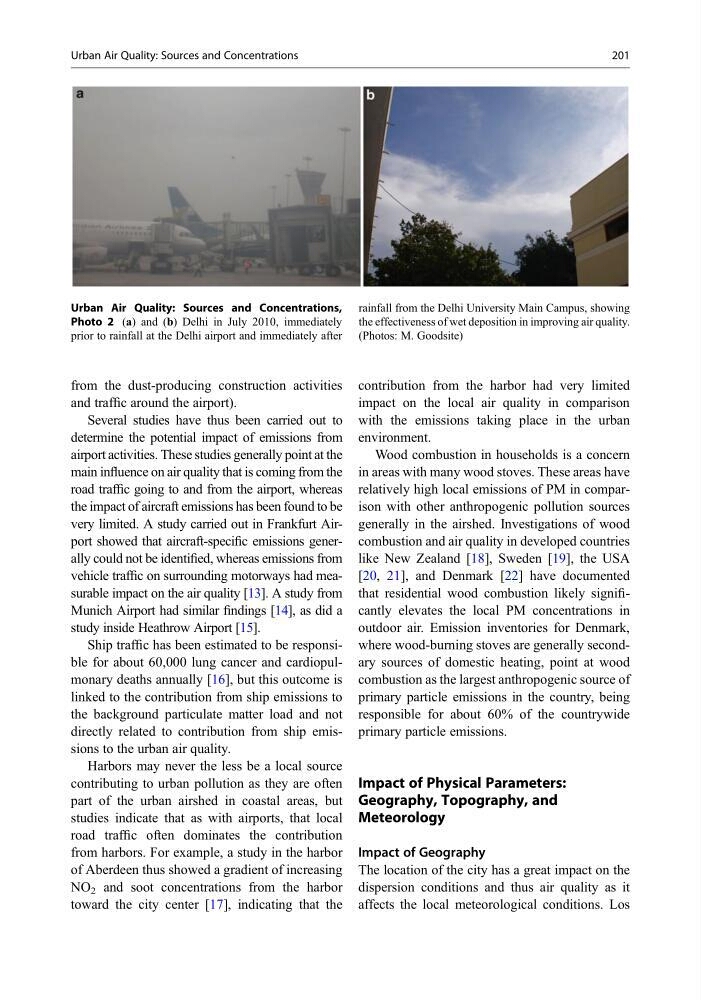
Urban Air Quality: Sources and Concentrations,
Photo 2 (a) and (b) Delhi in July 2010, immediately
prior to rainfall at the Delhi airport and immediately after
rainfall from the Delhi University Main Campus, showing
the effectiveness of wet deposition in improving air quality.
(Photos: M. Goodsite)
Urban Air Quality: Sources and Concentrations
201
and traffic around the airport).
Several studies have thus been carried out to
determine the potential impact of emissions from
airport activities. These studies generally point at the
main influence on air quality that is coming from the
road traffic going to and from the airport, whereas
the impact of aircraft emissions has been found to be
very limited. A study carried out in Frankfurt Airport showed that aircraft-specific emissions generally could not be identified, whereas emissions from
vehicle traffic on surrounding motorways had measurable impact on the air quality [13]. A study from
Munich Airport had similar findings [14], as did a
study inside Heathrow Airport [15].
Ship traffic has been estimated to be responsible for about 60,000 lung cancer and cardiopulmonary deaths annually [16], but this outcome is
linked to the contribution from ship emissions to
the background particulate matter load and not
directly related to contribution from ship emissions to the urban air quality.
Harbors may never the less be a local source
contributing to urban pollution as they are often
part of the urban airshed in coastal areas, but
studies indicate that as with airports, that local
road traffic often dominates the contribution
from harbors. For example, a study in the harbor
of Aberdeen thus showed a gradient of increasing
NO 2 and soot concentrations from the harbor
toward the city center [17], indicating that the
contribution from the harbor had very limited
impact on the local air quality in comparison
with the emissions taking place in the urban
environment.
Wood combustion in households is a concern
in areas with many wood stoves. These areas have
relatively high local emissions of PM in comparison with other anthropogenic pollution sources
generally in the airshed. Investigations of wood
combustion and air quality in developed countries
like New Zealand [18], Sweden [19], the USA
[20, 21], and Denmark [22] have documented
that residential wood combustion likely significantly elevates the local PM concentrations in
outdoor air. Emission inventories for Denmark,
where wood-burning stoves are generally secondary sources of domestic heating, point at wood
combustion as the largest anthropogenic source of
primary particle emissions in the country, being
responsible for about 60% of the countrywide
primary particle emissions.
Impact of Physical Parameters:
Geography, Topography, and
Meteorology
Impact of Geography
The location of the city has a great impact on the
dispersion conditions and thus air quality as it
affects the local meteorological conditions. Los
Urban Air Quality: Sources and Concentrations,
Photo 2 (a) and (b) Delhi in July 2010, immediately
prior to rainfall at the Delhi airport and immediately after
rainfall from the Delhi University Main Campus, showing
the effectiveness of wet deposition in improving air quality.
(Photos: M. Goodsite)
Urban Air Quality: Sources and Concentrations
201