

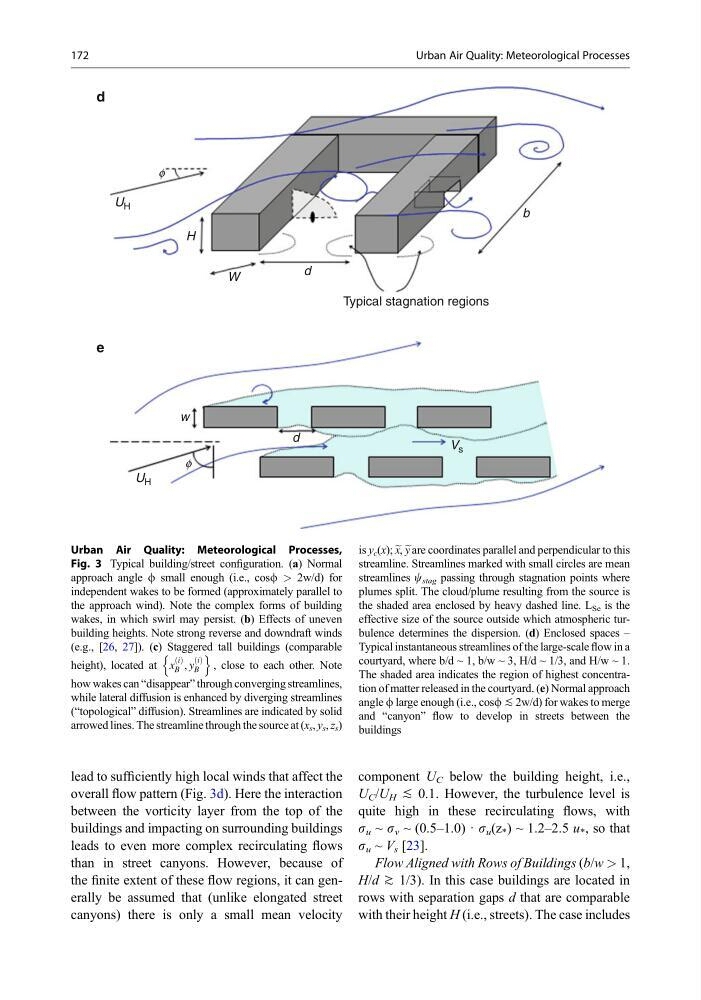
lead to sufficiently high local winds that affect the
overall flow pattern (Fig. 3d). Here the interaction
between the vorticity layer from the top of the
buildings and impacting on surrounding buildings
leads to even more complex recirculating flows
than in street canyons. However, because of
the finite extent of these flow regions, it can generally be assumed that (unlike elongated street
canyons) there is only a small mean velocity
component U C below the building height, i.e.,
U C /U H ≲ 0.1. However, the turbulence level is
quite high in these recirculating flows, with
s u ~ s v ~ (0.5–1.0) · s u (z * ) ~ 1.2–2.5 u * , so that
s u ~ V s [23].
Flow Aligned with Rows of Buildings (b/w > 1,
H/d ≳ 1/3). In this case buildings are located in
rows with separation gaps d that are comparable
with their height H (i.e., streets). The case includes
f
f
U H
U H
V s
H
w
W
d
d
b
Typical stagnation regions
d
e
Urban Air Quality: Meteorological Processes,
Fig. 3 Typical building/street configuration. (a) Normal
approach angle f small enough (i.e., cosf > 2w/d) for
independent wakes to be formed (approximately parallel to
the approach wind). Note the complex forms of building
wakes, in which swirl may persist. (b) Effects of uneven
building heights. Note strong reverse and downdraft winds
(e.g., [26, 27]). (c) Staggered tall buildings (comparable
height), located at x
i
ð Þ
B , y
i
ð Þ
B
n
o
, close to each other. Note
how wakes can “disappear” through converging streamlines,
while lateral diffusion is enhanced by diverging streamlines
(“topological” diffusion). Streamlines are indicated by solid
arrowed lines. The streamline through the source at (x s , y s , z s )
is y c (x); e
x, e
y are coordinates parallel and perpendicular to this
streamline. Streamlines marked with small circles are mean
streamlines c stag passing through stagnation points where
plumes split. The cloud/plume resulting from the source is
the shaded area enclosed by heavy dashed line. L Se is the
effective size of the source outside which atmospheric turbulence determines the dispersion. (d) Enclosed spaces –
Typical instantaneous streamlines of the large-scale flow in a
courtyard, where b/d ~ 1, b/w ~ 3, H/d ~ 1/3, and H/w ~ 1.
The shaded area indicates the region of highest concentration of matter released in the courtyard. (e) Normal approach
angle f large enough (i.e., cosf ≲ 2w/d) for wakes to merge
and “canyon” flow to develop in streets between the
buildings
172
Urban Air Quality: Meteorological Processes
overall flow pattern (Fig. 3d). Here the interaction
between the vorticity layer from the top of the
buildings and impacting on surrounding buildings
leads to even more complex recirculating flows
than in street canyons. However, because of
the finite extent of these flow regions, it can generally be assumed that (unlike elongated street
canyons) there is only a small mean velocity
component U C below the building height, i.e.,
U C /U H ≲ 0.1. However, the turbulence level is
quite high in these recirculating flows, with
s u ~ s v ~ (0.5–1.0) · s u (z * ) ~ 1.2–2.5 u * , so that
s u ~ V s [23].
Flow Aligned with Rows of Buildings (b/w > 1,
H/d ≳ 1/3). In this case buildings are located in
rows with separation gaps d that are comparable
with their height H (i.e., streets). The case includes
f
f
U H
U H
V s
H
w
W
d
d
b
Typical stagnation regions
d
e
Urban Air Quality: Meteorological Processes,
Fig. 3 Typical building/street configuration. (a) Normal
approach angle f small enough (i.e., cosf > 2w/d) for
independent wakes to be formed (approximately parallel to
the approach wind). Note the complex forms of building
wakes, in which swirl may persist. (b) Effects of uneven
building heights. Note strong reverse and downdraft winds
(e.g., [26, 27]). (c) Staggered tall buildings (comparable
height), located at x
i
ð Þ
B , y
i
ð Þ
B
n
o
, close to each other. Note
how wakes can “disappear” through converging streamlines,
while lateral diffusion is enhanced by diverging streamlines
(“topological” diffusion). Streamlines are indicated by solid
arrowed lines. The streamline through the source at (x s , y s , z s )
is y c (x); e
x, e
y are coordinates parallel and perpendicular to this
streamline. Streamlines marked with small circles are mean
streamlines c stag passing through stagnation points where
plumes split. The cloud/plume resulting from the source is
the shaded area enclosed by heavy dashed line. L Se is the
effective size of the source outside which atmospheric turbulence determines the dispersion. (d) Enclosed spaces –
Typical instantaneous streamlines of the large-scale flow in a
courtyard, where b/d ~ 1, b/w ~ 3, H/d ~ 1/3, and H/w ~ 1.
The shaded area indicates the region of highest concentration of matter released in the courtyard. (e) Normal approach
angle f large enough (i.e., cosf ≲ 2w/d) for wakes to merge
and “canyon” flow to develop in streets between the
buildings
172
Urban Air Quality: Meteorological Processes