

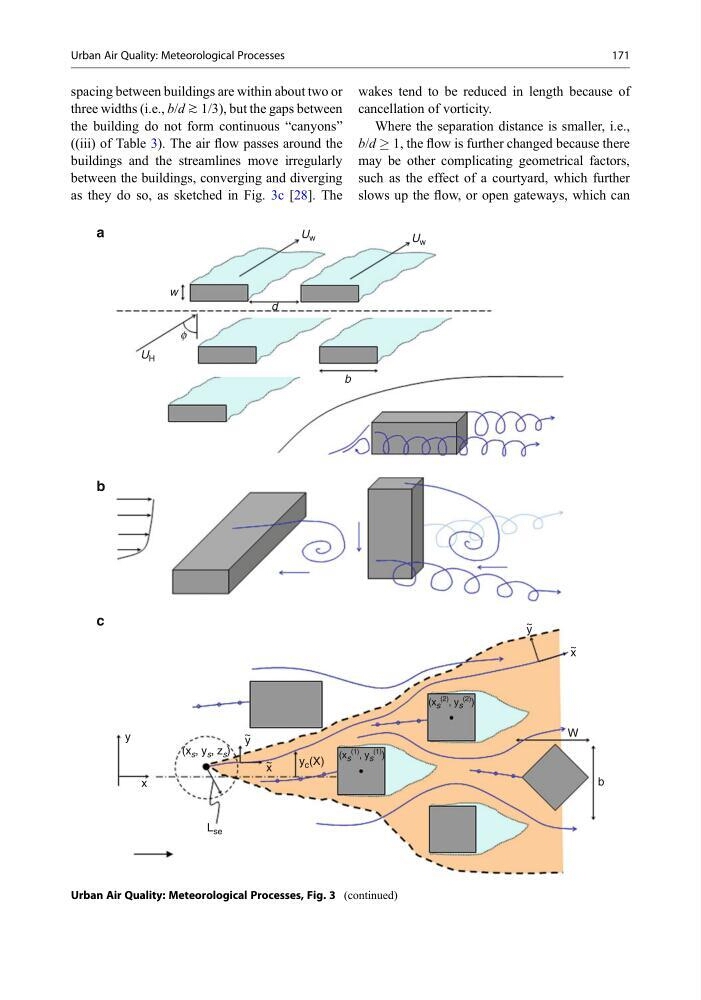
spacing between buildings are within about two or
three widths (i.e., b/d ≳ 1/3), but the gaps between
the building do not form continuous “canyons”
((iii) of Table 3). The air flow passes around the
buildings and the streamlines move irregularly
between the buildings, converging and diverging
as they do so, as sketched in Fig. 3c [28]. The
wakes tend to be reduced in length because of
cancellation of vorticity.
Where the separation distance is smaller, i.e.,
b/d ! 1, the flow is further changed because there
may be other complicating geometrical factors,
such as the effect of a courtyard, which further
slows up the flow, or open gateways, which can
y
y
~
y
~
x
~
x
W
b
~
x
f
y c (X)
L se
U H
U w
U w
d
b
w
(x s , y s , z s )
(x s
(1)
, y s
(1)
)
(x s
(2)
, y s
(2)
)
a
b
c
Urban Air Quality: Meteorological Processes, Fig. 3 (continued)
Urban Air Quality: Meteorological Processes
171
three widths (i.e., b/d ≳ 1/3), but the gaps between
the building do not form continuous “canyons”
((iii) of Table 3). The air flow passes around the
buildings and the streamlines move irregularly
between the buildings, converging and diverging
as they do so, as sketched in Fig. 3c [28]. The
wakes tend to be reduced in length because of
cancellation of vorticity.
Where the separation distance is smaller, i.e.,
b/d ! 1, the flow is further changed because there
may be other complicating geometrical factors,
such as the effect of a courtyard, which further
slows up the flow, or open gateways, which can
y
y
~
y
~
x
~
x
W
b
~
x
f
y c (X)
L se
U H
U w
U w
d
b
w
(x s , y s , z s )
(x s
(1)
, y s
(1)
)
(x s
(2)
, y s
(2)
)
a
b
c
Urban Air Quality: Meteorological Processes, Fig. 3 (continued)
Urban Air Quality: Meteorological Processes
171