

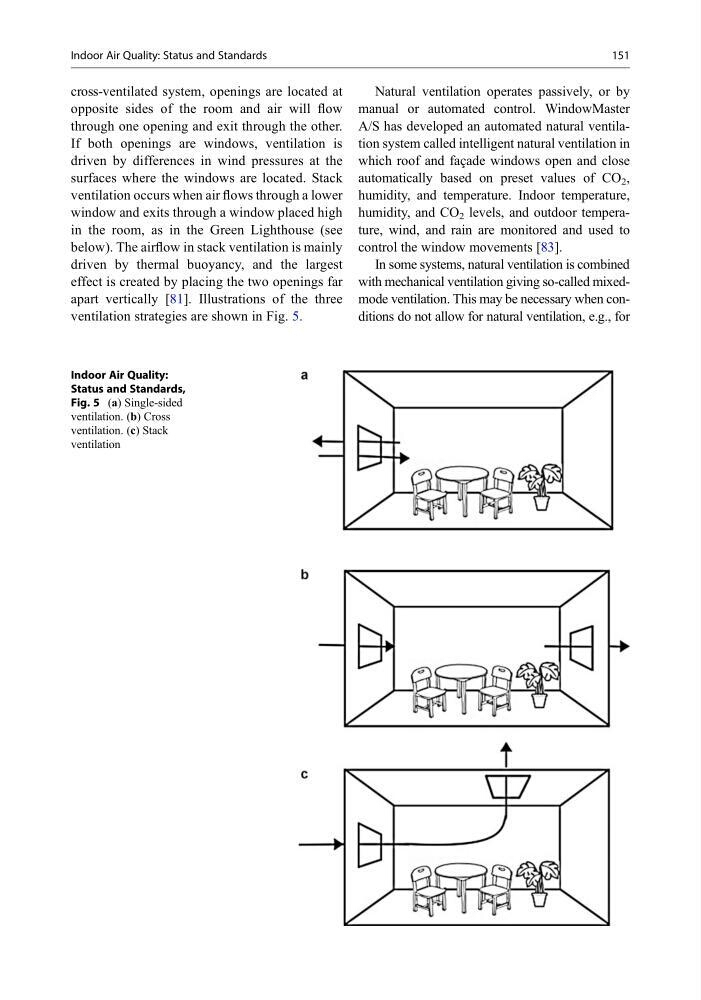
cross-ventilated system, openings are located at
opposite sides of the room and air will flow
through one opening and exit through the other.
If both openings are windows, ventilation is
driven by differences in wind pressures at the
surfaces where the windows are located. Stack
ventilation occurs when air flows through a lower
window and exits through a window placed high
in the room, as in the Green Lighthouse (see
below). The airflow in stack ventilation is mainly
driven by thermal buoyancy, and the largest
effect is created by placing the two openings far
apart vertically [81]. Illustrations of the three
ventilation strategies are shown in Fig. 5.
Natural ventilation operates passively, or by
manual or automated control. WindowMaster
A/S has developed an automated natural ventilation system called intelligent natural ventilation in
which roof and façade windows open and close
automatically based on preset values of CO 2 ,
humidity, and temperature. Indoor temperature,
humidity, and CO 2 levels, and outdoor temperature, wind, and rain are monitored and used to
control the window movements [83].
In some systems, natural ventilation is combined
with mechanical ventilation giving so-called mixedmode ventilation. This may be necessary when conditions do not allow for natural ventilation, e.g., for
Indoor Air Quality:
Status and Standards,
Fig. 5 (a) Single-sided
ventilation. (b) Cross
ventilation. (c) Stack
ventilation
Indoor Air Quality: Status and Standards
151
opposite sides of the room and air will flow
through one opening and exit through the other.
If both openings are windows, ventilation is
driven by differences in wind pressures at the
surfaces where the windows are located. Stack
ventilation occurs when air flows through a lower
window and exits through a window placed high
in the room, as in the Green Lighthouse (see
below). The airflow in stack ventilation is mainly
driven by thermal buoyancy, and the largest
effect is created by placing the two openings far
apart vertically [81]. Illustrations of the three
ventilation strategies are shown in Fig. 5.
Natural ventilation operates passively, or by
manual or automated control. WindowMaster
A/S has developed an automated natural ventilation system called intelligent natural ventilation in
which roof and façade windows open and close
automatically based on preset values of CO 2 ,
humidity, and temperature. Indoor temperature,
humidity, and CO 2 levels, and outdoor temperature, wind, and rain are monitored and used to
control the window movements [83].
In some systems, natural ventilation is combined
with mechanical ventilation giving so-called mixedmode ventilation. This may be necessary when conditions do not allow for natural ventilation, e.g., for
Indoor Air Quality:
Status and Standards,
Fig. 5 (a) Single-sided
ventilation. (b) Cross
ventilation. (c) Stack
ventilation
Indoor Air Quality: Status and Standards
151