

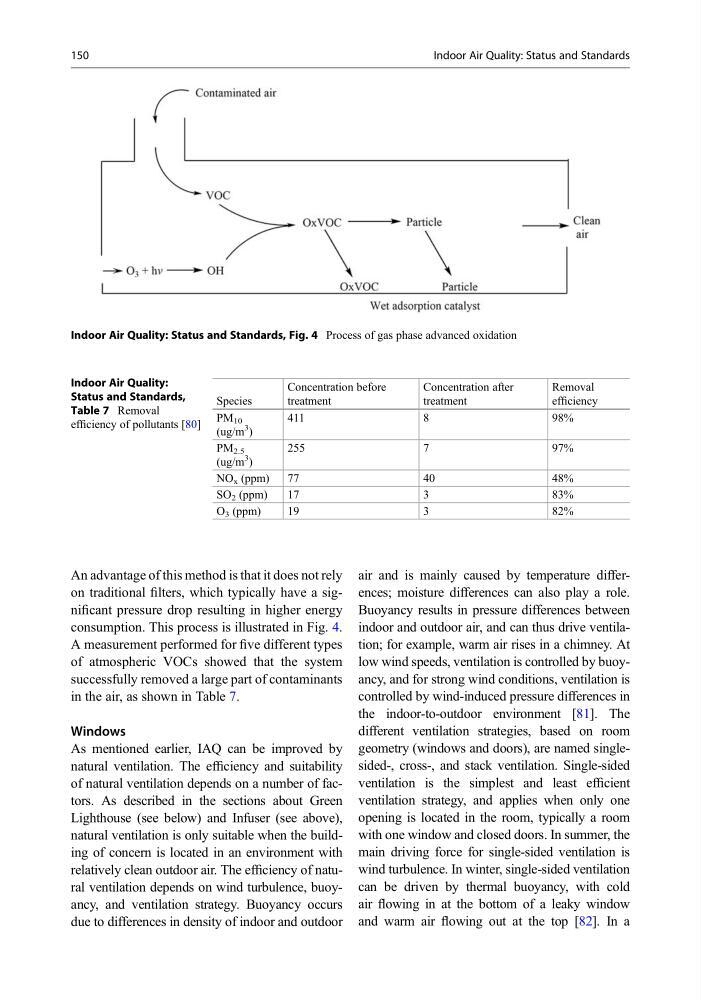
An advantage of this method is that it does not rely
on traditional filters, which typically have a significant pressure drop resulting in higher energy
consumption. This process is illustrated in Fig. 4.
A measurement performed for five different types
of atmospheric VOCs showed that the system
successfully removed a large part of contaminants
in the air, as shown in Table 7.
Windows
As mentioned earlier, IAQ can be improved by
natural ventilation. The efficiency and suitability
of natural ventilation depends on a number of factors. As described in the sections about Green
Lighthouse (see below) and Infuser (see above),
natural ventilation is only suitable when the building of concern is located in an environment with
relatively clean outdoor air. The efficiency of natural ventilation depends on wind turbulence, buoyancy, and ventilation strategy. Buoyancy occurs
due to differences in density of indoor and outdoor
air and is mainly caused by temperature differences; moisture differences can also play a role.
Buoyancy results in pressure differences between
indoor and outdoor air, and can thus drive ventilation; for example, warm air rises in a chimney. At
low wind speeds, ventilation is controlled by buoyancy, and for strong wind conditions, ventilation is
controlled by wind-induced pressure differences in
the indoor-to-outdoor environment [81]. The
different ventilation strategies, based on room
geometry (windows and doors), are named singlesided-, cross-, and stack ventilation. Single-sided
ventilation is the simplest and least efficient
ventilation strategy, and applies when only one
opening is located in the room, typically a room
with one window and closed doors. In summer, the
main driving force for single-sided ventilation is
wind turbulence. In winter, single-sided ventilation
can be driven by thermal buoyancy, with cold
air flowing in at the bottom of a leaky window
and warm air flowing out at the top [82]. In a
Indoor Air Quality: Status and Standards, Fig. 4 Process of gas phase advanced oxidation
Indoor Air Quality:
Status and Standards,
Table 7 Removal
efficiency of pollutants [80]
Species
Concentration before
treatment
Concentration after
treatment
Removal
efficiency
PM 10
(ug/m
3
)
411
8
98%
PM 2.5
(ug/m
3
)
255
7
97%
NO x (ppm)
77
40
48%
SO 2 (ppm)
17
3
83%
O 3 (ppm)
19
3
82%
150
Indoor Air Quality: Status and Standards
on traditional filters, which typically have a significant pressure drop resulting in higher energy
consumption. This process is illustrated in Fig. 4.
A measurement performed for five different types
of atmospheric VOCs showed that the system
successfully removed a large part of contaminants
in the air, as shown in Table 7.
Windows
As mentioned earlier, IAQ can be improved by
natural ventilation. The efficiency and suitability
of natural ventilation depends on a number of factors. As described in the sections about Green
Lighthouse (see below) and Infuser (see above),
natural ventilation is only suitable when the building of concern is located in an environment with
relatively clean outdoor air. The efficiency of natural ventilation depends on wind turbulence, buoyancy, and ventilation strategy. Buoyancy occurs
due to differences in density of indoor and outdoor
air and is mainly caused by temperature differences; moisture differences can also play a role.
Buoyancy results in pressure differences between
indoor and outdoor air, and can thus drive ventilation; for example, warm air rises in a chimney. At
low wind speeds, ventilation is controlled by buoyancy, and for strong wind conditions, ventilation is
controlled by wind-induced pressure differences in
the indoor-to-outdoor environment [81]. The
different ventilation strategies, based on room
geometry (windows and doors), are named singlesided-, cross-, and stack ventilation. Single-sided
ventilation is the simplest and least efficient
ventilation strategy, and applies when only one
opening is located in the room, typically a room
with one window and closed doors. In summer, the
main driving force for single-sided ventilation is
wind turbulence. In winter, single-sided ventilation
can be driven by thermal buoyancy, with cold
air flowing in at the bottom of a leaky window
and warm air flowing out at the top [82]. In a
Indoor Air Quality: Status and Standards, Fig. 4 Process of gas phase advanced oxidation
Indoor Air Quality:
Status and Standards,
Table 7 Removal
efficiency of pollutants [80]
Species
Concentration before
treatment
Concentration after
treatment
Removal
efficiency
PM 10
(ug/m
3
)
411
8
98%
PM 2.5
(ug/m
3
)
255
7
97%
NO x (ppm)
77
40
48%
SO 2 (ppm)
17
3
83%
O 3 (ppm)
19
3
82%
150
Indoor Air Quality: Status and Standards