

• Atmospheric turbulence
• Properties of the surface
The deposition velocity can be described by
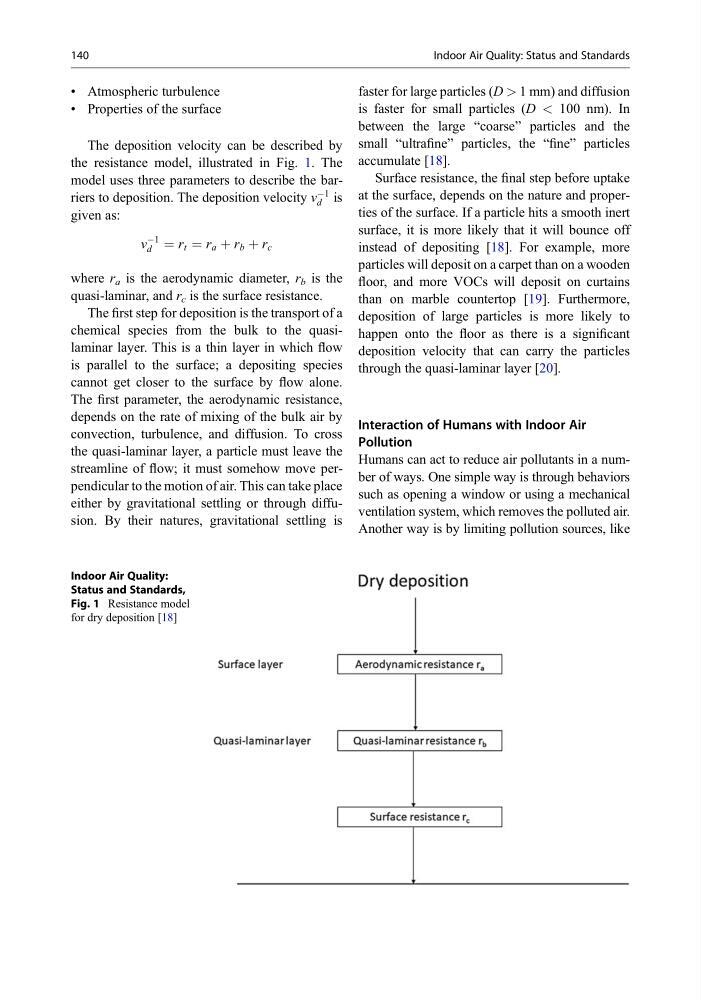
the resistance model, illustrated in Fig. 1. The
model uses three parameters to describe the barriers to deposition. The deposition velocity v
À1
d is
given as:
v
À1
d ¼ r t ¼ r a þ r b þ r c
where r a is the aerodynamic diameter, r b is the
quasi-laminar, and r c is the surface resistance.
The first step for deposition is the transport of a
chemical species from the bulk to the quasilaminar layer. This is a thin layer in which flow
is parallel to the surface; a depositing species
cannot get closer to the surface by flow alone.
The first parameter, the aerodynamic resistance,
depends on the rate of mixing of the bulk air by
convection, turbulence, and diffusion. To cross
the quasi-laminar layer, a particle must leave the
streamline of flow; it must somehow move perpendicular to the motion of air. This can take place
either by gravitational settling or through diffusion. By their natures, gravitational settling is
faster for large particles (D > 1 mm) and diffusion
is faster for small particles (D < 100 nm). In
between the large “coarse” particles and the
small “ultrafine” particles, the “fine” particles
accumulate [18].
Surface resistance, the final step before uptake
at the surface, depends on the nature and properties of the surface. If a particle hits a smooth inert
surface, it is more likely that it will bounce off
instead of depositing [18]. For example, more
particles will deposit on a carpet than on a wooden
floor, and more VOCs will deposit on curtains
than on marble countertop [19]. Furthermore,
deposition of large particles is more likely to
happen onto the floor as there is a significant
deposition velocity that can carry the particles
through the quasi-laminar layer [20].
Interaction of Humans with Indoor Air
Pollution
Humans can act to reduce air pollutants in a number of ways. One simple way is through behaviors
such as opening a window or using a mechanical
ventilation system, which removes the polluted air.
Another way is by limiting pollution sources, like
Indoor Air Quality:
Status and Standards,
Fig. 1 Resistance model
for dry deposition [18]
140
Indoor Air Quality: Status and Standards
• Properties of the surface
The deposition velocity can be described by
the resistance model, illustrated in Fig. 1. The
model uses three parameters to describe the barriers to deposition. The deposition velocity v
À1
d is
given as:
v
À1
d ¼ r t ¼ r a þ r b þ r c
where r a is the aerodynamic diameter, r b is the
quasi-laminar, and r c is the surface resistance.
The first step for deposition is the transport of a
chemical species from the bulk to the quasilaminar layer. This is a thin layer in which flow
is parallel to the surface; a depositing species
cannot get closer to the surface by flow alone.
The first parameter, the aerodynamic resistance,
depends on the rate of mixing of the bulk air by
convection, turbulence, and diffusion. To cross
the quasi-laminar layer, a particle must leave the
streamline of flow; it must somehow move perpendicular to the motion of air. This can take place
either by gravitational settling or through diffusion. By their natures, gravitational settling is
faster for large particles (D > 1 mm) and diffusion
is faster for small particles (D < 100 nm). In
between the large “coarse” particles and the
small “ultrafine” particles, the “fine” particles
accumulate [18].
Surface resistance, the final step before uptake
at the surface, depends on the nature and properties of the surface. If a particle hits a smooth inert
surface, it is more likely that it will bounce off
instead of depositing [18]. For example, more
particles will deposit on a carpet than on a wooden
floor, and more VOCs will deposit on curtains
than on marble countertop [19]. Furthermore,
deposition of large particles is more likely to
happen onto the floor as there is a significant
deposition velocity that can carry the particles
through the quasi-laminar layer [20].
Interaction of Humans with Indoor Air
Pollution
Humans can act to reduce air pollutants in a number of ways. One simple way is through behaviors
such as opening a window or using a mechanical
ventilation system, which removes the polluted air.
Another way is by limiting pollution sources, like
Indoor Air Quality:
Status and Standards,
Fig. 1 Resistance model
for dry deposition [18]
140
Indoor Air Quality: Status and Standards