

physical, or chemical origin. Outdoor air pollution
from whatever source enters a building by entrainment with supply air or infiltration through the
building envelope. Biological pollutants are emissions from living organisms, e.g. CO 2 , water
vapor, bioeffluent gases, mold, bacteria, viruses,
and dandruff. Physical sources of pollutants are
emissions from surfaces commonly found in
households such as furniture, electronics, paints,
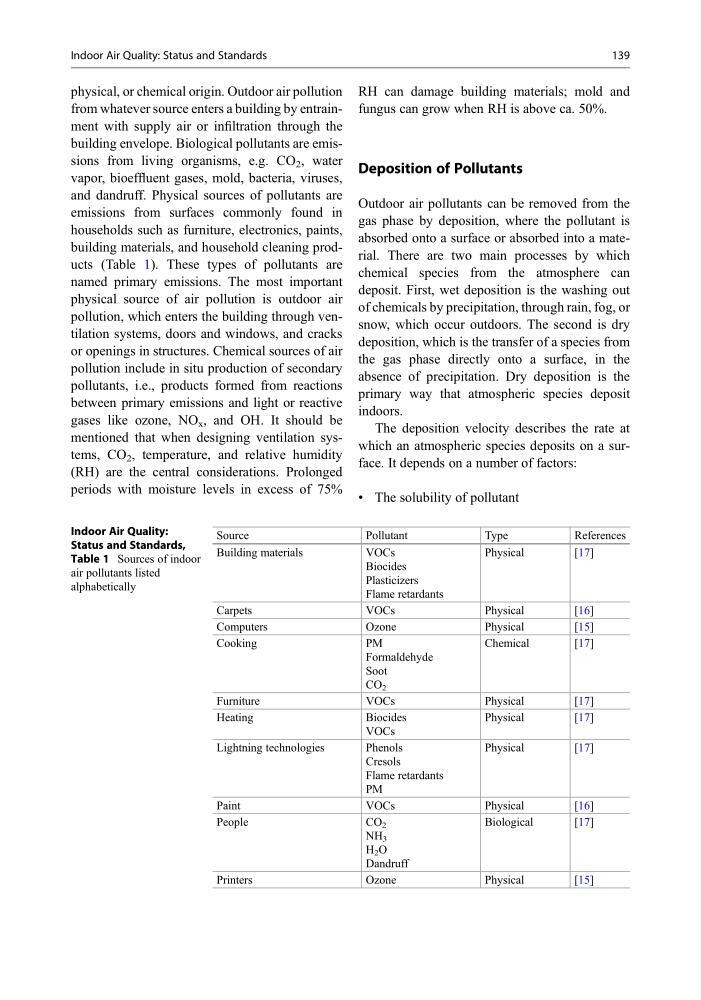
building materials, and household cleaning products (Table 1). These types of pollutants are
named primary emissions. The most important
physical source of air pollution is outdoor air
pollution, which enters the building through ventilation systems, doors and windows, and cracks
or openings in structures. Chemical sources of air
pollution include in situ production of secondary
pollutants, i.e., products formed from reactions
between primary emissions and light or reactive
gases like ozone, NO x , and OH. It should be
mentioned that when designing ventilation systems, CO 2 , temperature, and relative humidity
(RH) are the central considerations. Prolonged
periods with moisture levels in excess of 75%
RH can damage building materials; mold and
fungus can grow when RH is above ca. 50%.
Deposition of Pollutants
Outdoor air pollutants can be removed from the
gas phase by deposition, where the pollutant is
absorbed onto a surface or absorbed into a material. There are two main processes by which
chemical species from the atmosphere can
deposit. First, wet deposition is the washing out
of chemicals by precipitation, through rain, fog, or
snow, which occur outdoors. The second is dry
deposition, which is the transfer of a species from
the gas phase directly onto a surface, in the
absence of precipitation. Dry deposition is the
primary way that atmospheric species deposit
indoors.
The deposition velocity describes the rate at
which an atmospheric species deposits on a surface. It depends on a number of factors:
• The solubility of pollutant
Indoor Air Quality:
Status and Standards,
Table 1 Sources of indoor
air pollutants listed
alphabetically
Source
Pollutant
Type
References
Building materials
VOCs
Biocides
Plasticizers
Flame retardants
Physical
[17]
Carpets
VOCs
Physical
[16]
Computers
Ozone
Physical
[15]
Cooking
PM
Formaldehyde
Soot
CO 2
Chemical
[17]
Furniture
VOCs
Physical
[17]
Heating
Biocides
VOCs
Physical
[17]
Lightning technologies
Phenols
Cresols
Flame retardants
PM
Physical
[17]
Paint
VOCs
Physical
[16]
People
CO 2
NH 3
H 2 O
Dandruff
Biological
[17]
Printers
Ozone
Physical
[15]
Indoor Air Quality: Status and Standards
139
from whatever source enters a building by entrainment with supply air or infiltration through the
building envelope. Biological pollutants are emissions from living organisms, e.g. CO 2 , water
vapor, bioeffluent gases, mold, bacteria, viruses,
and dandruff. Physical sources of pollutants are
emissions from surfaces commonly found in
households such as furniture, electronics, paints,
building materials, and household cleaning products (Table 1). These types of pollutants are
named primary emissions. The most important
physical source of air pollution is outdoor air
pollution, which enters the building through ventilation systems, doors and windows, and cracks
or openings in structures. Chemical sources of air
pollution include in situ production of secondary
pollutants, i.e., products formed from reactions
between primary emissions and light or reactive
gases like ozone, NO x , and OH. It should be
mentioned that when designing ventilation systems, CO 2 , temperature, and relative humidity
(RH) are the central considerations. Prolonged
periods with moisture levels in excess of 75%
RH can damage building materials; mold and
fungus can grow when RH is above ca. 50%.
Deposition of Pollutants
Outdoor air pollutants can be removed from the
gas phase by deposition, where the pollutant is
absorbed onto a surface or absorbed into a material. There are two main processes by which
chemical species from the atmosphere can
deposit. First, wet deposition is the washing out
of chemicals by precipitation, through rain, fog, or
snow, which occur outdoors. The second is dry
deposition, which is the transfer of a species from
the gas phase directly onto a surface, in the
absence of precipitation. Dry deposition is the
primary way that atmospheric species deposit
indoors.
The deposition velocity describes the rate at
which an atmospheric species deposits on a surface. It depends on a number of factors:
• The solubility of pollutant
Indoor Air Quality:
Status and Standards,
Table 1 Sources of indoor
air pollutants listed
alphabetically
Source
Pollutant
Type
References
Building materials
VOCs
Biocides
Plasticizers
Flame retardants
Physical
[17]
Carpets
VOCs
Physical
[16]
Computers
Ozone
Physical
[15]
Cooking
PM
Formaldehyde
Soot
CO 2
Chemical
[17]
Furniture
VOCs
Physical
[17]
Heating
Biocides
VOCs
Physical
[17]
Lightning technologies
Phenols
Cresols
Flame retardants
PM
Physical
[17]
Paint
VOCs
Physical
[16]
People
CO 2
NH 3
H 2 O
Dandruff
Biological
[17]
Printers
Ozone
Physical
[15]
Indoor Air Quality: Status and Standards
139