

particle counter (CPC) is a widely used optical
instrument capable of characterizing aerosols. The
method involves three steps: (I) generation of a
supersaturation of water vapor or another working
fluid, (II) growth of particles by condensation of
the vapors, and (III) the optical detection of the
enlarged particles, by counting individual pulses
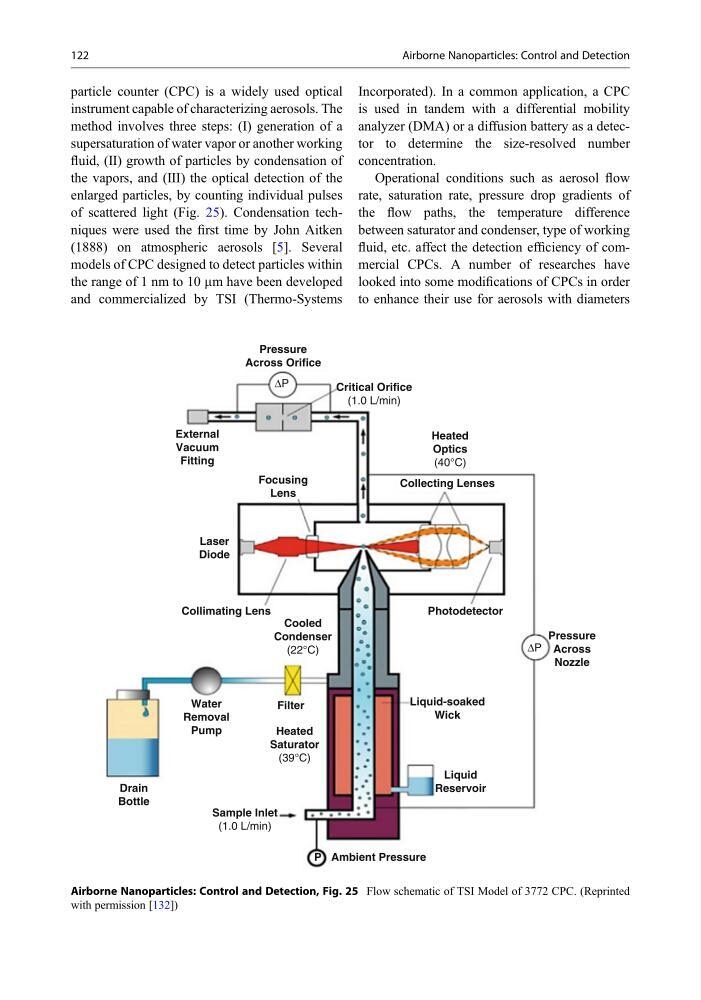
of scattered light (Fig. 25). Condensation techniques were used the first time by John Aitken
(1888) on atmospheric aerosols [5]. Several
models of CPC designed to detect particles within
the range of 1 nm to 10 mm have been developed
and commercialized by TSI (Thermo-Systems
Incorporated). In a common application, a CPC
is used in tandem with a differential mobility
analyzer (DMA) or a diffusion battery as a detector to determine the size-resolved number
concentration.
Operational conditions such as aerosol flow
rate, saturation rate, pressure drop gradients of
the flow paths, the temperature difference
between saturator and condenser, type of working
fluid, etc. affect the detection efficiency of commercial CPCs. A number of researches have
looked into some modifications of CPCs in order
to enhance their use for aerosols with diameters
Pressure
Across Orifice
Focusing
Lens
Heated
Optics
(40°C)
External
Vacuum
Fitting
Critical Orifice
(1.0 L/min)
ΔP
ΔP
Collecting Lenses
Photodetector
Collimating Lens
Laser
Diode
Cooled
Condenser
(22°C)
Filter
Water
Removal
Pump
Heated
Saturator
(39°C)
Drain
Bottle
Sample lnlet
(1.0 L/min)
Ambient Pressure
P
Liquid
Reservoir
Liquid-soaked
Wick
Pressure
Across
Nozzle
Airborne Nanoparticles: Control and Detection, Fig. 25 Flow schematic of TSI Model of 3772 CPC. (Reprinted
with permission [132])
122
Airborne Nanoparticles: Control and Detection
instrument capable of characterizing aerosols. The
method involves three steps: (I) generation of a
supersaturation of water vapor or another working
fluid, (II) growth of particles by condensation of
the vapors, and (III) the optical detection of the
enlarged particles, by counting individual pulses
of scattered light (Fig. 25). Condensation techniques were used the first time by John Aitken
(1888) on atmospheric aerosols [5]. Several
models of CPC designed to detect particles within
the range of 1 nm to 10 mm have been developed
and commercialized by TSI (Thermo-Systems
Incorporated). In a common application, a CPC
is used in tandem with a differential mobility
analyzer (DMA) or a diffusion battery as a detector to determine the size-resolved number
concentration.
Operational conditions such as aerosol flow
rate, saturation rate, pressure drop gradients of
the flow paths, the temperature difference
between saturator and condenser, type of working
fluid, etc. affect the detection efficiency of commercial CPCs. A number of researches have
looked into some modifications of CPCs in order
to enhance their use for aerosols with diameters
Pressure
Across Orifice
Focusing
Lens
Heated
Optics
(40°C)
External
Vacuum
Fitting
Critical Orifice
(1.0 L/min)
ΔP
ΔP
Collecting Lenses
Photodetector
Collimating Lens
Laser
Diode
Cooled
Condenser
(22°C)
Filter
Water
Removal
Pump
Heated
Saturator
(39°C)
Drain
Bottle
Sample lnlet
(1.0 L/min)
Ambient Pressure
P
Liquid
Reservoir
Liquid-soaked
Wick
Pressure
Across
Nozzle
Airborne Nanoparticles: Control and Detection, Fig. 25 Flow schematic of TSI Model of 3772 CPC. (Reprinted
with permission [132])
122
Airborne Nanoparticles: Control and Detection