

differential mobility analyzer (DMA, see
section “Electrical-Based Measurement”) is
widely used. A coupled DMA/APM is capable
of determining the effective density [117], sizeresolved mass information [101], specific surface area [118], dynamic shape factor [119], and
fractal dimension [119] of an aerosol. The
Couette centrifugal particle mass analyzer
(CPMA) is a similar technology, developed by
Olfert and Collings [120] as a mass classifier
similar to the APM. Unlike the APM, the CPMA
applies an improved transfer function to the
classifier using a stable system of forces. The
system has been used recently by Liao et al.
[117] and Johnson et al. [121] to determine the
size-resolved effective density of rural ambient
and cigarette smoke nanoparticles, respectively.
Impaction
Since the development of impactors in 1860, many
impactors have been used in aerosol research
[103]. Cascade impactors such as the Andersen,
Mercer, quartz crystal microbalance (QCM), Pilat,
Berner, low-pressure impactor (LPI) (MOUDI),
and the electric low-pressure impactor (ELPI) are
commercialized versions [122].
Generally, a cascade impactor consists of several stages where each stage has a porous microorifice plate and an impaction plate under it. As a
particle-laden stream passes through the stages,
particles are impacted and thus collected on the
plates. Because of inertia, larger particles are not
able to turn with the streamlines and impact due to
their forward momentum. The geometry of the
Airborne Nanoparticles: Control and Detection,
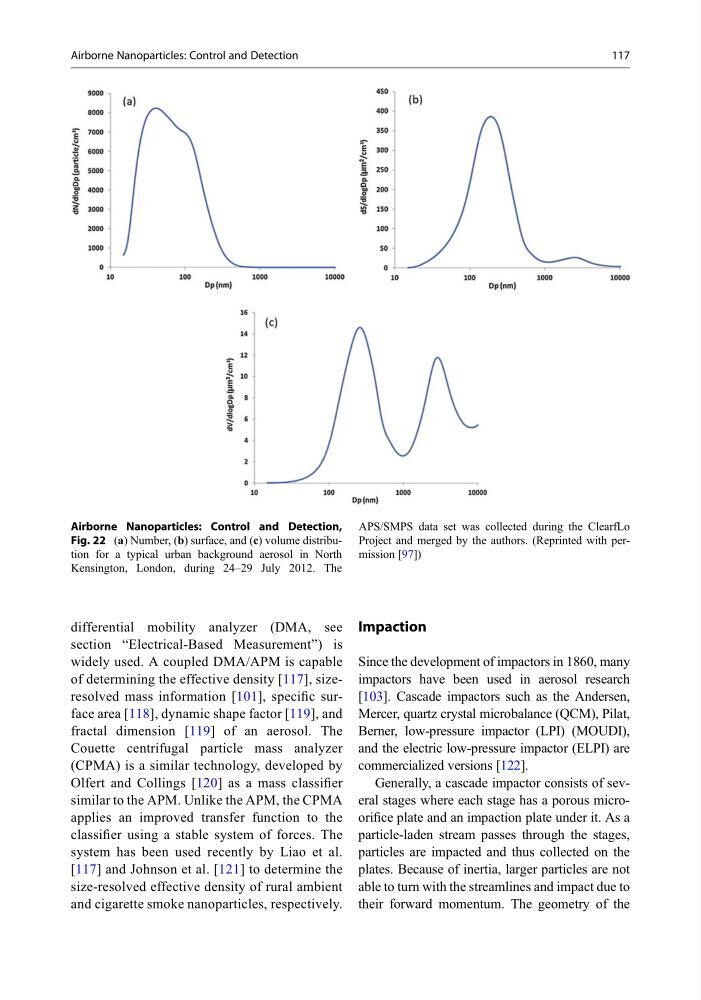
Fig. 22 (a) Number, (b) surface, and (c) volume distribution for a typical urban background aerosol in North
Kensington, London, during 24–29 July 2012. The
APS/SMPS data set was collected during the ClearfLo
Project and merged by the authors. (Reprinted with permission [97])
Airborne Nanoparticles: Control and Detection
117
section “Electrical-Based Measurement”) is
widely used. A coupled DMA/APM is capable
of determining the effective density [117], sizeresolved mass information [101], specific surface area [118], dynamic shape factor [119], and
fractal dimension [119] of an aerosol. The
Couette centrifugal particle mass analyzer
(CPMA) is a similar technology, developed by
Olfert and Collings [120] as a mass classifier
similar to the APM. Unlike the APM, the CPMA
applies an improved transfer function to the
classifier using a stable system of forces. The
system has been used recently by Liao et al.
[117] and Johnson et al. [121] to determine the
size-resolved effective density of rural ambient
and cigarette smoke nanoparticles, respectively.
Impaction
Since the development of impactors in 1860, many
impactors have been used in aerosol research
[103]. Cascade impactors such as the Andersen,
Mercer, quartz crystal microbalance (QCM), Pilat,
Berner, low-pressure impactor (LPI) (MOUDI),
and the electric low-pressure impactor (ELPI) are
commercialized versions [122].
Generally, a cascade impactor consists of several stages where each stage has a porous microorifice plate and an impaction plate under it. As a
particle-laden stream passes through the stages,
particles are impacted and thus collected on the
plates. Because of inertia, larger particles are not
able to turn with the streamlines and impact due to
their forward momentum. The geometry of the
Airborne Nanoparticles: Control and Detection,
Fig. 22 (a) Number, (b) surface, and (c) volume distribution for a typical urban background aerosol in North
Kensington, London, during 24–29 July 2012. The
APS/SMPS data set was collected during the ClearfLo
Project and merged by the authors. (Reprinted with permission [97])
Airborne Nanoparticles: Control and Detection
117