

E f ¼ E R þ E D
ð12Þ
Electrospun Nanofibers
A series of studies have found that electrospinning
is capable of producing a felt or mat of high
porosity electrospun nanofibers which efficiently
and effectively remove ultrafine PM from an air
stream. The diameter of the electrospun nanofibers can be from <2 nm (microporous) to
50 nm (mesoporous) and are a thousand times
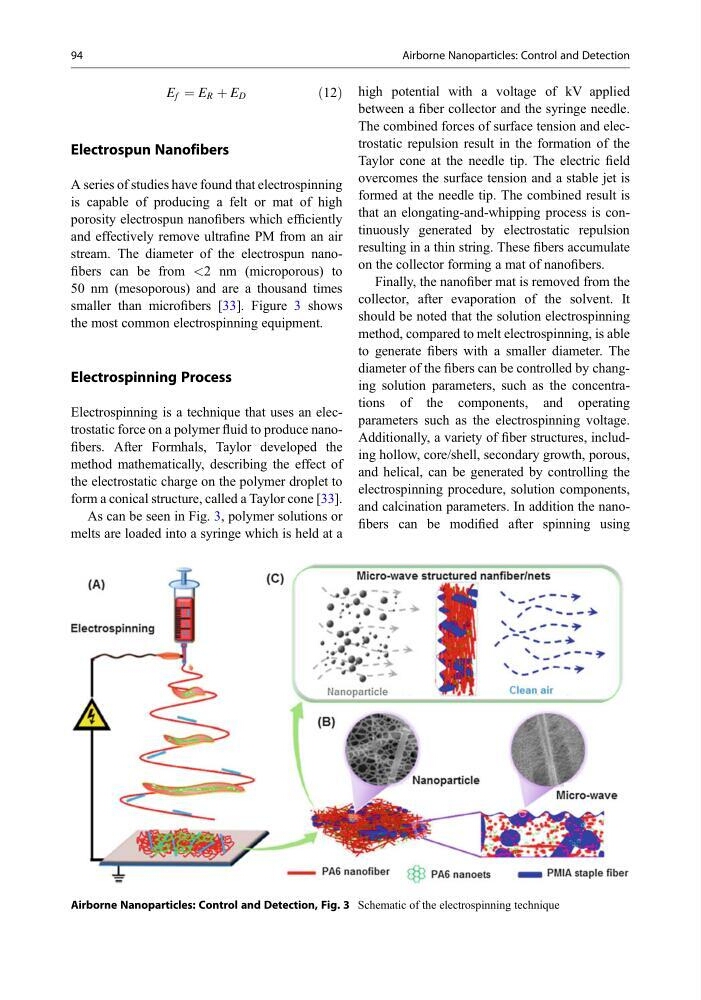
smaller than microfibers [33]. Figure 3 shows
the most common electrospinning equipment.
Electrospinning Process
Electrospinning is a technique that uses an electrostatic force on a polymer fluid to produce nanofibers. After Formhals, Taylor developed the
method mathematically, describing the effect of
the electrostatic charge on the polymer droplet to
form a conical structure, called a Taylor cone [33].
As can be seen in Fig. 3, polymer solutions or
melts are loaded into a syringe which is held at a
high potential with a voltage of kV applied
between a fiber collector and the syringe needle.
The combined forces of surface tension and electrostatic repulsion result in the formation of the
Taylor cone at the needle tip. The electric field
overcomes the surface tension and a stable jet is
formed at the needle tip. The combined result is
that an elongating-and-whipping process is continuously generated by electrostatic repulsion
resulting in a thin string. These fibers accumulate
on the collector forming a mat of nanofibers.
Finally, the nanofiber mat is removed from the
collector, after evaporation of the solvent. It
should be noted that the solution electrospinning
method, compared to melt electrospinning, is able
to generate fibers with a smaller diameter. The
diameter of the fibers can be controlled by changing solution parameters, such as the concentrations of the components, and operating
parameters such as the electrospinning voltage.
Additionally, a variety of fiber structures, including hollow, core/shell, secondary growth, porous,
and helical, can be generated by controlling the
electrospinning procedure, solution components,
and calcination parameters. In addition the nanofibers can be modified after spinning using
Airborne Nanoparticles: Control and Detection, Fig. 3 Schematic of the electrospinning technique
94
Airborne Nanoparticles: Control and Detection
ð12Þ
Electrospun Nanofibers
A series of studies have found that electrospinning
is capable of producing a felt or mat of high
porosity electrospun nanofibers which efficiently
and effectively remove ultrafine PM from an air
stream. The diameter of the electrospun nanofibers can be from <2 nm (microporous) to
50 nm (mesoporous) and are a thousand times
smaller than microfibers [33]. Figure 3 shows
the most common electrospinning equipment.
Electrospinning Process
Electrospinning is a technique that uses an electrostatic force on a polymer fluid to produce nanofibers. After Formhals, Taylor developed the
method mathematically, describing the effect of
the electrostatic charge on the polymer droplet to
form a conical structure, called a Taylor cone [33].
As can be seen in Fig. 3, polymer solutions or
melts are loaded into a syringe which is held at a
high potential with a voltage of kV applied
between a fiber collector and the syringe needle.
The combined forces of surface tension and electrostatic repulsion result in the formation of the
Taylor cone at the needle tip. The electric field
overcomes the surface tension and a stable jet is
formed at the needle tip. The combined result is
that an elongating-and-whipping process is continuously generated by electrostatic repulsion
resulting in a thin string. These fibers accumulate
on the collector forming a mat of nanofibers.
Finally, the nanofiber mat is removed from the
collector, after evaporation of the solvent. It
should be noted that the solution electrospinning
method, compared to melt electrospinning, is able
to generate fibers with a smaller diameter. The
diameter of the fibers can be controlled by changing solution parameters, such as the concentrations of the components, and operating
parameters such as the electrospinning voltage.
Additionally, a variety of fiber structures, including hollow, core/shell, secondary growth, porous,
and helical, can be generated by controlling the
electrospinning procedure, solution components,
and calcination parameters. In addition the nanofibers can be modified after spinning using
Airborne Nanoparticles: Control and Detection, Fig. 3 Schematic of the electrospinning technique
94
Airborne Nanoparticles: Control and Detection