

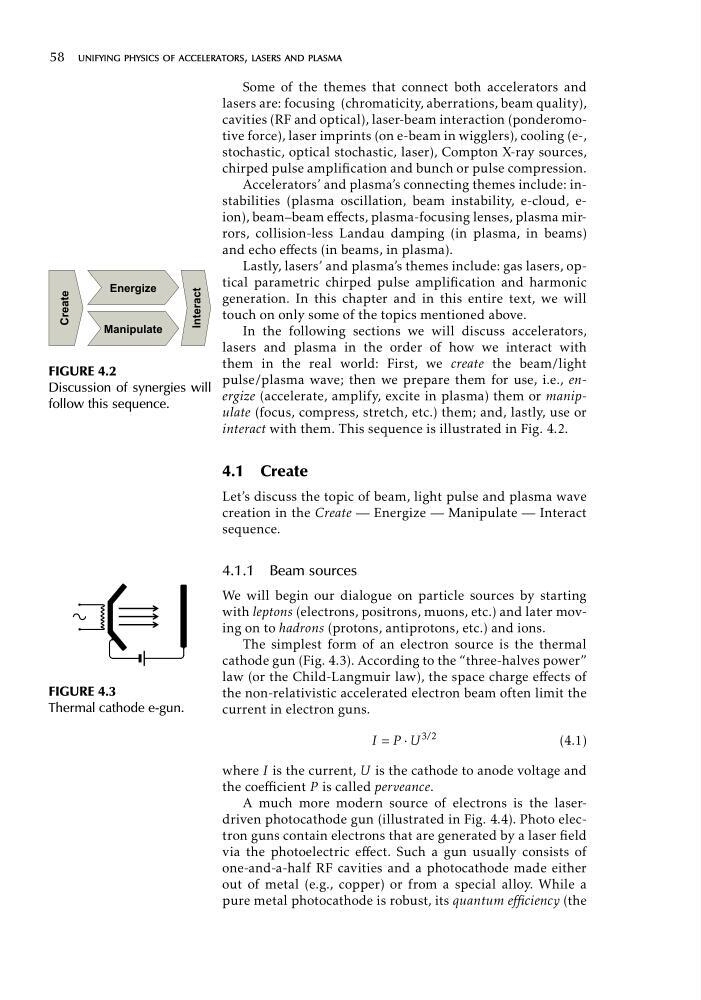
FIGURE 4.3
Thermal cathode e-gun.
58 unifying physics of accelerators, lasers and plasma
Some of the themes that connect both accelerators and
lasers are: focusing (chromaticity, aberrations, beam quality),
cavities (RF and optical), laser-beam interaction (ponderomotive force), laser imprints (on e-beam in wigglers), cooling (e-,
stochastic, optical stochastic, laser), Compton X-ray sources,
chirped pulse amplification and bunch or pulse compression.
Accelerators’ and plasma’s connecting themes include: instabilities (plasma oscillation, beam instability, e-cloud, eion), beam–beam effects, plasma-focusing lenses, plasma mirrors, collision-less Landau damping (in plasma, in beams)
and echo effects (in beams, in plasma).
FIGURE 4.2
Discussion of synergies will
follow this sequence.
Lastly, lasers’ and plasma’s themes include: gas lasers, optical parametric chirped pulse amplification and harmonic
generation. In this chapter and in this entire text, we will
touch on only some of the topics mentioned above.
In the following sections we will discuss accelerators,
lasers and plasma in the order of how we interact with
them in the real world: First, we create the beam/light
pulse/plasma wave; then we prepare them for use, i.e., energize (accelerate, amplify, excite in plasma) them or manipulate (focus, compress, stretch, etc.) them; and, lastly, use or
interact with them. This sequence is illustrated in Fig. 4.2.
4.1 Create
Let’s discuss the topic of beam, light pulse and plasma wave
creation in the Create — Energize — Manipulate — Interact
sequence.
4.1.1 Beam sources
We will begin our dialogue on particle sources by starting
with leptons (electrons, positrons, muons, etc.) and later moving on to hadrons (protons, antiprotons, etc.) and ions.
The simplest form of an electron source is the thermal
cathode gun (Fig. 4.3). According to the “three-halves power”
law (or the Child-Langmuir law), the space charge effects of
the non-relativistic accelerated electron beam often limit the
current in electron guns.
I = P · U
3/2
(4.1)
where I is the current, U is the cathode to anode voltage and
the coefficient P is called perveance.
A much more modern source of electrons is the laserdriven photocathode gun (illustrated in Fig. 4.4). Photo electron guns contain electrons that are generated by a laser field
via the photoelectric effect. Such a gun usually consists of
one-and-a-half RF cavities and a photocathode made either
out of metal (e.g., copper) or from a special alloy. While a
pure metal photocathode is robust, its quantum efficiency (the
Thermal cathode e-gun.
58 unifying physics of accelerators, lasers and plasma
Some of the themes that connect both accelerators and
lasers are: focusing (chromaticity, aberrations, beam quality),
cavities (RF and optical), laser-beam interaction (ponderomotive force), laser imprints (on e-beam in wigglers), cooling (e-,
stochastic, optical stochastic, laser), Compton X-ray sources,
chirped pulse amplification and bunch or pulse compression.
Accelerators’ and plasma’s connecting themes include: instabilities (plasma oscillation, beam instability, e-cloud, eion), beam–beam effects, plasma-focusing lenses, plasma mirrors, collision-less Landau damping (in plasma, in beams)
and echo effects (in beams, in plasma).
FIGURE 4.2
Discussion of synergies will
follow this sequence.
Lastly, lasers’ and plasma’s themes include: gas lasers, optical parametric chirped pulse amplification and harmonic
generation. In this chapter and in this entire text, we will
touch on only some of the topics mentioned above.
In the following sections we will discuss accelerators,
lasers and plasma in the order of how we interact with
them in the real world: First, we create the beam/light
pulse/plasma wave; then we prepare them for use, i.e., energize (accelerate, amplify, excite in plasma) them or manipulate (focus, compress, stretch, etc.) them; and, lastly, use or
interact with them. This sequence is illustrated in Fig. 4.2.
4.1 Create
Let’s discuss the topic of beam, light pulse and plasma wave
creation in the Create — Energize — Manipulate — Interact
sequence.
4.1.1 Beam sources
We will begin our dialogue on particle sources by starting
with leptons (electrons, positrons, muons, etc.) and later moving on to hadrons (protons, antiprotons, etc.) and ions.
The simplest form of an electron source is the thermal
cathode gun (Fig. 4.3). According to the “three-halves power”
law (or the Child-Langmuir law), the space charge effects of
the non-relativistic accelerated electron beam often limit the
current in electron guns.
I = P · U
3/2
(4.1)
where I is the current, U is the cathode to anode voltage and
the coefficient P is called perveance.
A much more modern source of electrons is the laserdriven photocathode gun (illustrated in Fig. 4.4). Photo electron guns contain electrons that are generated by a laser field
via the photoelectric effect. Such a gun usually consists of
one-and-a-half RF cavities and a photocathode made either
out of metal (e.g., copper) or from a special alloy. While a
pure metal photocathode is robust, its quantum efficiency (the