

34 unifying physics of accelerators, lasers and plasma
can be easily proven, J 2 = −I and thus M 2 = cos 2μ·I+sin 2μ·J.
Similarly, one can show that
(
)
cos nμ + α 0 sin nμ
β 0 sin nμ
M
n =
(2.37)
−γ 0 sin nμ
cos nμ − α 0 sin nμ
Observing the expression for this periodic transverse
map, one can conclude that stability of the transverse motion
necessarily requires the phase advance μ to be a real number,
which ensures that the multi-turn motion represents stable
oscillations. The condition of μ being real can be re-written
as | cos μ| < 1 or as a more general expression involving the
trace or spur (sum of its diagonal elements) of the transfer
matrix
1
| cos μ| = |tr M| < 1
(2.38)
2
The criteria defined above is a necessary condition for a transfer line to be suitable for multi-turn stable dynamics. We are
now ready to apply this criteria to a practical example.
2.4.9 Stability of a FODO lattice
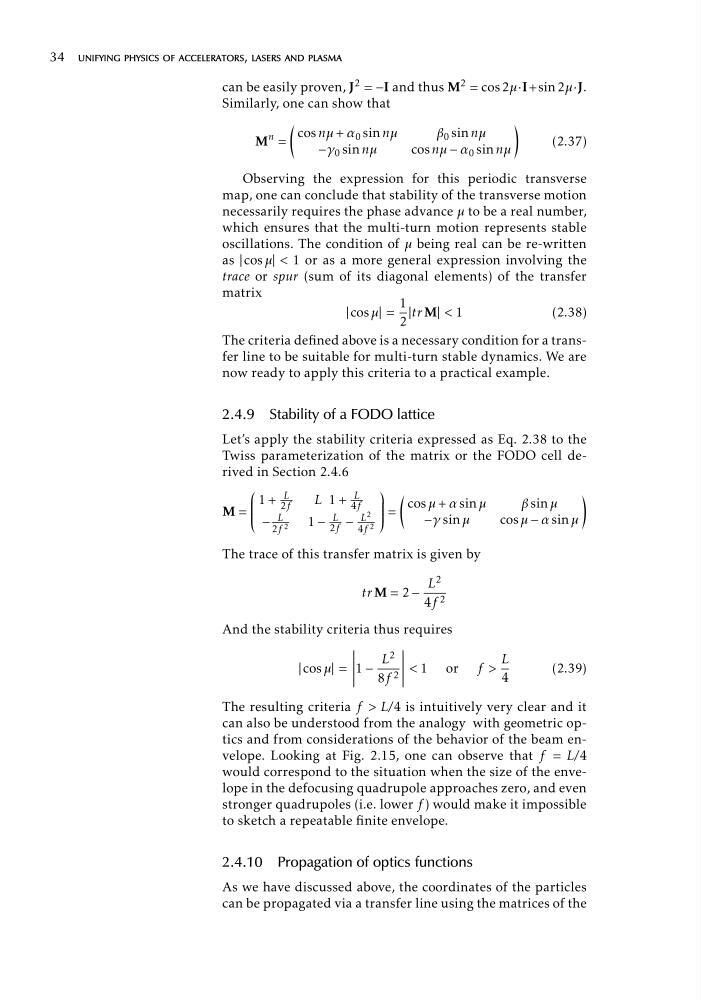
Let’s apply the stability criteria expressed as Eq. 2.38 to the
Twiss parameterization of the matrix or the FODO cell derived in Section 2.4.6
⎛
⎞ (
)
⎜ 1 +
L
L 1 +
L
⎟
⎜
⎟
cos μ + α sin μ
β sin μ
⎜
2f
4f
⎟
M = ⎜
⎟ ⎟ =
⎜
L
L
L 2
⎝ −
1 − −
⎠
−γ sin μ
cos μ − α sin μ
2f 2
2f
4f 2
The trace of this transfer matrix is given by
L 2
tr M = 2 − 4f 2
And the stability criteria thus requires
L 2
L
| cos μ| = 1 −
< 1 or f >
(2.39)
8f 2
4
The resulting criteria f > L/4 is intuitively very clear and it
can also be understood from the analogy with geometric optics and from considerations of the behavior of the beam envelope. Looking at Fig. 2.15, one can observe that f = L/4
would correspond to the situation when the size of the envelope in the defocusing quadrupole approaches zero, and even
stronger quadrupoles (i.e. lower f ) would make it impossible
to sketch a repeatable finite envelope.
2.4.10 Propagation of optics functions
As we have discussed above, the coordinates of the particles
can be propagated via a transfer line using the matrices of the
can be easily proven, J 2 = −I and thus M 2 = cos 2μ·I+sin 2μ·J.
Similarly, one can show that
(
)
cos nμ + α 0 sin nμ
β 0 sin nμ
M
n =
(2.37)
−γ 0 sin nμ
cos nμ − α 0 sin nμ
Observing the expression for this periodic transverse
map, one can conclude that stability of the transverse motion
necessarily requires the phase advance μ to be a real number,
which ensures that the multi-turn motion represents stable
oscillations. The condition of μ being real can be re-written
as | cos μ| < 1 or as a more general expression involving the
trace or spur (sum of its diagonal elements) of the transfer
matrix
1
| cos μ| = |tr M| < 1
(2.38)
2
The criteria defined above is a necessary condition for a transfer line to be suitable for multi-turn stable dynamics. We are
now ready to apply this criteria to a practical example.
2.4.9 Stability of a FODO lattice
Let’s apply the stability criteria expressed as Eq. 2.38 to the
Twiss parameterization of the matrix or the FODO cell derived in Section 2.4.6
⎛
⎞ (
)
⎜ 1 +
L
L 1 +
L
⎟
⎜
⎟
cos μ + α sin μ
β sin μ
⎜
2f
4f
⎟
M = ⎜
⎟ ⎟ =
⎜
L
L
L 2
⎝ −
1 − −
⎠
−γ sin μ
cos μ − α sin μ
2f 2
2f
4f 2
The trace of this transfer matrix is given by
L 2
tr M = 2 − 4f 2
And the stability criteria thus requires
L 2
L
| cos μ| = 1 −
< 1 or f >
(2.39)
8f 2
4
The resulting criteria f > L/4 is intuitively very clear and it
can also be understood from the analogy with geometric optics and from considerations of the behavior of the beam envelope. Looking at Fig. 2.15, one can observe that f = L/4
would correspond to the situation when the size of the envelope in the defocusing quadrupole approaches zero, and even
stronger quadrupoles (i.e. lower f ) would make it impossible
to sketch a repeatable finite envelope.
2.4.10 Propagation of optics functions
As we have discussed above, the coordinates of the particles
can be propagated via a transfer line using the matrices of the