

32 unifying physics of accelerators, lasers and plasma
two lenses (in linear approximation), properly spaced and located, can provide an arbitrary demagnification.
In a direct analogy to geometrical optics, two focusing
doublets are needed in order to create a telescope with arbitrary demagnification in the case of magnetic element optics
(i.e., four quadrupoles appropriately placed and spaced).
FIGURE 2.14
Optical telescope with two lenses.
The comparison of geometrical optics to magnetic element
optics is a powerful method that often helps for back-of-theFour quadrupoles are needed envelope evaluations of various optical systems.
to create a telescope with arbitrary demagnification for 2.4.6 An example of a FODO lattice
charged particle optics.
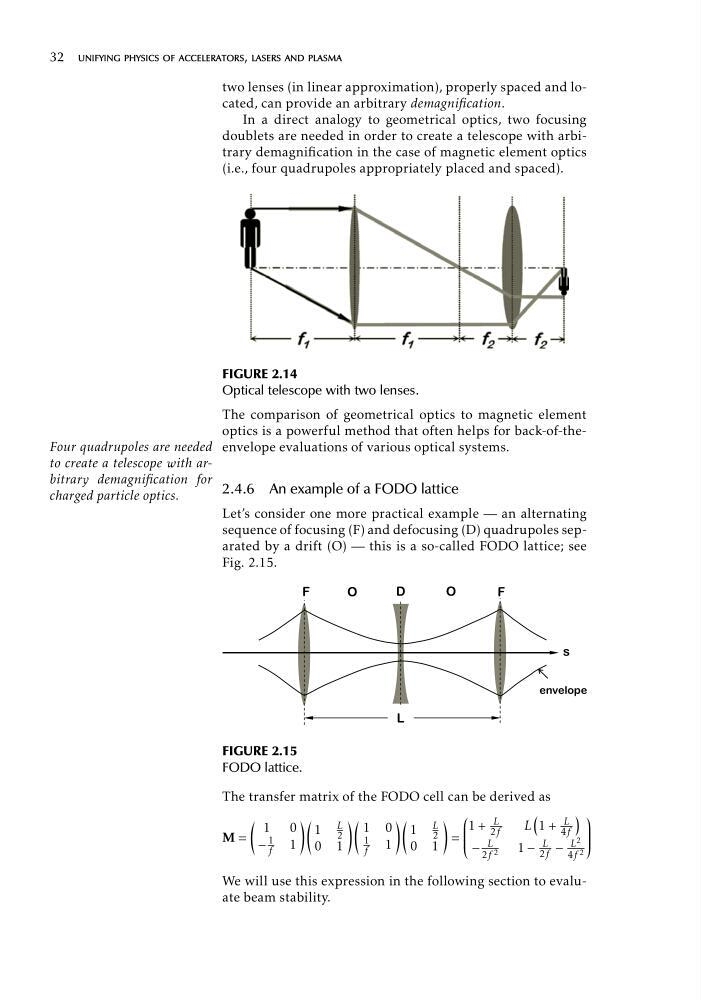
Let’s consider one more practical example — an alternating
sequence of focusing (F) and defocusing (D) quadrupoles separated by a drift (O) — this is a so-called FODO lattice; see
Fig. 2.15.
/
)
)
2
2
'
V
HQYHORSH
FIGURE 2.15
FODO lattice.
The transfer matrix of the FODO cell can be derived as
(
1 0
)(
1
L
)(
1 0
L
1
)
L
=
)(
L
M
=
⎛
⎜1 +
L 1 +
⎜ ⎜
2f
4
2
2
f
1
−
1
1 0 1
1 0 1
⎜ ⎜ −
− −
2
L
L
f
f
1
L
2f 2
2f
4f 2
⎞
⎟ ⎟
We will use this expression in the following section to evalu⎟
⎟
⎝
⎠
⎟
ate beam stability.
two lenses (in linear approximation), properly spaced and located, can provide an arbitrary demagnification.
In a direct analogy to geometrical optics, two focusing
doublets are needed in order to create a telescope with arbitrary demagnification in the case of magnetic element optics
(i.e., four quadrupoles appropriately placed and spaced).
FIGURE 2.14
Optical telescope with two lenses.
The comparison of geometrical optics to magnetic element
optics is a powerful method that often helps for back-of-theFour quadrupoles are needed envelope evaluations of various optical systems.
to create a telescope with arbitrary demagnification for 2.4.6 An example of a FODO lattice
charged particle optics.
Let’s consider one more practical example — an alternating
sequence of focusing (F) and defocusing (D) quadrupoles separated by a drift (O) — this is a so-called FODO lattice; see
Fig. 2.15.
/
)
)
2
2
'
V
HQYHORSH
FIGURE 2.15
FODO lattice.
The transfer matrix of the FODO cell can be derived as
(
1 0
)(
1
L
)(
1 0
L
1
)
L
=
)(
L
M
=
⎛
⎜1 +
L 1 +
⎜ ⎜
2f
4
2
2
f
1
−
1
1 0 1
1 0 1
⎜ ⎜ −
− −
2
L
L
f
f
1
L
2f 2
2f
4f 2
⎞
⎟ ⎟
We will use this expression in the following section to evalu⎟
⎟
⎝
⎠
⎟
ate beam stability.