

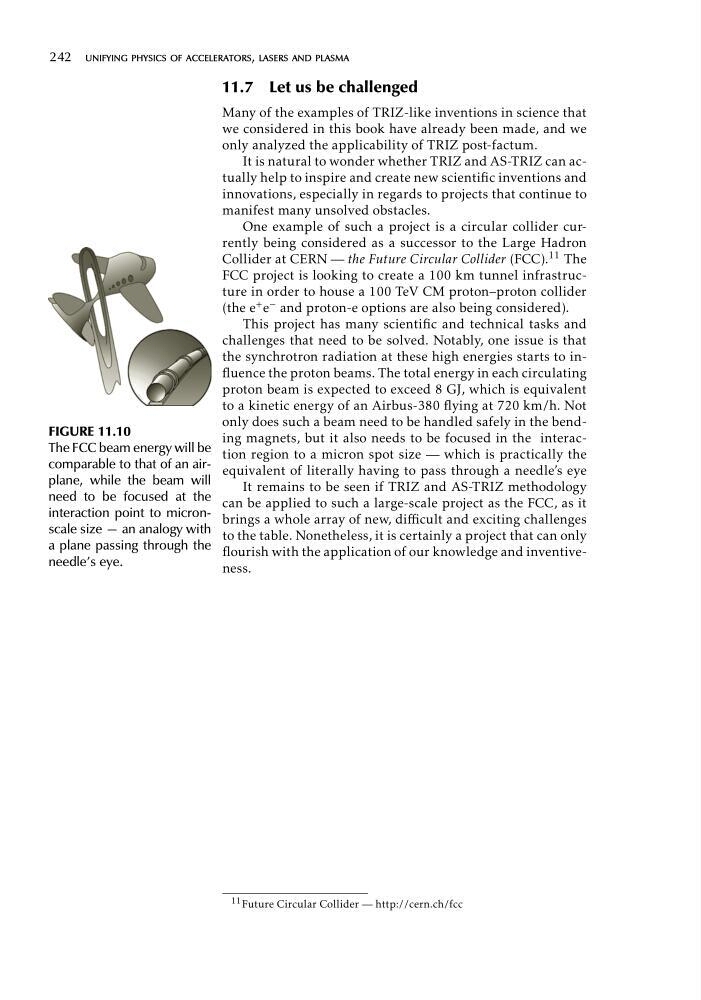
FIGURE 11.10
The FCC beam energy will be
comparable to that of an airplane, while the beam will
need to be focused at the
interaction point to micronscale size — an analogy with
a plane passing through the
needle’s eye.
242 unifying physics of accelerators, lasers and plasma
11.7 Let us be challenged
Many of the examples of TRIZ-like inventions in science that
we considered in this book have already been made, and we
only analyzed the applicability of TRIZ post-factum.
It is natural to wonder whether TRIZ and AS-TRIZ can actually help to inspire and create new scientific inventions and
innovations, especially in regards to projects that continue to
manifest many unsolved obstacles.
One example of such a project is a circular collider currently being considered as a successor to the Large Hadron
Collider at CERN — the Future Circular Collider (FCC). 11 The
FCC project is looking to create a 100 km tunnel infrastructure in order to house a 100 TeV CM proton–proton collider
(the e + e − and proton-e options are also being considered).
This project has many scientific and technical tasks and
challenges that need to be solved. Notably, one issue is that
the synchrotron radiation at these high energies starts to influence the proton beams. The total energy in each circulating
proton beam is expected to exceed 8 GJ, which is equivalent
to a kinetic energy of an Airbus-380 flying at 720 km/h. Not
only does such a beam need to be handled safely in the bending magnets, but it also needs to be focused in the interaction region to a micron spot size — which is practically the
equivalent of literally having to pass through a needle’s eye
It remains to be seen if TRIZ and AS-TRIZ methodology
can be applied to such a large-scale project as the FCC, as it
brings a whole array of new, difficult and exciting challenges
to the table. Nonetheless, it is certainly a project that can only
flourish with the application of our knowledge and inventiveness.
11 Future Circular Collider — http://cern.ch/fcc
The FCC beam energy will be
comparable to that of an airplane, while the beam will
need to be focused at the
interaction point to micronscale size — an analogy with
a plane passing through the
needle’s eye.
242 unifying physics of accelerators, lasers and plasma
11.7 Let us be challenged
Many of the examples of TRIZ-like inventions in science that
we considered in this book have already been made, and we
only analyzed the applicability of TRIZ post-factum.
It is natural to wonder whether TRIZ and AS-TRIZ can actually help to inspire and create new scientific inventions and
innovations, especially in regards to projects that continue to
manifest many unsolved obstacles.
One example of such a project is a circular collider currently being considered as a successor to the Large Hadron
Collider at CERN — the Future Circular Collider (FCC). 11 The
FCC project is looking to create a 100 km tunnel infrastructure in order to house a 100 TeV CM proton–proton collider
(the e + e − and proton-e options are also being considered).
This project has many scientific and technical tasks and
challenges that need to be solved. Notably, one issue is that
the synchrotron radiation at these high energies starts to influence the proton beams. The total energy in each circulating
proton beam is expected to exceed 8 GJ, which is equivalent
to a kinetic energy of an Airbus-380 flying at 720 km/h. Not
only does such a beam need to be handled safely in the bending magnets, but it also needs to be focused in the interaction region to a micron spot size — which is practically the
equivalent of literally having to pass through a needle’s eye
It remains to be seen if TRIZ and AS-TRIZ methodology
can be applied to such a large-scale project as the FCC, as it
brings a whole array of new, difficult and exciting challenges
to the table. Nonetheless, it is certainly a project that can only
flourish with the application of our knowledge and inventiveness.
11 Future Circular Collider — http://cern.ch/fcc