

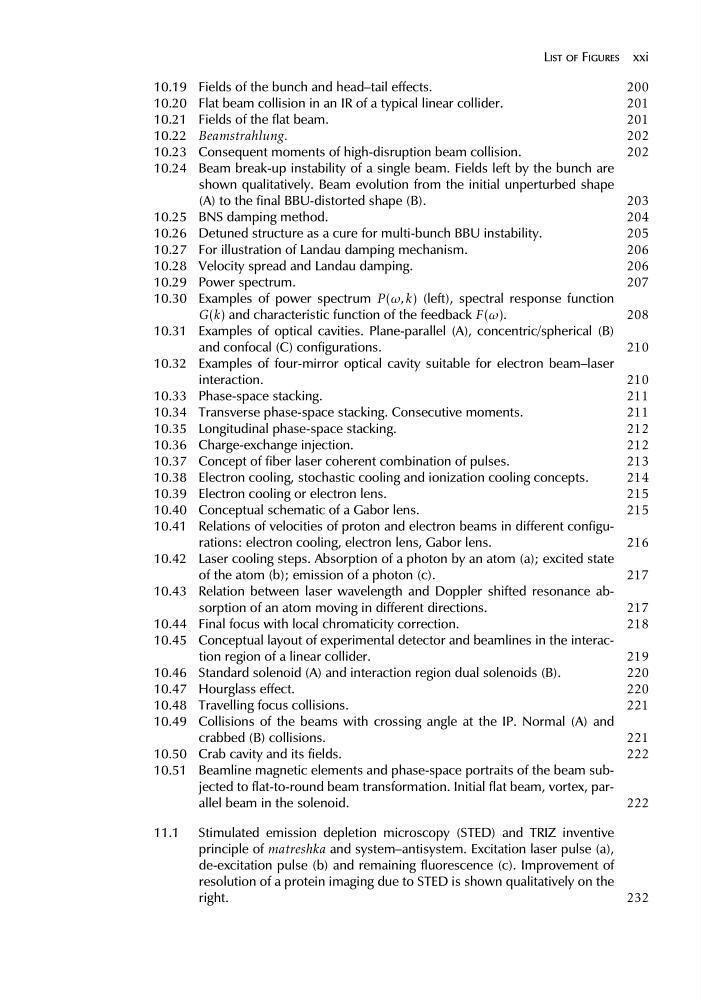
List of Figures xxi
10.19 Fields of the bunch and head–tail effects.
200
10.20 Flat beam collision in an IR of a typical linear collider.
201
10.21 Fields of the flat beam.
201
10.22 Beamstrahlung.
202
10.23 Consequent moments of high-disruption beam collision.
202
10.24 Beam break-up instability of a single beam. Fields left by the bunch are
shown qualitatively. Beam evolution from the initial unperturbed shape
(A) to the final BBU-distorted shape (B).
203
10.25 BNS damping method.
204
10.26 Detuned structure as a cure for multi-bunch BBU instability.
205
10.27 For illustration of Landau damping mechanism.
206
10.28 Velocity spread and Landau damping.
206
10.29 Power spectrum.
207
10.30 Examples of power spectrum P(ω, k) (left), spectral response function
G(k) and characteristic function of the feedback F(ω).
208
10.31 Examples of optical cavities. Plane-parallel (A), concentric/spherical (B)
and confocal (C) configurations.
210
10.32 Examples of four-mirror optical cavity suitable for electron beam–laser
interaction.
210
10.33 Phase-space stacking.
211
10.34 Transverse phase-space stacking. Consecutive moments.
211
10.35 Longitudinal phase-space stacking.
212
10.36 Charge-exchange injection.
212
10.37 Concept of fiber laser coherent combination of pulses.
213
10.38 Electron cooling, stochastic cooling and ionization cooling concepts.
214
10.39 Electron cooling or electron lens.
215
10.40 Conceptual schematic of a Gabor lens.
215
10.41 Relations of velocities of proton and electron beams in different configurations: electron cooling, electron lens, Gabor lens.
216
10.42 Laser cooling steps. Absorption of a photon by an atom (a); excited state
of the atom (b); emission of a photon (c).
217
10.43 Relation between laser wavelength and Doppler shifted resonance absorption of an atom moving in different directions.
217
10.44 Final focus with local chromaticity correction.
218
10.45 Conceptual layout of experimental detector and beamlines in the interaction region of a linear collider.
219
10.46 Standard solenoid (A) and interaction region dual solenoids (B).
220
10.47 Hourglass effect.
220
10.48 Travelling focus collisions.
221
10.49 Collisions of the beams with crossing angle at the IP. Normal (A) and
crabbed (B) collisions.
221
10.50 Crab cavity and its fields.
222
10.51 Beamline magnetic elements and phase-space portraits of the beam subjected to flat-to-round beam transformation. Initial flat beam, vortex, parallel beam in the solenoid.
222
11.1 Stimulated emission depletion microscopy (STED) and TRIZ inventive
principle of matreshka and system–antisystem. Excitation laser pulse (a),
de-excitation pulse (b) and remaining fluorescence (c). Improvement of
resolution of a protein imaging due to STED is shown qualitatively on the
right.
232
10.19 Fields of the bunch and head–tail effects.
200
10.20 Flat beam collision in an IR of a typical linear collider.
201
10.21 Fields of the flat beam.
201
10.22 Beamstrahlung.
202
10.23 Consequent moments of high-disruption beam collision.
202
10.24 Beam break-up instability of a single beam. Fields left by the bunch are
shown qualitatively. Beam evolution from the initial unperturbed shape
(A) to the final BBU-distorted shape (B).
203
10.25 BNS damping method.
204
10.26 Detuned structure as a cure for multi-bunch BBU instability.
205
10.27 For illustration of Landau damping mechanism.
206
10.28 Velocity spread and Landau damping.
206
10.29 Power spectrum.
207
10.30 Examples of power spectrum P(ω, k) (left), spectral response function
G(k) and characteristic function of the feedback F(ω).
208
10.31 Examples of optical cavities. Plane-parallel (A), concentric/spherical (B)
and confocal (C) configurations.
210
10.32 Examples of four-mirror optical cavity suitable for electron beam–laser
interaction.
210
10.33 Phase-space stacking.
211
10.34 Transverse phase-space stacking. Consecutive moments.
211
10.35 Longitudinal phase-space stacking.
212
10.36 Charge-exchange injection.
212
10.37 Concept of fiber laser coherent combination of pulses.
213
10.38 Electron cooling, stochastic cooling and ionization cooling concepts.
214
10.39 Electron cooling or electron lens.
215
10.40 Conceptual schematic of a Gabor lens.
215
10.41 Relations of velocities of proton and electron beams in different configurations: electron cooling, electron lens, Gabor lens.
216
10.42 Laser cooling steps. Absorption of a photon by an atom (a); excited state
of the atom (b); emission of a photon (c).
217
10.43 Relation between laser wavelength and Doppler shifted resonance absorption of an atom moving in different directions.
217
10.44 Final focus with local chromaticity correction.
218
10.45 Conceptual layout of experimental detector and beamlines in the interaction region of a linear collider.
219
10.46 Standard solenoid (A) and interaction region dual solenoids (B).
220
10.47 Hourglass effect.
220
10.48 Travelling focus collisions.
221
10.49 Collisions of the beams with crossing angle at the IP. Normal (A) and
crabbed (B) collisions.
221
10.50 Crab cavity and its fields.
222
10.51 Beamline magnetic elements and phase-space portraits of the beam subjected to flat-to-round beam transformation. Initial flat beam, vortex, parallel beam in the solenoid.
222
11.1 Stimulated emission depletion microscopy (STED) and TRIZ inventive
principle of matreshka and system–antisystem. Excitation laser pulse (a),
de-excitation pulse (b) and remaining fluorescence (c). Improvement of
resolution of a protein imaging due to STED is shown qualitatively on the
right.
232