

188 unifying physics of accelerators, lasers and plasma
should adjust the value of R 65 (energy chirp induced by the
RF cavity) in such a way that
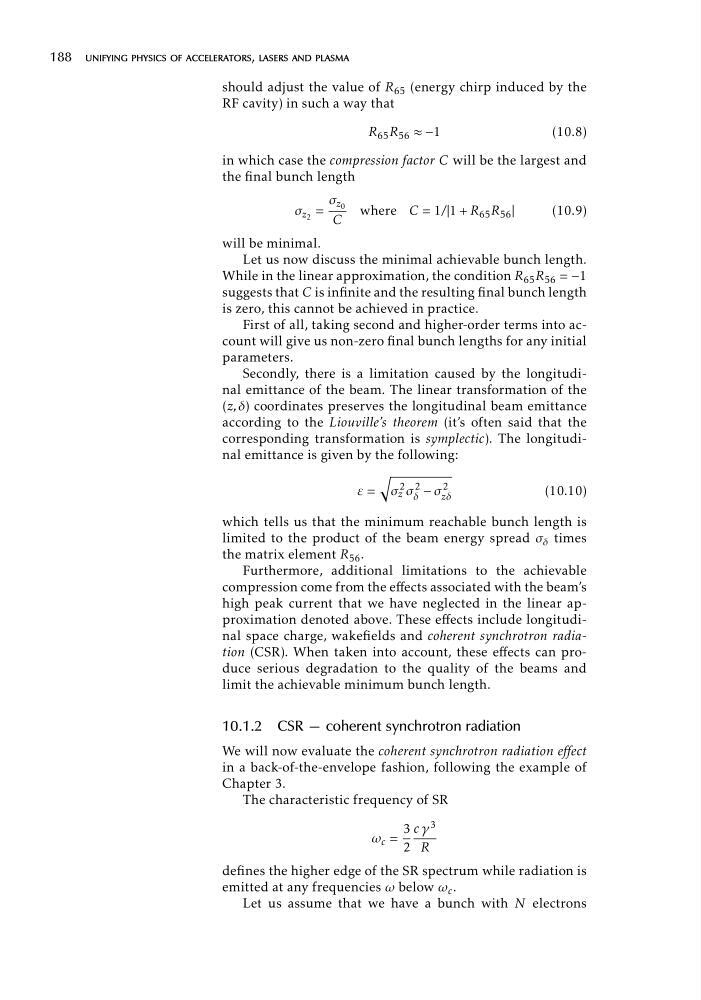
R 65 R 56 ≈ −1
(10.8)
in which case the compression factor C will be the largest and
the final bunch length
σ z 2 =
σ z 0 where C = 1/|1 + R 65 R 56 |
(10.9)
C
will be minimal.
Let us now discuss the minimal achievable bunch length.
While in the linear approximation, the condition R 65 R 56 = −1
suggests that C is infinite and the resulting final bunch length
is zero, this cannot be achieved in practice.
First of all, taking second and higher-order terms into account will give us non-zero final bunch lengths for any initial
parameters.
Secondly, there is a limitation caused by the longitudinal emittance of the beam. The linear transformation of the
(z, δ) coordinates preserves the longitudinal beam emittance
according to the Liouville’s theorem (it’s often said that the
corresponding transformation is symplectic). The longitudinal emittance is given by the following:
)
ε = σ z
2 σ
2
− σ
2
(10.10)
δ
zδ
which tells us that the minimum reachable bunch length is
limited to the product of the beam energy spread σ δ times
the matrix element R 56 .
Furthermore, additional limitations to the achievable
compression come from the effects associated with the beam’s
high peak current that we have neglected in the linear approximation denoted above. These effects include longitudinal space charge, wakefields and coherent synchrotron radiation (CSR). When taken into account, these effects can produce serious degradation to the quality of the beams and
limit the achievable minimum bunch length.
10.1.2 CSR — coherent synchrotron radiation
We will now evaluate the coherent synchrotron radiation effect
in a back-of-the-envelope fashion, following the example of
Chapter 3.
The characteristic frequency of SR
3 c γ 3
ω c = 2 R
defines the higher edge of the SR spectrum while radiation is
emitted at any frequencies ω below ω c .
Let us assume that we have a bunch with N electrons
should adjust the value of R 65 (energy chirp induced by the
RF cavity) in such a way that
R 65 R 56 ≈ −1
(10.8)
in which case the compression factor C will be the largest and
the final bunch length
σ z 2 =
σ z 0 where C = 1/|1 + R 65 R 56 |
(10.9)
C
will be minimal.
Let us now discuss the minimal achievable bunch length.
While in the linear approximation, the condition R 65 R 56 = −1
suggests that C is infinite and the resulting final bunch length
is zero, this cannot be achieved in practice.
First of all, taking second and higher-order terms into account will give us non-zero final bunch lengths for any initial
parameters.
Secondly, there is a limitation caused by the longitudinal emittance of the beam. The linear transformation of the
(z, δ) coordinates preserves the longitudinal beam emittance
according to the Liouville’s theorem (it’s often said that the
corresponding transformation is symplectic). The longitudinal emittance is given by the following:
)
ε = σ z
2 σ
2
− σ
2
(10.10)
δ
zδ
which tells us that the minimum reachable bunch length is
limited to the product of the beam energy spread σ δ times
the matrix element R 56 .
Furthermore, additional limitations to the achievable
compression come from the effects associated with the beam’s
high peak current that we have neglected in the linear approximation denoted above. These effects include longitudinal space charge, wakefields and coherent synchrotron radiation (CSR). When taken into account, these effects can produce serious degradation to the quality of the beams and
limit the achievable minimum bunch length.
10.1.2 CSR — coherent synchrotron radiation
We will now evaluate the coherent synchrotron radiation effect
in a back-of-the-envelope fashion, following the example of
Chapter 3.
The characteristic frequency of SR
3 c γ 3
ω c = 2 R
defines the higher edge of the SR spectrum while radiation is
emitted at any frequencies ω below ω c .
Let us assume that we have a bunch with N electrons