

186 unifying physics of accelerators, lasers and plasma
energy for beams that are still weakly relativistic can create
a difference in longitudinal velocities. If the faster particles
are arranged to be at the tail of the bunch (as illustrated in
Fig. 10.1), they can catch up, resulting in a shortening of the
bunch.
Because velocity bunching is based on the velocity’s dependence on energy, it can work only for weakly relativistic beams and this, in fact, is the method’s main shortcoming. Weakly relativistic electron beams can, in particular, suffer strongly from space charge effects, limiting the degree of
compression.
Therefore, achieving ultra-short electron bunches is usually done at higher energies, when the beam is relativistic
and space charge effects are less severe. Shortening the bunch
length in this case is usually achieved with a magnetic compression system. When discussing bunch compressors, we
will build on the foundation established in Chapter 4, further
expanding it towards an analytical description of the process.
A typical arrangement that can compress the bunch is a
beamline made of four bending magnets of opposite polarity arranged as shown in Fig. 10.2 — called a chicane. In this
chicane, the time of flight (or equivalently the path length) is
different for different energies.
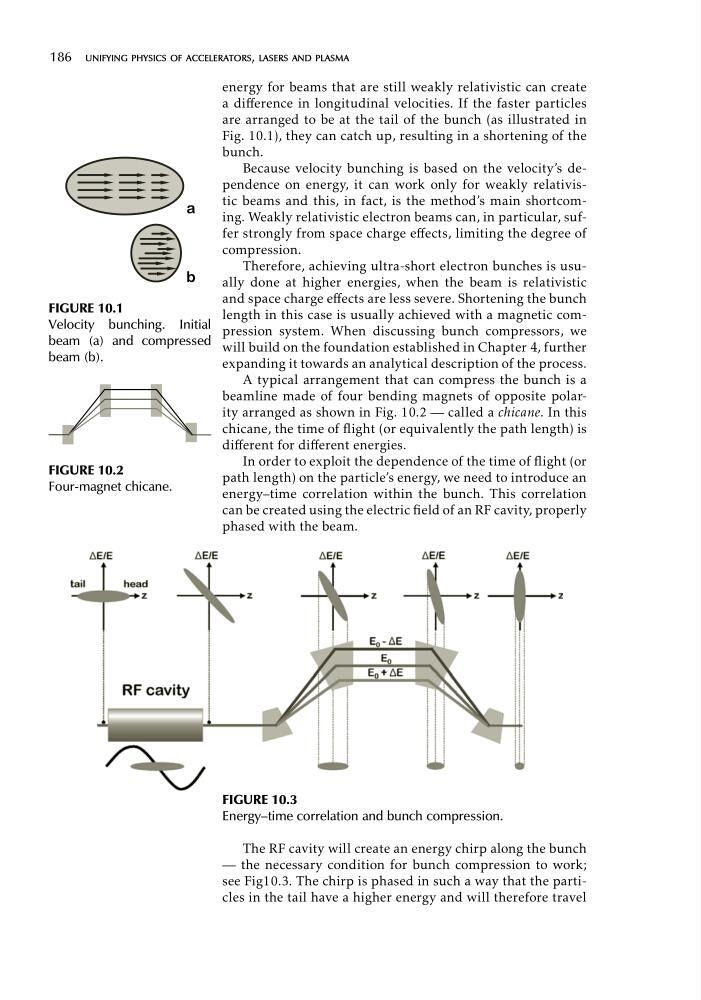
In order to exploit the dependence of the time of flight (or
path length) on the particle’s energy, we need to introduce an
energy–time correlation within the bunch. This correlation
can be created using the electric field of an RF cavity, properly
phased with the beam.
D
E
FIGURE 10.1
Velocity bunching. Initial
beam (a) and compressed
beam (b).
FIGURE 10.2
Four-magnet chicane.
FIGURE 10.3
Energy–time correlation and bunch compression.
The RF cavity will create an energy chirp along the bunch
— the necessary condition for bunch compression to work;
see Fig10.3. The chirp is phased in such a way that the particles in the tail have a higher energy and will therefore travel
energy for beams that are still weakly relativistic can create
a difference in longitudinal velocities. If the faster particles
are arranged to be at the tail of the bunch (as illustrated in
Fig. 10.1), they can catch up, resulting in a shortening of the
bunch.
Because velocity bunching is based on the velocity’s dependence on energy, it can work only for weakly relativistic beams and this, in fact, is the method’s main shortcoming. Weakly relativistic electron beams can, in particular, suffer strongly from space charge effects, limiting the degree of
compression.
Therefore, achieving ultra-short electron bunches is usually done at higher energies, when the beam is relativistic
and space charge effects are less severe. Shortening the bunch
length in this case is usually achieved with a magnetic compression system. When discussing bunch compressors, we
will build on the foundation established in Chapter 4, further
expanding it towards an analytical description of the process.
A typical arrangement that can compress the bunch is a
beamline made of four bending magnets of opposite polarity arranged as shown in Fig. 10.2 — called a chicane. In this
chicane, the time of flight (or equivalently the path length) is
different for different energies.
In order to exploit the dependence of the time of flight (or
path length) on the particle’s energy, we need to introduce an
energy–time correlation within the bunch. This correlation
can be created using the electric field of an RF cavity, properly
phased with the beam.
D
E
FIGURE 10.1
Velocity bunching. Initial
beam (a) and compressed
beam (b).
FIGURE 10.2
Four-magnet chicane.
FIGURE 10.3
Energy–time correlation and bunch compression.
The RF cavity will create an energy chirp along the bunch
— the necessary condition for bunch compression to work;
see Fig10.3. The chirp is phased in such a way that the particles in the tail have a higher energy and will therefore travel