

proton and ion laser plasma acceleration 181
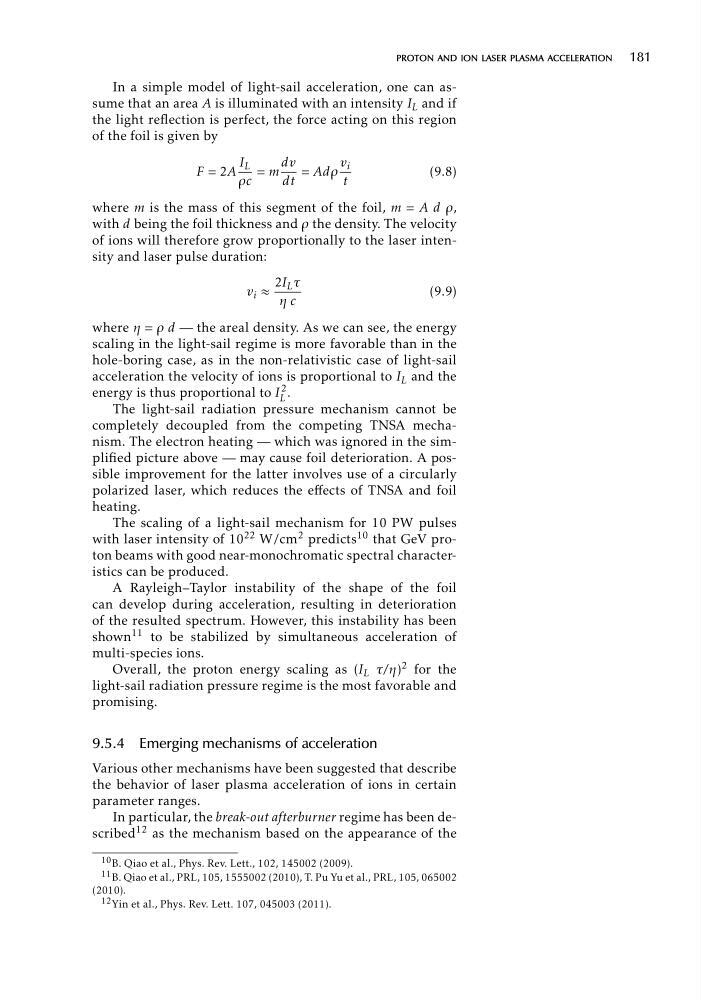
In a simple model of light-sail acceleration, one can assume that an area A is illuminated with an intensity I L and if
the light reflection is perfect, the force acting on this region
of the foil is given by
I L
dv
v i
F = 2A = m
= Adρ
(9.8)
ρc
dt
t
where m is the mass of this segment of the foil, m = A d ρ,
with d being the foil thickness and ρ the density. The velocity
of ions will therefore grow proportionally to the laser intensity and laser pulse duration:
2I L τ
v i ≈
(9.9)
η c
where η = ρ d — the areal density. As we can see, the energy
scaling in the light-sail regime is more favorable than in the
hole-boring case, as in the non-relativistic case of light-sail
acceleration the velocity of ions is proportional to I L and the
energy is thus proportional to I L
2 .
The light-sail radiation pressure mechanism cannot be
completely decoupled from the competing TNSA mechanism. The electron heating — which was ignored in the simplified picture above — may cause foil deterioration. A possible improvement for the latter involves use of a circularly
polarized laser, which reduces the effects of TNSA and foil
heating.
The scaling of a light-sail mechanism for 10 PW pulses
with laser intensity of 10 22 W/cm 2 predicts 10 that GeV proton beams with good near-monochromatic spectral characteristics can be produced.
A Rayleigh–Taylor instability of the shape of the foil
can develop during acceleration, resulting in deterioration
of the resulted spectrum. However, this instability has been
shown 11 to be stabilized by simultaneous acceleration of
multi-species ions.
Overall, the proton energy scaling as (I L τ/η) 2 for the
light-sail radiation pressure regime is the most favorable and
promising.
9.5.4 Emerging mechanisms of acceleration
Various other mechanisms have been suggested that describe
the behavior of laser plasma acceleration of ions in certain
parameter ranges.
In particular, the break-out afterburner regime has been described 12 as the mechanism based on the appearance of the
10 B. Qiao et al., Phys. Rev. Lett., 102, 145002 (2009).
11 B. Qiao et al., PRL, 105, 1555002 (2010), T. Pu Yu et al., PRL, 105, 065002
(2010).
12 Yin et al., Phys. Rev. Lett. 107, 045003 (2011).
In a simple model of light-sail acceleration, one can assume that an area A is illuminated with an intensity I L and if
the light reflection is perfect, the force acting on this region
of the foil is given by
I L
dv
v i
F = 2A = m
= Adρ
(9.8)
ρc
dt
t
where m is the mass of this segment of the foil, m = A d ρ,
with d being the foil thickness and ρ the density. The velocity
of ions will therefore grow proportionally to the laser intensity and laser pulse duration:
2I L τ
v i ≈
(9.9)
η c
where η = ρ d — the areal density. As we can see, the energy
scaling in the light-sail regime is more favorable than in the
hole-boring case, as in the non-relativistic case of light-sail
acceleration the velocity of ions is proportional to I L and the
energy is thus proportional to I L
2 .
The light-sail radiation pressure mechanism cannot be
completely decoupled from the competing TNSA mechanism. The electron heating — which was ignored in the simplified picture above — may cause foil deterioration. A possible improvement for the latter involves use of a circularly
polarized laser, which reduces the effects of TNSA and foil
heating.
The scaling of a light-sail mechanism for 10 PW pulses
with laser intensity of 10 22 W/cm 2 predicts 10 that GeV proton beams with good near-monochromatic spectral characteristics can be produced.
A Rayleigh–Taylor instability of the shape of the foil
can develop during acceleration, resulting in deterioration
of the resulted spectrum. However, this instability has been
shown 11 to be stabilized by simultaneous acceleration of
multi-species ions.
Overall, the proton energy scaling as (I L τ/η) 2 for the
light-sail radiation pressure regime is the most favorable and
promising.
9.5.4 Emerging mechanisms of acceleration
Various other mechanisms have been suggested that describe
the behavior of laser plasma acceleration of ions in certain
parameter ranges.
In particular, the break-out afterburner regime has been described 12 as the mechanism based on the appearance of the
10 B. Qiao et al., Phys. Rev. Lett., 102, 145002 (2009).
11 B. Qiao et al., PRL, 105, 1555002 (2010), T. Pu Yu et al., PRL, 105, 065002
(2010).
12 Yin et al., Phys. Rev. Lett. 107, 045003 (2011).