

180 unifying physics of accelerators, lasers and plasma
hole-boring mechanism can be obtained by including the radiation light pressure into the fluid equation of motion, and
transferring it to the reference frame where the shock is stationary (i.e., where the time derivatives are zero). This will
yield ρu 2 = P L and therefore the velocity of ions can be estimated as
I L
u ≈
(9.7)
ρc
Consider an example of a laser with I L = 10 21 W/cm 2
shining on an aluminum target with ρ = 2.710 3 kg/m 3 . The
resulting velocity of ions in this case is u ∼ 0.01c or about
3 mm/ps. The energy of the protons associated with this
shock is 60 keV. By “bouncing” the stationary protons of the
shock front, the protons can gain twice the velocity or four
times the energy. Reducing the density of the foil could lead
to a further increase of the energy of accelerated ions — the
latter can be achieved by using gas targets.
The most attractive feature of the hole-boring radiation
pressure mechanism is that the resulting proton beam has
been demonstrated 8 to have a nearly monochromatic peak at
the maximum energy.
9.5.3 Light-sail radiation pressure acceleration regime
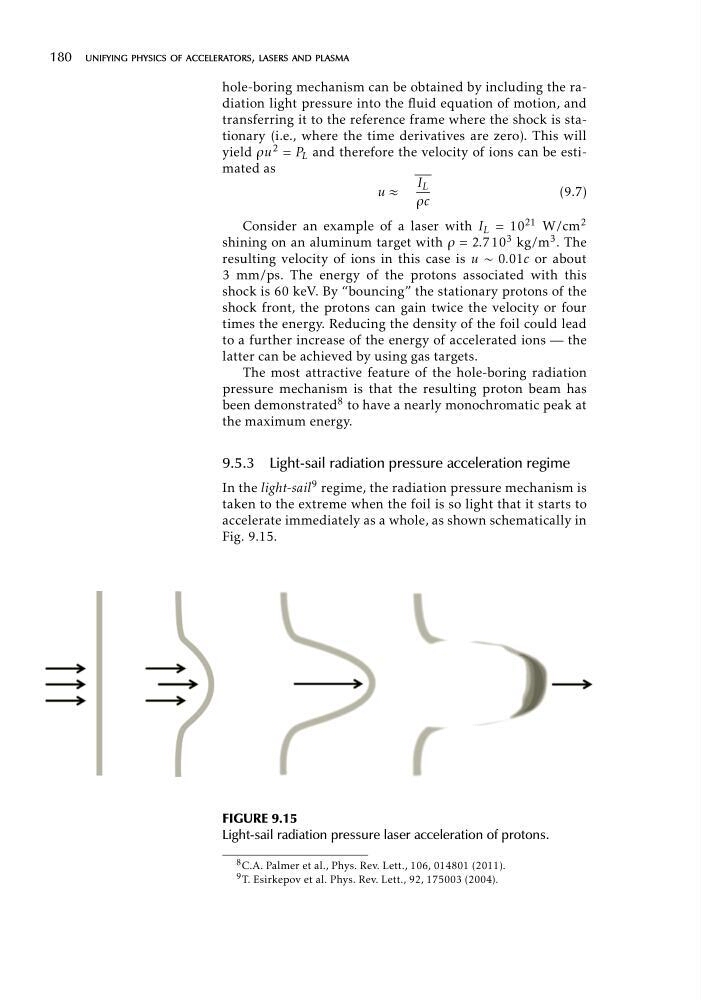
In the light-sail 9 regime, the radiation pressure mechanism is
taken to the extreme when the foil is so light that it starts to
accelerate immediately as a whole, as shown schematically in
Fig. 9.15.
FIGURE 9.15
Light-sail radiation pressure laser acceleration of protons.
8 C.A. Palmer et al., Phys. Rev. Lett., 106, 014801 (2011).
9 T. Esirkepov et al. Phys. Rev. Lett., 92, 175003 (2004).
hole-boring mechanism can be obtained by including the radiation light pressure into the fluid equation of motion, and
transferring it to the reference frame where the shock is stationary (i.e., where the time derivatives are zero). This will
yield ρu 2 = P L and therefore the velocity of ions can be estimated as
I L
u ≈
(9.7)
ρc
Consider an example of a laser with I L = 10 21 W/cm 2
shining on an aluminum target with ρ = 2.710 3 kg/m 3 . The
resulting velocity of ions in this case is u ∼ 0.01c or about
3 mm/ps. The energy of the protons associated with this
shock is 60 keV. By “bouncing” the stationary protons of the
shock front, the protons can gain twice the velocity or four
times the energy. Reducing the density of the foil could lead
to a further increase of the energy of accelerated ions — the
latter can be achieved by using gas targets.
The most attractive feature of the hole-boring radiation
pressure mechanism is that the resulting proton beam has
been demonstrated 8 to have a nearly monochromatic peak at
the maximum energy.
9.5.3 Light-sail radiation pressure acceleration regime
In the light-sail 9 regime, the radiation pressure mechanism is
taken to the extreme when the foil is so light that it starts to
accelerate immediately as a whole, as shown schematically in
Fig. 9.15.
FIGURE 9.15
Light-sail radiation pressure laser acceleration of protons.
8 C.A. Palmer et al., Phys. Rev. Lett., 106, 014801 (2011).
9 T. Esirkepov et al. Phys. Rev. Lett., 92, 175003 (2004).