

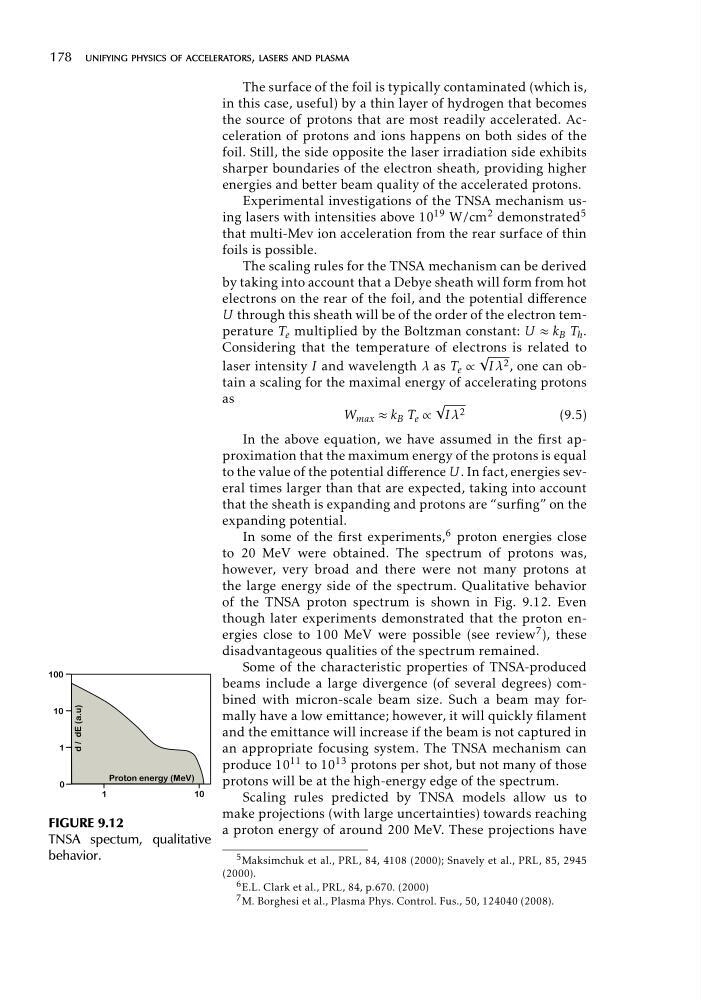
FIGURE 9.12
TNSA spectum, qualitative
behavior.
(
178 unifying physics of accelerators, lasers and plasma
The surface of the foil is typically contaminated (which is,
in this case, useful) by a thin layer of hydrogen that becomes
the source of protons that are most readily accelerated. Acceleration of protons and ions happens on both sides of the
foil. Still, the side opposite the laser irradiation side exhibits
sharper boundaries of the electron sheath, providing higher
energies and better beam quality of the accelerated protons.
Experimental investigations of the TNSA mechanism using lasers with intensities above 10 19 W/cm 2 demonstrated 5
that multi-Mev ion acceleration from the rear surface of thin
foils is possible.
The scaling rules for the TNSA mechanism can be derived
by taking into account that a Debye sheath will form from hot
electrons on the rear of the foil, and the potential difference
U through this sheath will be of the order of the electron temperature T e multiplied by the Boltzman constant: U ≈ k B T h .
Considering that the temperature of electrons is related to
√
laser intensity I and wavelength λ as T e ∝ Iλ 2 , one can obtain a scaling for the maximal energy of accelerating protons
as
√
W max ≈ k B T e ∝ Iλ 2
(9.5)
In the above equation, we have assumed in the first approximation that the maximum energy of the protons is equal
to the value of the potential difference U. In fact, energies several times larger than that are expected, taking into account
that the sheath is expanding and protons are “surfing” on the
expanding potential.
In some of the first experiments, 6 proton energies close
to 20 MeV were obtained. The spectrum of protons was,
however, very broad and there were not many protons at
the large energy side of the spectrum. Qualitative behavior
of the TNSA proton spectrum is shown in Fig. 9.12. Even
though later experiments demonstrated that the proton energies close to 100 MeV were possible (see review 7 ), these
disadvantageous qualities of the spectrum remained.
Some of the characteristic properties of TNSA-produced
beams include a large divergence (of several degrees) combined with micron-scale beam size. Such a beam may formally have a low emittance; however, it will quickly filament
and the emittance will increase if the beam is not captured in
an appropriate focusing system. The TNSA mechanism can
produce 10 11 to 10 13 protons per shot, but not many of those
protons will be at the high-energy edge of the spectrum.
Scaling rules predicted by TNSA models allow us to
make projections (with large uncertainties) towards reaching
a proton energy of around 200 MeV. These projections have
5 Maksimchuk et al., PRL, 84, 4108 (2000); Snavely et al., PRL, 85, 2945
2000).
6 E.L. Clark et al., PRL, 84, p.670. (2000)
7 M. Borghesi et al., Plasma Phys. Control. Fus., 50, 124040 (2008).
TNSA spectum, qualitative
behavior.
(
178 unifying physics of accelerators, lasers and plasma
The surface of the foil is typically contaminated (which is,
in this case, useful) by a thin layer of hydrogen that becomes
the source of protons that are most readily accelerated. Acceleration of protons and ions happens on both sides of the
foil. Still, the side opposite the laser irradiation side exhibits
sharper boundaries of the electron sheath, providing higher
energies and better beam quality of the accelerated protons.
Experimental investigations of the TNSA mechanism using lasers with intensities above 10 19 W/cm 2 demonstrated 5
that multi-Mev ion acceleration from the rear surface of thin
foils is possible.
The scaling rules for the TNSA mechanism can be derived
by taking into account that a Debye sheath will form from hot
electrons on the rear of the foil, and the potential difference
U through this sheath will be of the order of the electron temperature T e multiplied by the Boltzman constant: U ≈ k B T h .
Considering that the temperature of electrons is related to
√
laser intensity I and wavelength λ as T e ∝ Iλ 2 , one can obtain a scaling for the maximal energy of accelerating protons
as
√
W max ≈ k B T e ∝ Iλ 2
(9.5)
In the above equation, we have assumed in the first approximation that the maximum energy of the protons is equal
to the value of the potential difference U. In fact, energies several times larger than that are expected, taking into account
that the sheath is expanding and protons are “surfing” on the
expanding potential.
In some of the first experiments, 6 proton energies close
to 20 MeV were obtained. The spectrum of protons was,
however, very broad and there were not many protons at
the large energy side of the spectrum. Qualitative behavior
of the TNSA proton spectrum is shown in Fig. 9.12. Even
though later experiments demonstrated that the proton energies close to 100 MeV were possible (see review 7 ), these
disadvantageous qualities of the spectrum remained.
Some of the characteristic properties of TNSA-produced
beams include a large divergence (of several degrees) combined with micron-scale beam size. Such a beam may formally have a low emittance; however, it will quickly filament
and the emittance will increase if the beam is not captured in
an appropriate focusing system. The TNSA mechanism can
produce 10 11 to 10 13 protons per shot, but not many of those
protons will be at the high-energy edge of the spectrum.
Scaling rules predicted by TNSA models allow us to
make projections (with large uncertainties) towards reaching
a proton energy of around 200 MeV. These projections have
5 Maksimchuk et al., PRL, 84, 4108 (2000); Snavely et al., PRL, 85, 2945
2000).
6 E.L. Clark et al., PRL, 84, p.670. (2000)
7 M. Borghesi et al., Plasma Phys. Control. Fus., 50, 124040 (2008).