

proton and ion laser plasma acceleration 177
ically the mechanisms of hole-boring and light-sail acceleration. The latter has favorable scaling with laser power and
promising perspectives for achieving near-monoenergetic
beams.
We will briefly touch upon other mechanisms that have
been identified, such as shock acceleration and the relativistic transparency regime — also called the break-out afterburner.
Various academic review papers 2,3,4 can be consulted to gain
deeper insights into the discussed areas.
Once more, we would like to stress that the mentioned mechanisms of plasma acceleration represent a gradual improvement of our understanding of this very complicated phenomenon. Different mechanisms compete, and often more than one mechanism is active in a particular case. As
we strive to sharpen our understanding of these mechanisms,
further significant progress in this area will be inevitable.
9.5.1 Sheath acceleration regime
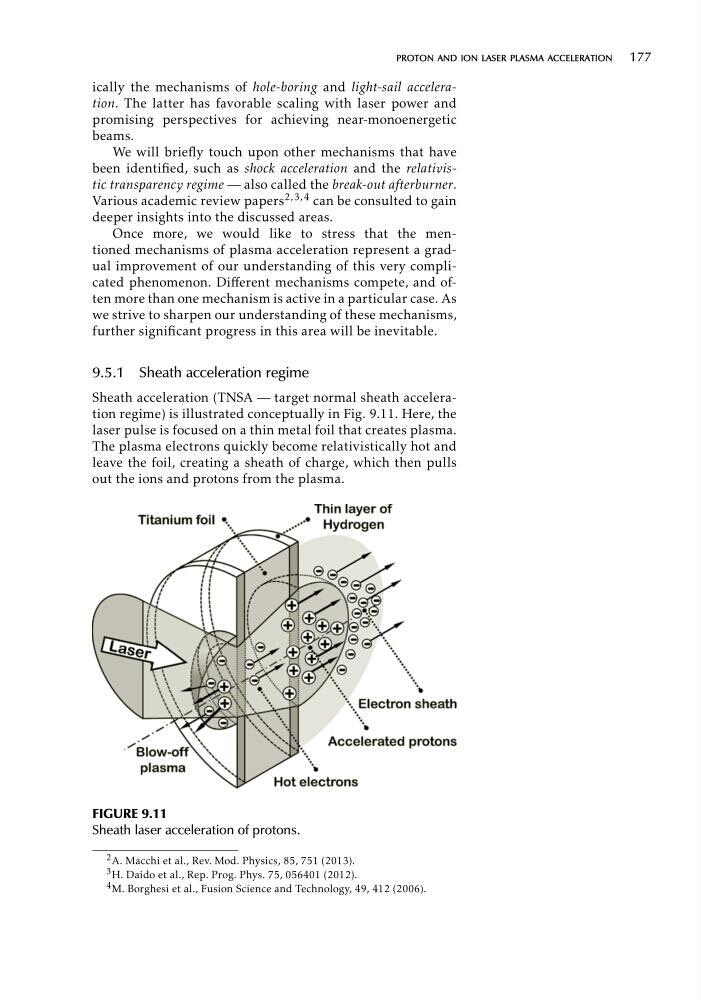
Sheath acceleration (TNSA — target normal sheath acceleration regime) is illustrated conceptually in Fig. 9.11. Here, the
laser pulse is focused on a thin metal foil that creates plasma.
The plasma electrons quickly become relativistically hot and
leave the foil, creating a sheath of charge, which then pulls
out the ions and protons from the plasma.
FIGURE 9.11
Sheath laser acceleration of protons.
2 A. Macchi et al., Rev. Mod. Physics, 85, 751 (2013).
3 H. Daido et al., Rep. Prog. Phys. 75, 056401 (2012).
4 M. Borghesi et al., Fusion Science and Technology, 49, 412 (2006).
ically the mechanisms of hole-boring and light-sail acceleration. The latter has favorable scaling with laser power and
promising perspectives for achieving near-monoenergetic
beams.
We will briefly touch upon other mechanisms that have
been identified, such as shock acceleration and the relativistic transparency regime — also called the break-out afterburner.
Various academic review papers 2,3,4 can be consulted to gain
deeper insights into the discussed areas.
Once more, we would like to stress that the mentioned mechanisms of plasma acceleration represent a gradual improvement of our understanding of this very complicated phenomenon. Different mechanisms compete, and often more than one mechanism is active in a particular case. As
we strive to sharpen our understanding of these mechanisms,
further significant progress in this area will be inevitable.
9.5.1 Sheath acceleration regime
Sheath acceleration (TNSA — target normal sheath acceleration regime) is illustrated conceptually in Fig. 9.11. Here, the
laser pulse is focused on a thin metal foil that creates plasma.
The plasma electrons quickly become relativistically hot and
leave the foil, creating a sheath of charge, which then pulls
out the ions and protons from the plasma.
FIGURE 9.11
Sheath laser acceleration of protons.
2 A. Macchi et al., Rev. Mod. Physics, 85, 751 (2013).
3 H. Daido et al., Rep. Prog. Phys. 75, 056401 (2012).
4 M. Borghesi et al., Fusion Science and Technology, 49, 412 (2006).