

free electron lasers 161
high brightness FELs are machines that require considerable
resources for their construction and can usually be realized
only as national-scale facilities.
New technological solutions are required if we are to
build more economical and compact radiation sources.
Progress with laser plasma accelerators in the last several
years has opened up new possibilities to work towards compact betatron radiation sources and has also created an aspiration in the community to use this technology to drive compact FELs.
The first generation of undulator radiation in the soft Xray range driven by an LWFA-produced beam has already
been obtained. In this first experiment, a laser plasma wakefield accelerator produced 55–75 MeV electron bunches,
which were then sent to an undulator to generate visible to
IR-range synchrotron radiation. 1
A generic layout of a compact light source based on laser
plasma acceleration and an undulator is shown in Fig. 8.20.
Such compact sources are often referred to as table-top although at present time a more appropriate term would be
“room-sized.”
Laser plasma wakefield accelerators demonstrated the
possibility of generating a GeV beam with promising electron beam qualities, including a normalized emittance of the
order of 1 mm mrad and an energy spread of close to 1% for
the entire bunch.
Recall that lasing in FEL requires the beam slice to have
appropriately small emittances; these characteristics are already within reach for laser plasma acceleration and will
likely be achieved with relatively modest improvements on
what has presently been obtained. The beam energy spread
will, however, require more noticeable improvements from
the presently achieved values of a few percent for the entire
beam to around a few hundredth of a percent for a radiationgenerating slice.
Furthermore, an FEL based on laser plasma acceleration
will require significant improvement to the stability of LPWA
beams; at present, the repeatability of its beam parameters is
poor and important characteristics of beams can often exhibit
nearly 100% pulse-to-pulse fluctuations.
We should also note that an election beam generated in a
plasma bubble typically has inconvenient ratios between its
size and its angular spread. While the beam size may be of
the order of a micron, the angular spread can reach several
milliradians. Even if the calculated emittance of such a beam
is very small, its usefulness strongly depends on the ability to
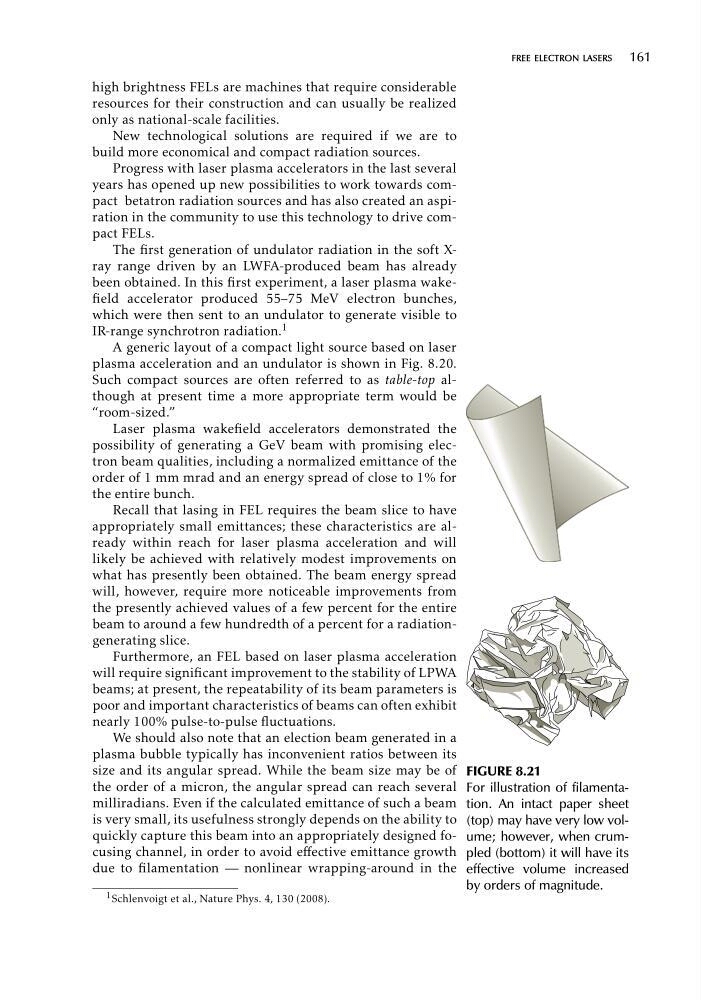
quickly capture this beam into an appropriately designed focusing channel, in order to avoid effective emittance growth
due to filamentation — nonlinear wrapping-around in the
1 Schlenvoigt et al., Nature Phys. 4, 130 (2008).
FIGURE 8.21
For illustration of filamentation. An intact paper sheet
(top) may have very low volume; however, when crumpled (bottom) it will have its
effective volume increased
by orders of magnitude.
high brightness FELs are machines that require considerable
resources for their construction and can usually be realized
only as national-scale facilities.
New technological solutions are required if we are to
build more economical and compact radiation sources.
Progress with laser plasma accelerators in the last several
years has opened up new possibilities to work towards compact betatron radiation sources and has also created an aspiration in the community to use this technology to drive compact FELs.
The first generation of undulator radiation in the soft Xray range driven by an LWFA-produced beam has already
been obtained. In this first experiment, a laser plasma wakefield accelerator produced 55–75 MeV electron bunches,
which were then sent to an undulator to generate visible to
IR-range synchrotron radiation. 1
A generic layout of a compact light source based on laser
plasma acceleration and an undulator is shown in Fig. 8.20.
Such compact sources are often referred to as table-top although at present time a more appropriate term would be
“room-sized.”
Laser plasma wakefield accelerators demonstrated the
possibility of generating a GeV beam with promising electron beam qualities, including a normalized emittance of the
order of 1 mm mrad and an energy spread of close to 1% for
the entire bunch.
Recall that lasing in FEL requires the beam slice to have
appropriately small emittances; these characteristics are already within reach for laser plasma acceleration and will
likely be achieved with relatively modest improvements on
what has presently been obtained. The beam energy spread
will, however, require more noticeable improvements from
the presently achieved values of a few percent for the entire
beam to around a few hundredth of a percent for a radiationgenerating slice.
Furthermore, an FEL based on laser plasma acceleration
will require significant improvement to the stability of LPWA
beams; at present, the repeatability of its beam parameters is
poor and important characteristics of beams can often exhibit
nearly 100% pulse-to-pulse fluctuations.
We should also note that an election beam generated in a
plasma bubble typically has inconvenient ratios between its
size and its angular spread. While the beam size may be of
the order of a micron, the angular spread can reach several
milliradians. Even if the calculated emittance of such a beam
is very small, its usefulness strongly depends on the ability to
quickly capture this beam into an appropriately designed focusing channel, in order to avoid effective emittance growth
due to filamentation — nonlinear wrapping-around in the
1 Schlenvoigt et al., Nature Phys. 4, 130 (2008).
FIGURE 8.21
For illustration of filamentation. An intact paper sheet
(top) may have very low volume; however, when crumpled (bottom) it will have its
effective volume increased
by orders of magnitude.