

160 unifying physics of accelerators, lasers and plasma
particularly at a low energy). Compression of the bunch to a
tens of fs range is challenged by coherent synchrotron radiation
(CSR), which will be discussed in closer detail in Chapter 10.
Another group of challenges related to FELs is simultaneously connected to both the physics and technologies of accelerators and lasers. Firstly, this refers to the synchronization of
conventional lasers and FEL electron sources for pump-probe
experiments. And secondly, conventional lasers are essential
to applications in FELs for the seeding of radiation in order to
ensure improved temporal coherence of generated X-rays, as
well as for high harmonic generation (HHG) (discussed further
in Chapter 10).
8.7 Beyond the fourth-generation light sources
Let us summarise the properties of third- and fourthgeneration light sources and outline prospects for future generations.
The third generation (storage rings) and FEL have complementary properties. The storage ring synchrotron light
sources are extremely stable, can serve several tens of user
beamlines, and their radiation can approach full transverse
coherence for ultimate diffraction-limited storage rings.
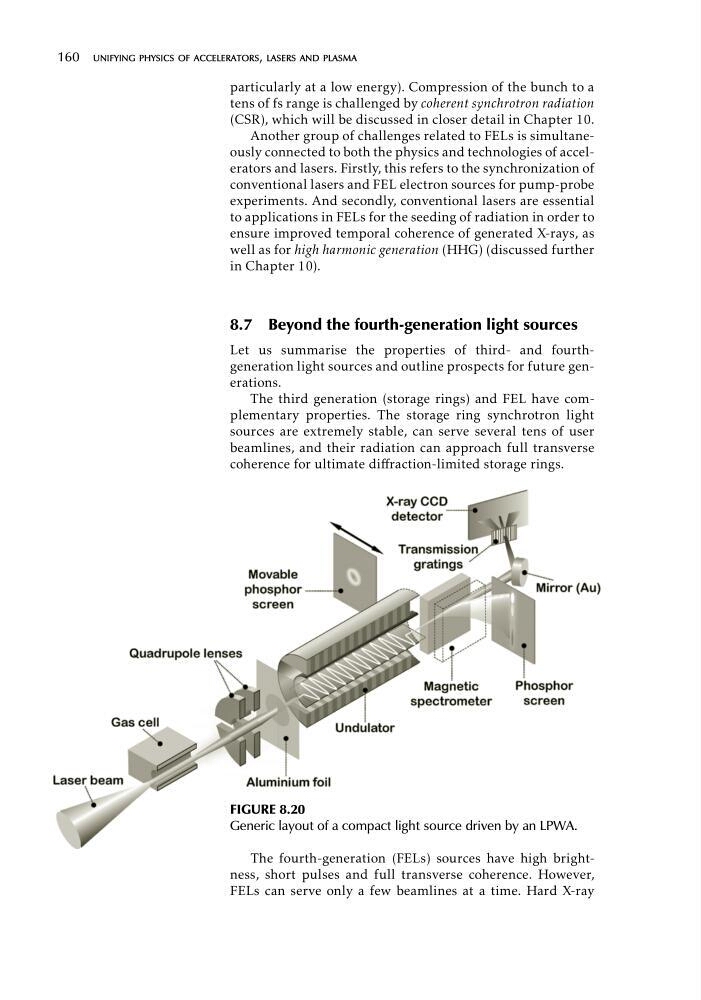
FIGURE 8.20
Generic layout of a compact light source driven by an LPWA.
The fourth-generation (FELs) sources have high brightness, short pulses and full transverse coherence. However,
FELs can serve only a few beamlines at a time. Hard X-ray
particularly at a low energy). Compression of the bunch to a
tens of fs range is challenged by coherent synchrotron radiation
(CSR), which will be discussed in closer detail in Chapter 10.
Another group of challenges related to FELs is simultaneously connected to both the physics and technologies of accelerators and lasers. Firstly, this refers to the synchronization of
conventional lasers and FEL electron sources for pump-probe
experiments. And secondly, conventional lasers are essential
to applications in FELs for the seeding of radiation in order to
ensure improved temporal coherence of generated X-rays, as
well as for high harmonic generation (HHG) (discussed further
in Chapter 10).
8.7 Beyond the fourth-generation light sources
Let us summarise the properties of third- and fourthgeneration light sources and outline prospects for future generations.
The third generation (storage rings) and FEL have complementary properties. The storage ring synchrotron light
sources are extremely stable, can serve several tens of user
beamlines, and their radiation can approach full transverse
coherence for ultimate diffraction-limited storage rings.
FIGURE 8.20
Generic layout of a compact light source driven by an LPWA.
The fourth-generation (FELs) sources have high brightness, short pulses and full transverse coherence. However,
FELs can serve only a few beamlines at a time. Hard X-ray