

94 unifying physics of accelerators, lasers and plasma
pler of the acceleration cavity must ensure an appropriate
mode conversion.
It is typical to feed the RF power into the linac structure by a TE 10 mode of EM wave in a rectangular waveguide.
The mode is then converted by a coupling slot into a cylindrical TM 01 mode in the accelerating cavity, as illustrated in
Fig.5.29.
5.5 Longitudinal dynamics
In this section, we will discuss the basics of longitudinal dynamics in travelling and standing wave linacs, as well as in
synchrotrons.
5.5.1 Acceleration in RF structures
Particle acceleration in linacs is achieved with RF structures,
using EM modes with the electric field pointing in the longitudinal direction (the direction of the charged particle’s motion). The RF electric field can be provided by either travelling
wave structures or standing wave structures.
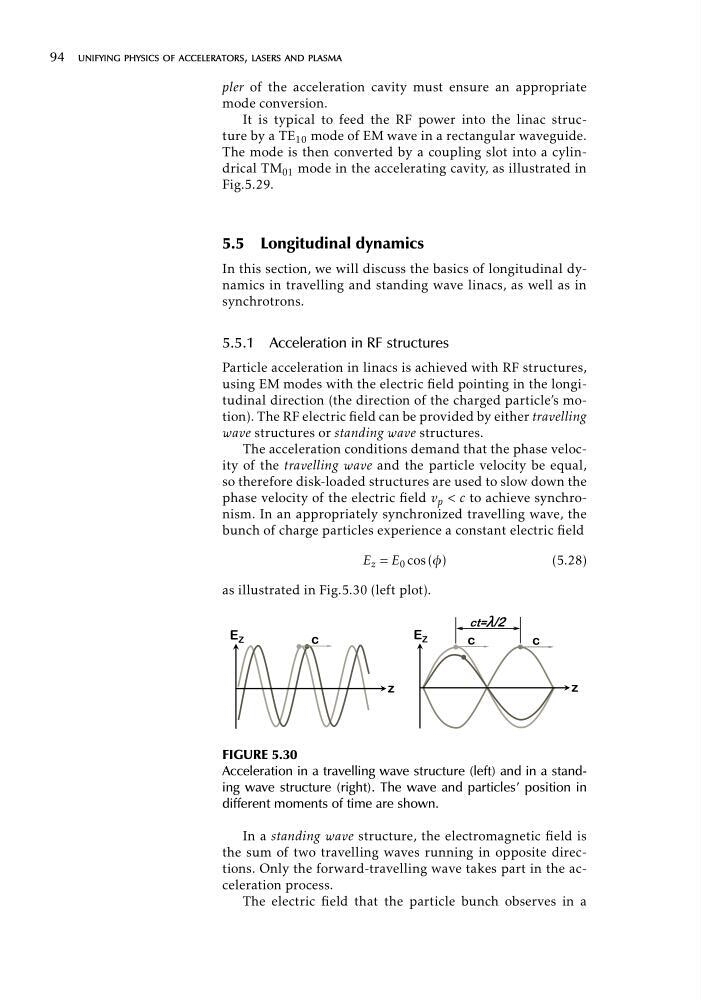
The acceleration conditions demand that the phase velocity of the travelling wave and the particle velocity be equal,
so therefore disk-loaded structures are used to slow down the
phase velocity of the electric field v p < c to achieve synchronism. In an appropriately synchronized travelling wave, the
bunch of charge particles experience a constant electric field
E = E 0 cos (φ)
(5.28)
z
as illustrated in Fig.5.30 (left plot).
( =
]
F
( =
]
F
F
FW
FIGURE 5.30
Acceleration in a travelling wave structure (left) and in a standing wave structure (right). The wave and particles’ position in
different moments of time are shown.
In a standing wave structure, the electromagnetic field is
the sum of two travelling waves running in opposite directions. Only the forward-travelling wave takes part in the acceleration process.
The electric field that the particle bunch observes in a
pler of the acceleration cavity must ensure an appropriate
mode conversion.
It is typical to feed the RF power into the linac structure by a TE 10 mode of EM wave in a rectangular waveguide.
The mode is then converted by a coupling slot into a cylindrical TM 01 mode in the accelerating cavity, as illustrated in
Fig.5.29.
5.5 Longitudinal dynamics
In this section, we will discuss the basics of longitudinal dynamics in travelling and standing wave linacs, as well as in
synchrotrons.
5.5.1 Acceleration in RF structures
Particle acceleration in linacs is achieved with RF structures,
using EM modes with the electric field pointing in the longitudinal direction (the direction of the charged particle’s motion). The RF electric field can be provided by either travelling
wave structures or standing wave structures.
The acceleration conditions demand that the phase velocity of the travelling wave and the particle velocity be equal,
so therefore disk-loaded structures are used to slow down the
phase velocity of the electric field v p < c to achieve synchronism. In an appropriately synchronized travelling wave, the
bunch of charge particles experience a constant electric field
E = E 0 cos (φ)
(5.28)
z
as illustrated in Fig.5.30 (left plot).
( =
]
F
( =
]
F
F
FW
FIGURE 5.30
Acceleration in a travelling wave structure (left) and in a standing wave structure (right). The wave and particles’ position in
different moments of time are shown.
In a standing wave structure, the electromagnetic field is
the sum of two travelling waves running in opposite directions. Only the forward-travelling wave takes part in the acceleration process.
The electric field that the particle bunch observes in a