

conventional acceleration 83
The same can be obtained by requesting the convective derivative (∂/∂t + v p ∂/∂x) of f 1 to be equal to zero, which again results in
∂f 1 (x, t) /∂t ω
v p = −
=
∂f 1 (x, t) /∂x k
The second function in Eq.5.9 describes the evolution of
the envelope of the pattern: f 2 (x, t) = cos [dk x − dω t]. Again,
any point in the envelope propagates such that the quantity
dk x − dω t remains constant and therefore its velocity, i.e.,
the group velocity, is given by
∂f 2 (x, t) /∂t dω
v g = −
=
(5.11)
∂f 2 (x, t) /∂x dk
This prepares us for discussion of the notions of dispersion
and group or phase velocity of a waveguide.
5.2.4 Dispersion diagram for a waveguide
We will start our conversation regarding wave propagation
down a waveguide using two extreme cases.
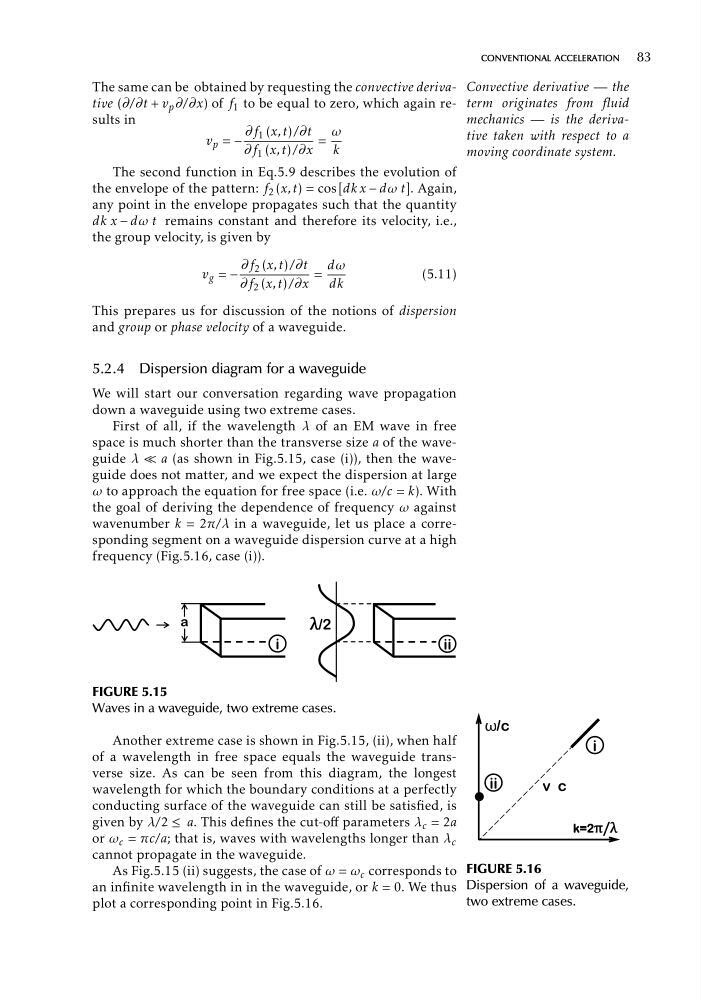
First of all, if the wavelength λ of an EM wave in free
space is much shorter than the transverse size a of the waveguide λ « a (as shown in Fig.5.15, case (i)), then the waveguide does not matter, and we expect the dispersion at large
ω to approach the equation for free space (i.e. ω/c = k). With
the goal of deriving the dependence of frequency ω against
wavenumber k = 2π/λ in a waveguide, let us place a corresponding segment on a waveguide dispersion curve at a high
frequency (Fig.5.16, case (i)).
D
L
LL
FIGURE 5.15
Waves in a waveguide, two extreme cases.
Another extreme case is shown in Fig.5.15, (ii), when half
of a wavelength in free space equals the waveguide transverse size. As can be seen from this diagram, the longest
wavelength for which the boundary conditions at a perfectly
conducting surface of the waveguide can still be satisfied, is
given by λ/2 ≤ a. This defines the cut-off parameters λ c = 2a
or ω c = πc/a; that is, waves with wavelengths longer than λ c
cannot propagate in the waveguide.
As Fig.5.15 (ii) suggests, the case of ω = ω c corresponds to
an infinite wavelength in in the waveguide, or k = 0. We thus
plot a corresponding point in Fig.5.16.
Convective derivative — the
term originates from fluid
mechanics — is the derivative taken with respect to a
moving coordinate system.
F
Y F
LL
L
FIGURE 5.16
Dispersion of a waveguide,
two extreme cases.
The same can be obtained by requesting the convective derivative (∂/∂t + v p ∂/∂x) of f 1 to be equal to zero, which again results in
∂f 1 (x, t) /∂t ω
v p = −
=
∂f 1 (x, t) /∂x k
The second function in Eq.5.9 describes the evolution of
the envelope of the pattern: f 2 (x, t) = cos [dk x − dω t]. Again,
any point in the envelope propagates such that the quantity
dk x − dω t remains constant and therefore its velocity, i.e.,
the group velocity, is given by
∂f 2 (x, t) /∂t dω
v g = −
=
(5.11)
∂f 2 (x, t) /∂x dk
This prepares us for discussion of the notions of dispersion
and group or phase velocity of a waveguide.
5.2.4 Dispersion diagram for a waveguide
We will start our conversation regarding wave propagation
down a waveguide using two extreme cases.
First of all, if the wavelength λ of an EM wave in free
space is much shorter than the transverse size a of the waveguide λ « a (as shown in Fig.5.15, case (i)), then the waveguide does not matter, and we expect the dispersion at large
ω to approach the equation for free space (i.e. ω/c = k). With
the goal of deriving the dependence of frequency ω against
wavenumber k = 2π/λ in a waveguide, let us place a corresponding segment on a waveguide dispersion curve at a high
frequency (Fig.5.16, case (i)).
D
L
LL
FIGURE 5.15
Waves in a waveguide, two extreme cases.
Another extreme case is shown in Fig.5.15, (ii), when half
of a wavelength in free space equals the waveguide transverse size. As can be seen from this diagram, the longest
wavelength for which the boundary conditions at a perfectly
conducting surface of the waveguide can still be satisfied, is
given by λ/2 ≤ a. This defines the cut-off parameters λ c = 2a
or ω c = πc/a; that is, waves with wavelengths longer than λ c
cannot propagate in the waveguide.
As Fig.5.15 (ii) suggests, the case of ω = ω c corresponds to
an infinite wavelength in in the waveguide, or k = 0. We thus
plot a corresponding point in Fig.5.16.
Convective derivative — the
term originates from fluid
mechanics — is the derivative taken with respect to a
moving coordinate system.
F
Y F
LL
L
FIGURE 5.16
Dispersion of a waveguide,
two extreme cases.