

The Linearization of the Equations of Motion
83
integration. In horizontal and vertical directions, the homogeneous solution
corresponds to harmonic oscillators with frequencies
ω x = h
√
1 − n,
ω y = h
√
n.
For 0 < n < 1, the magnet is focusing in both planes. An interesting case
occurs for n = 1/2, in which case the magnet focuses x and y identically and
represents a nice equivalent of the glass lens.
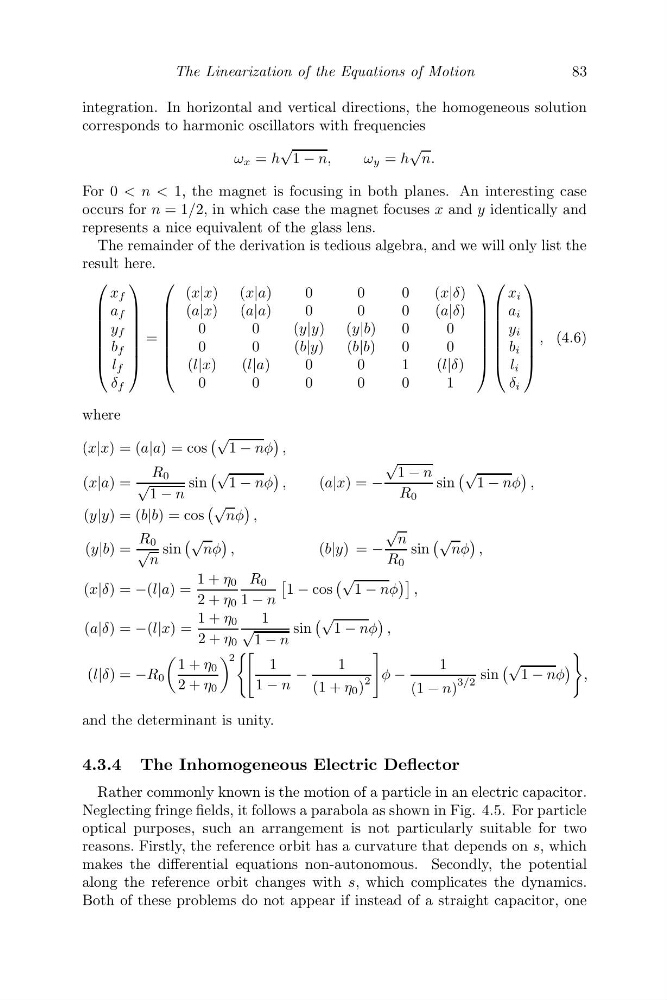
The remainder of the derivation is tedious algebra, and we will only list the
result here.
⎛
⎜
⎜
⎜
⎜
⎜
⎜
⎝
x f
a f
y f
b f
l f
δ f
⎞
⎟
⎟
⎟
⎟
⎟
⎟
⎠
=
⎛
⎜
⎜
⎜
⎜
⎜
⎜
⎝
(x|x) (x|a)
0
0
0
(x|δ)
(a|x) (a|a)
0
0
0
(a|δ)
0
0
( y|y) (y|b)
0
0
0
0
( b|y)
(b|b)
0
0
(l|x)
(l|a)
0
0
1
(l|δ)
0
0
0
0
0
1
⎞
⎟
⎟
⎟
⎟
⎟
⎟
⎠
⎛
⎜
⎜
⎜
⎜
⎜
⎜
⎝
x i
a i
y i
b i
l i
δ i
⎞
⎟
⎟
⎟
⎟
⎟
⎟
⎠
, (4.6)
where
(x|x) = (a|a) = cos
√
1 − nφ
,
(x|a) =
R 0
√
1 − n
sin
√
1 − nφ
,
(a|x) = −
√
1 − n
R 0
sin
√
1 − nφ
,
(y|y) = (b|b) = cos
√
nφ
,
(y|b) =
R 0
√
n
sin
√
nφ
,
(b|y) = −
√
n
R 0
sin
√
nφ
,
(x|δ) = −(l|a) =
1 + η 0
2 + η 0
R 0
1 − n
1 − cos
√
1 − nφ
,
(a|δ) = −(l|x) =
1 + η 0
2 + η 0
1
√
1 − n
sin
√
1 − nφ
,
(l|δ) = −R 0
1 + η 0
2 + η 0
2
1
1 − n
−
1
(1 + η 0 )
2
φ −
1
(1 − n)
3/2
sin
√
1 − nφ
,
and the determinant is unity.
4.3.4 The Inhomogeneous Electric Deflector
Rather commonly known is the motion of a particle in an electric capacitor.
Neglecting fringe fields, it follows a parabola as shown in Fig. 4.5. For particle
optical purposes, such an arrangement is not particularly suitable for two
reasons. Firstly, the reference orbit has a curvature that depends on s, which
makes the differential equations non-autonomous. Secondly, the potential
along the reference orbit changes with s, which complicates the dynamics.
Both of these problems do not appear if instead of a straight capacitor, one
83
integration. In horizontal and vertical directions, the homogeneous solution
corresponds to harmonic oscillators with frequencies
ω x = h
√
1 − n,
ω y = h
√
n.
For 0 < n < 1, the magnet is focusing in both planes. An interesting case
occurs for n = 1/2, in which case the magnet focuses x and y identically and
represents a nice equivalent of the glass lens.
The remainder of the derivation is tedious algebra, and we will only list the
result here.
⎛
⎜
⎜
⎜
⎜
⎜
⎜
⎝
x f
a f
y f
b f
l f
δ f
⎞
⎟
⎟
⎟
⎟
⎟
⎟
⎠
=
⎛
⎜
⎜
⎜
⎜
⎜
⎜
⎝
(x|x) (x|a)
0
0
0
(x|δ)
(a|x) (a|a)
0
0
0
(a|δ)
0
0
( y|y) (y|b)
0
0
0
0
( b|y)
(b|b)
0
0
(l|x)
(l|a)
0
0
1
(l|δ)
0
0
0
0
0
1
⎞
⎟
⎟
⎟
⎟
⎟
⎟
⎠
⎛
⎜
⎜
⎜
⎜
⎜
⎜
⎝
x i
a i
y i
b i
l i
δ i
⎞
⎟
⎟
⎟
⎟
⎟
⎟
⎠
, (4.6)
where
(x|x) = (a|a) = cos
√
1 − nφ
,
(x|a) =
R 0
√
1 − n
sin
√
1 − nφ
,
(a|x) = −
√
1 − n
R 0
sin
√
1 − nφ
,
(y|y) = (b|b) = cos
√
nφ
,
(y|b) =
R 0
√
n
sin
√
nφ
,
(b|y) = −
√
n
R 0
sin
√
nφ
,
(x|δ) = −(l|a) =
1 + η 0
2 + η 0
R 0
1 − n
1 − cos
√
1 − nφ
,
(a|δ) = −(l|x) =
1 + η 0
2 + η 0
1
√
1 − n
sin
√
1 − nφ
,
(l|δ) = −R 0
1 + η 0
2 + η 0
2
1
1 − n
−
1
(1 + η 0 )
2
φ −
1
(1 − n)
3/2
sin
√
1 − nφ
,
and the determinant is unity.
4.3.4 The Inhomogeneous Electric Deflector
Rather commonly known is the motion of a particle in an electric capacitor.
Neglecting fringe fields, it follows a parabola as shown in Fig. 4.5. For particle
optical purposes, such an arrangement is not particularly suitable for two
reasons. Firstly, the reference orbit has a curvature that depends on s, which
makes the differential equations non-autonomous. Secondly, the potential
along the reference orbit changes with s, which complicates the dynamics.
Both of these problems do not appear if instead of a straight capacitor, one