

80
An Introduction to Beam Physics
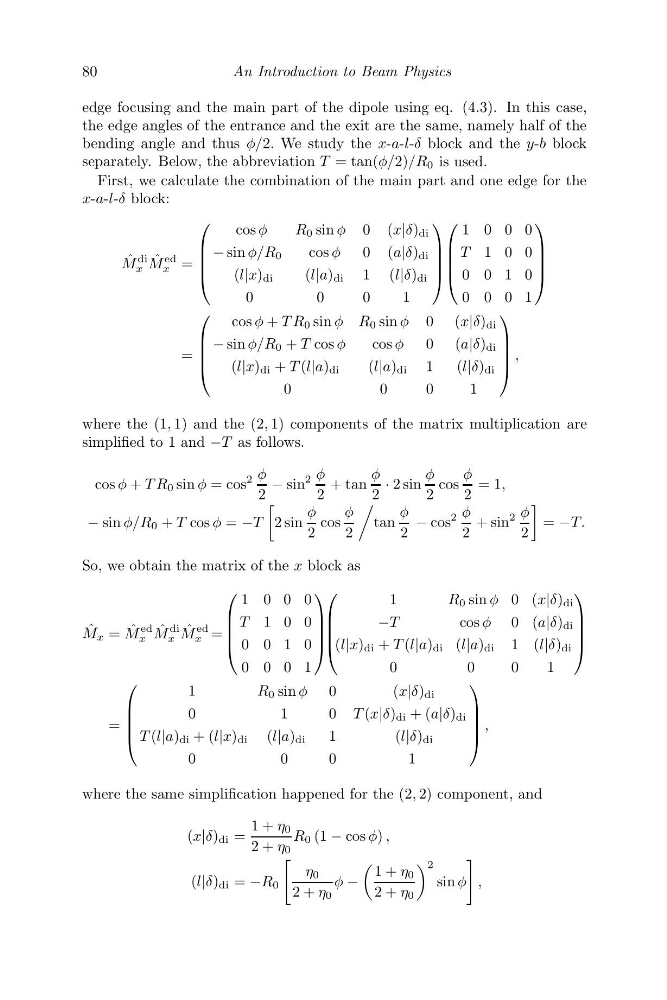
edge focusing and the main part of the dipole using eq. (4.3). In this case,
the edge angles of the entrance and the exit are the same, namely half of the
bending angle and thus φ/2. We study the x-a-l-δ block and the y-b block
separately. Below, the abbreviation T = tan(φ/2)/R 0 is used.
First, we calculate the combination of the main part and one edge for the
x-a-l-δ block:
ˆ
M
di
x
ˆ
M
ed
x =
⎛
⎜
⎜
⎜
⎝
cos φ
R 0 sin φ 0 (x|δ) di
− sin φ/R 0
cos φ 0 (a|δ) di
(l|x) di
(l|a) di 1 (l|δ) di
0
0
0
1
⎞
⎟
⎟
⎟
⎠
⎛
⎜
⎜
⎜
⎝
1 0 0 0
T 1 0 0
0 0 1 0
0 0 0 1
⎞
⎟
⎟
⎟
⎠
=
⎛
⎜
⎜
⎜
⎝
cos φ + T R 0 sin φ R 0 sin φ 0 (x|δ) di
− sin φ/R 0 + T cos φ
cos φ 0 (a|δ) di
(l|x) di + T (l|a) di
(l|a) di 1
(l|δ) di
0
0
0
1
⎞
⎟
⎟
⎟
⎠
,
where the (1, 1) and the (2, 1) components of the matrix multiplication are
simplified to 1 and −T as follows.
cos φ + T R 0 sin φ = cos
2 φ
2
− sin
2 φ
2
+ tan
φ
2
· 2 sin
φ
2
cos
φ
2
= 1,
− sin φ/R 0 + T cos φ = −T
2 sin
φ
2
cos
φ
2
tan
φ
2
− cos
2 φ
2
+ sin
2 φ
2
= −T.
So, we obtain the matrix of the x block as
ˆ
M x = ˆ
M
ed
x
ˆ
M
di
x
ˆ
M
ed
x =
⎛
⎜
⎜
⎜
⎝
1 0 0 0
T 1 0 0
0 0 1 0
0 0 0 1
⎞
⎟
⎟
⎟
⎠
⎛
⎜
⎜
⎜
⎝
1
R 0 sin φ 0 (x|δ) di
−T
cos φ 0 (a|δ) di
(l|x) di + T (l|a) di (l|a) di 1 (l|δ) di
0
0
0
1
⎞
⎟
⎟
⎟
⎠
=
⎛
⎜
⎜
⎜
⎝
1
R 0 sin φ 0
( x|δ) di
0
1
0 T (x|δ) di + (a|δ) di
T (l|a) di + (l|x) di (l|a) di
1
( l|δ) di
0
0
0
1
⎞
⎟
⎟
⎟
⎠
,
where the same simplification happened for the (2, 2) component, and
(x|δ) di =
1 + η 0
2 + η 0
R 0 (1 − cos φ) ,
(l|δ) di = −R 0
η 0
2 + η 0
φ −
1 + η 0
2 + η 0
2
sin φ
,
An Introduction to Beam Physics
edge focusing and the main part of the dipole using eq. (4.3). In this case,
the edge angles of the entrance and the exit are the same, namely half of the
bending angle and thus φ/2. We study the x-a-l-δ block and the y-b block
separately. Below, the abbreviation T = tan(φ/2)/R 0 is used.
First, we calculate the combination of the main part and one edge for the
x-a-l-δ block:
ˆ
M
di
x
ˆ
M
ed
x =
⎛
⎜
⎜
⎜
⎝
cos φ
R 0 sin φ 0 (x|δ) di
− sin φ/R 0
cos φ 0 (a|δ) di
(l|x) di
(l|a) di 1 (l|δ) di
0
0
0
1
⎞
⎟
⎟
⎟
⎠
⎛
⎜
⎜
⎜
⎝
1 0 0 0
T 1 0 0
0 0 1 0
0 0 0 1
⎞
⎟
⎟
⎟
⎠
=
⎛
⎜
⎜
⎜
⎝
cos φ + T R 0 sin φ R 0 sin φ 0 (x|δ) di
− sin φ/R 0 + T cos φ
cos φ 0 (a|δ) di
(l|x) di + T (l|a) di
(l|a) di 1
(l|δ) di
0
0
0
1
⎞
⎟
⎟
⎟
⎠
,
where the (1, 1) and the (2, 1) components of the matrix multiplication are
simplified to 1 and −T as follows.
cos φ + T R 0 sin φ = cos
2 φ
2
− sin
2 φ
2
+ tan
φ
2
· 2 sin
φ
2
cos
φ
2
= 1,
− sin φ/R 0 + T cos φ = −T
2 sin
φ
2
cos
φ
2
tan
φ
2
− cos
2 φ
2
+ sin
2 φ
2
= −T.
So, we obtain the matrix of the x block as
ˆ
M x = ˆ
M
ed
x
ˆ
M
di
x
ˆ
M
ed
x =
⎛
⎜
⎜
⎜
⎝
1 0 0 0
T 1 0 0
0 0 1 0
0 0 0 1
⎞
⎟
⎟
⎟
⎠
⎛
⎜
⎜
⎜
⎝
1
R 0 sin φ 0 (x|δ) di
−T
cos φ 0 (a|δ) di
(l|x) di + T (l|a) di (l|a) di 1 (l|δ) di
0
0
0
1
⎞
⎟
⎟
⎟
⎠
=
⎛
⎜
⎜
⎜
⎝
1
R 0 sin φ 0
( x|δ) di
0
1
0 T (x|δ) di + (a|δ) di
T (l|a) di + (l|x) di (l|a) di
1
( l|δ) di
0
0
0
1
⎞
⎟
⎟
⎟
⎠
,
where the same simplification happened for the (2, 2) component, and
(x|δ) di =
1 + η 0
2 + η 0
R 0 (1 − cos φ) ,
(l|δ) di = −R 0
η 0
2 + η 0
φ −
1 + η 0
2 + η 0
2
sin φ
,