

The Linearization of the Equations of Motion
71
form that the constant part E x0 of E x is 0 and the factor of the linear term
in x is E x0 n e = −∂E x /∂x = 2M 2,2 . The equations of motion have the form
x
= a,
a
= −
2M 2,2
χ e0
x = −ω
2 x,
y
= b,
b
=
2M 2,2
χ e0
y = ω
2 y,
l
=
1
(2 + η 0 )
2 δ,
δ
= 0,
where
ω =
2M 2,2
χ e0
.
Apparently we have sine-cosine solutions in the horizontal plane, and sinhcosh solutions in the vertical plane. For the quadrupole with the length L, we
have
x f = x i cos ωL + a i
sin ωL
ω
,
a f = −ωx i sin ωL + a i cos ωL,
y f = y i cosh ωL + b i
sinh ωL
ω
, b f = ωy i sinh ωL + b i cosh ωL,
l f =
L
(2 + η 0 )
2 δ i + l i ,
δ f = δ i .
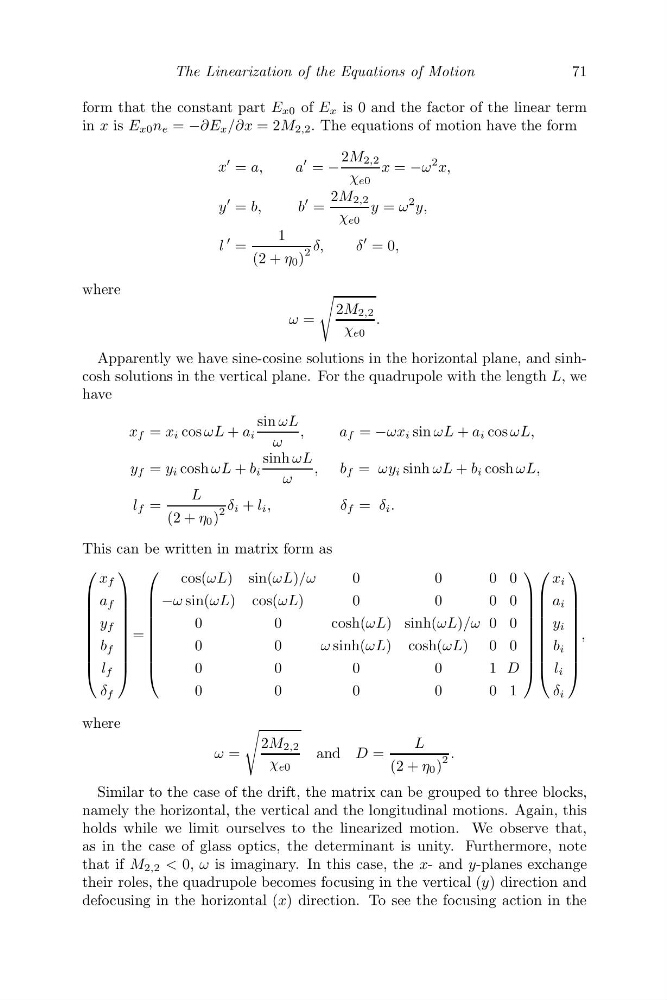
This can be written in matrix form as
⎛
⎜
⎜
⎜
⎜
⎜
⎜
⎜
⎜
⎝
x f
a f
y f
b f
l f
δ f
⎞
⎟
⎟
⎟
⎟
⎟
⎟
⎟
⎟
⎠
=
⎛
⎜
⎜
⎜
⎜
⎜
⎜
⎜
⎜
⎝
cos(ωL) sin(ωL)/ω
0
0
0 0
−ω sin(ωL) cos(ωL)
0
0
0 0
0
0
c o s h ( ωL) sinh(ωL)/ω 0 0
0
0
ω sinh(ωL) cosh(ωL) 0 0
0
0
0
0
1 D
0
0
0
0
0 1
⎞
⎟
⎟
⎟
⎟
⎟
⎟
⎟
⎟
⎠
⎛
⎜
⎜
⎜
⎜
⎜
⎜
⎜
⎜
⎝
x i
a i
y i
b i
l i
δ i
⎞
⎟
⎟
⎟
⎟
⎟
⎟
⎟
⎟
⎠
,
where
ω =
2M 2,2
χ e0
and D =
L
(2 + η 0 )
2 .
Similar to the case of the drift, the matrix can be grouped to three blocks,
namely the horizontal, the vertical and the longitudinal motions. Again, this
holds while we limit ourselves to the linearized motion. We observe that,
as in the case of glass optics, the determinant is unity. Furthermore, note
that if M 2,2 < 0, ω is imaginary. In this case, the x- and y-planes exchange
their roles, the quadrupole becomes focusing in the vertical (y) direction and
defocusing in the horizontal (x) direction. To see the focusing action in the
71
form that the constant part E x0 of E x is 0 and the factor of the linear term
in x is E x0 n e = −∂E x /∂x = 2M 2,2 . The equations of motion have the form
x
= a,
a
= −
2M 2,2
χ e0
x = −ω
2 x,
y
= b,
b
=
2M 2,2
χ e0
y = ω
2 y,
l
=
1
(2 + η 0 )
2 δ,
δ
= 0,
where
ω =
2M 2,2
χ e0
.
Apparently we have sine-cosine solutions in the horizontal plane, and sinhcosh solutions in the vertical plane. For the quadrupole with the length L, we
have
x f = x i cos ωL + a i
sin ωL
ω
,
a f = −ωx i sin ωL + a i cos ωL,
y f = y i cosh ωL + b i
sinh ωL
ω
, b f = ωy i sinh ωL + b i cosh ωL,
l f =
L
(2 + η 0 )
2 δ i + l i ,
δ f = δ i .
This can be written in matrix form as
⎛
⎜
⎜
⎜
⎜
⎜
⎜
⎜
⎜
⎝
x f
a f
y f
b f
l f
δ f
⎞
⎟
⎟
⎟
⎟
⎟
⎟
⎟
⎟
⎠
=
⎛
⎜
⎜
⎜
⎜
⎜
⎜
⎜
⎜
⎝
cos(ωL) sin(ωL)/ω
0
0
0 0
−ω sin(ωL) cos(ωL)
0
0
0 0
0
0
c o s h ( ωL) sinh(ωL)/ω 0 0
0
0
ω sinh(ωL) cosh(ωL) 0 0
0
0
0
0
1 D
0
0
0
0
0 1
⎞
⎟
⎟
⎟
⎟
⎟
⎟
⎟
⎟
⎠
⎛
⎜
⎜
⎜
⎜
⎜
⎜
⎜
⎜
⎝
x i
a i
y i
b i
l i
δ i
⎞
⎟
⎟
⎟
⎟
⎟
⎟
⎟
⎟
⎠
,
where
ω =
2M 2,2
χ e0
and D =
L
(2 + η 0 )
2 .
Similar to the case of the drift, the matrix can be grouped to three blocks,
namely the horizontal, the vertical and the longitudinal motions. Again, this
holds while we limit ourselves to the linearized motion. We observe that,
as in the case of glass optics, the determinant is unity. Furthermore, note
that if M 2,2 < 0, ω is imaginary. In this case, the x- and y-planes exchange
their roles, the quadrupole becomes focusing in the vertical (y) direction and
defocusing in the horizontal (x) direction. To see the focusing action in the