

60
An Introduction to Beam Physics
3.3 The Equations of Motion in Curvilinear Coordinates
There are a variety of methods to derive the equations of motion in curvilinear coordinates with the arc length s as the independent variable. It
is conveniently done in the Lagrangian picture, in which one first expresses
Cartesian variables by curvilinear coordinates and rewrites the Lagrangian.
Then one proceeds to a Hamiltonian through a Legendre transformation in
the common way. In the Hamiltonian picture, it is then possible to perform a
change of independent variable from t to s while maintaining the Hamiltonian
structure [49].
While very illuminating, the Lagrangian-Hamiltonian mechanism is too
involved for our purposes, and we thus follow a more straightforward, classical way that leads to the same canonical equations of motion. For simplicity,
we also restrict ourselves in that the reference orbit is allowed to bend in only
one plane.
3.3.1 The Coordinate System and the Independent Variable
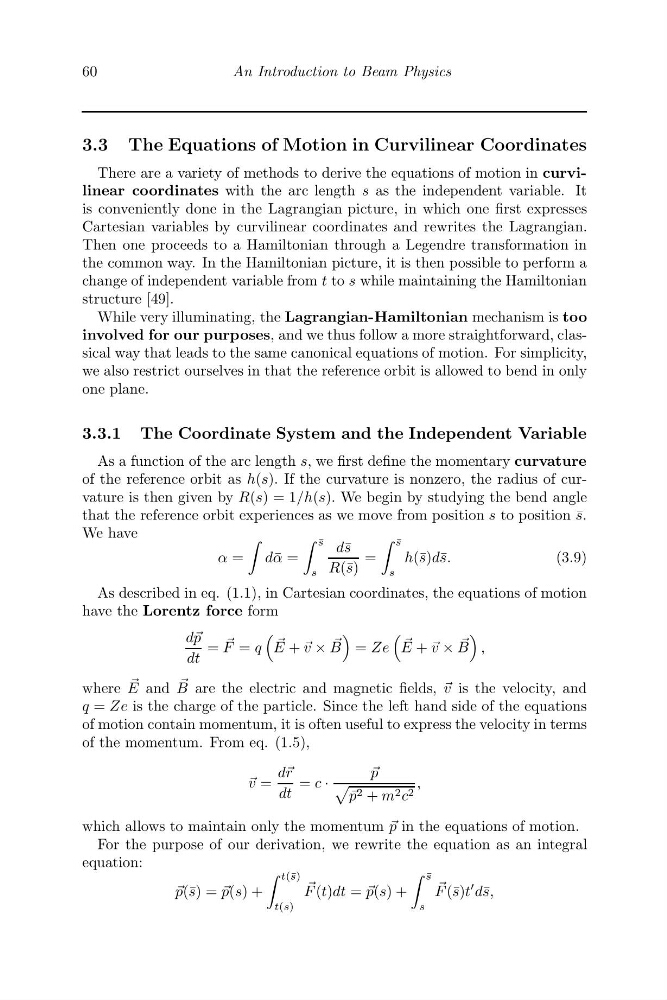
As a function of the arc length s, we first define the momentary curvature
of the reference orbit as h(s). If the curvature is nonzero, the radius of curvature is then given by R(s) = 1/h(s). We begin by studying the bend angle
that the reference orbit experiences as we move from position s to position ¯
s.
We have
α =
d¯ α =
¯
s
s
d¯ s
R(¯ s)
=
¯
s
s
h(¯ s)d¯ s.
(3.9)
As described in eq. (1.1), in Cartesian coordinates, the equations of motion
have the Lorentz force form
dd p
dt
=
F = q
E + v ×
B
= Ze
E + v ×
B
,
where
E and
B are the electric and magnetic fields, v is the velocity, and
q = Ze is the charge of the particle. Since the left hand side of the equations
of motion contain momentum, it is often useful to express the velocity in terms
of the momentum. From eq. (1.5),
v =
dd r
dt
= c ·
p
p 2 + m 2 c 2
,
which allows to maintain only the momentum p in the equations of motion.
For the purpose of our derivation, we rewrite the equation as an integral
equation:
p(¯ s) =
p(s) +
t(¯ s)
t(s)
F (t)dt = p(s) +
¯
s
s
F (¯ s)t
d¯ s,
An Introduction to Beam Physics
3.3 The Equations of Motion in Curvilinear Coordinates
There are a variety of methods to derive the equations of motion in curvilinear coordinates with the arc length s as the independent variable. It
is conveniently done in the Lagrangian picture, in which one first expresses
Cartesian variables by curvilinear coordinates and rewrites the Lagrangian.
Then one proceeds to a Hamiltonian through a Legendre transformation in
the common way. In the Hamiltonian picture, it is then possible to perform a
change of independent variable from t to s while maintaining the Hamiltonian
structure [49].
While very illuminating, the Lagrangian-Hamiltonian mechanism is too
involved for our purposes, and we thus follow a more straightforward, classical way that leads to the same canonical equations of motion. For simplicity,
we also restrict ourselves in that the reference orbit is allowed to bend in only
one plane.
3.3.1 The Coordinate System and the Independent Variable
As a function of the arc length s, we first define the momentary curvature
of the reference orbit as h(s). If the curvature is nonzero, the radius of curvature is then given by R(s) = 1/h(s). We begin by studying the bend angle
that the reference orbit experiences as we move from position s to position ¯
s.
We have
α =
d¯ α =
¯
s
s
d¯ s
R(¯ s)
=
¯
s
s
h(¯ s)d¯ s.
(3.9)
As described in eq. (1.1), in Cartesian coordinates, the equations of motion
have the Lorentz force form
dd p
dt
=
F = q
E + v ×
B
= Ze
E + v ×
B
,
where
E and
B are the electric and magnetic fields, v is the velocity, and
q = Ze is the charge of the particle. Since the left hand side of the equations
of motion contain momentum, it is often useful to express the velocity in terms
of the momentum. From eq. (1.5),
v =
dd r
dt
= c ·
p
p 2 + m 2 c 2
,
which allows to maintain only the momentum p in the equations of motion.
For the purpose of our derivation, we rewrite the equation as an integral
equation:
p(¯ s) =
p(s) +
t(¯ s)
t(s)
F (t)dt = p(s) +
¯
s
s
F (¯ s)t
d¯ s,