

48
An Introduction to Beam Physics
And we have to satisfy
(a|x) = −
1
f 2
−
1
f 1
+
l
f 1 f 2
= 0 =⇒ l = f 1 + f 2 ,
which is a well-known condition for Newtonian or Galilean telescopes. The
magnification of the telescope is given by
(a|a) = 1 −
l
f 2
= 1 −
1
f 2
(f 1 + f 2 ) = −
f 1
f 2
.
Thus, it requires f 1 f 2 to obtain large magnification. Since there is a limit
on how short f 2 can be, it is thus necessary to make f 1 large, which entails
what the rather large size telescopes usually have.
2.3.5 Combination Systems
Often the question arises to what extent it is possible to simultaneously
satisfy the requirements for the above systems. To some extent this is possible,
but the fact that the determinant of the total system has to be unity due to
Liouville’s theorem for glass optics imposes some restrictions.
A closer look shows that
1. • • and is possible: (x|a) = (a|x) = 0.
2. • and • • is possible: (x|x) = (a|a) = 0.
All other cases are impossible because they would require a zero determinant.
Another important question is what happens when two systems satisfying
certain properties are combined into one system; for example, we already saw
in eq. (2.5) that two point–to–point systems placed behind each other again
produce a point–to–point system. A more detailed analysis shows that of
the sixteen cases describing combinations of two systems, eight cases lead to
another special system
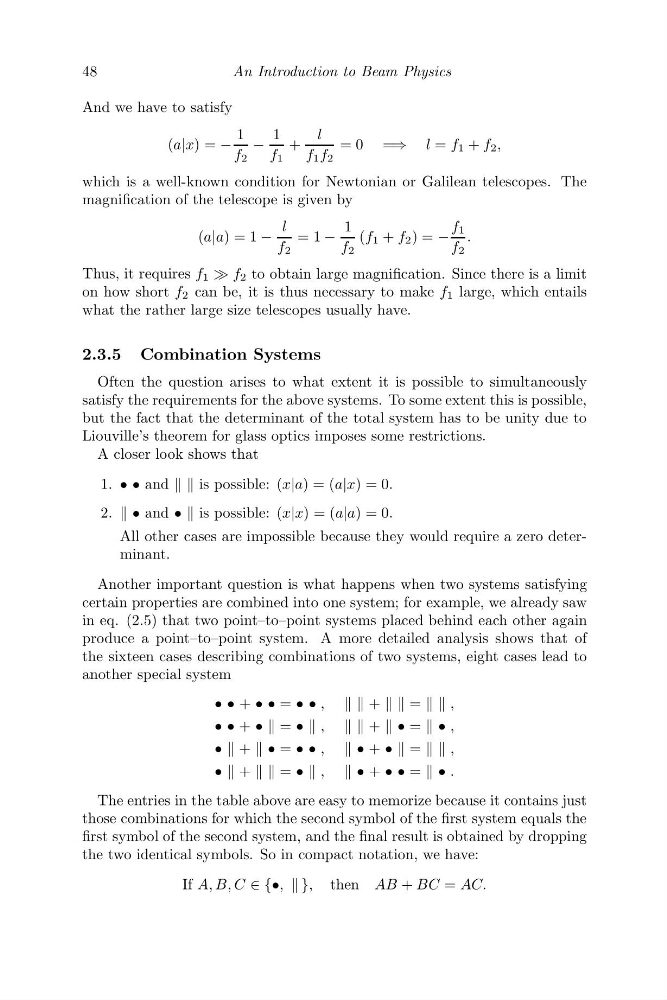
• • + • • = • • , + = ,
• • + • • = • • , + • = • ,
• • + • = • • , • + • • = ,
• • + = • • , • + • • = • .
The entries in the table above are easy to memorize because it contains just
those combinations for which the second symbol of the first system equals the
first symbol of the second system, and the final result is obtained by dropping
the two identical symbols. So in compact notation, we have:
If A, B, C ∈ {•, }, then AB + BC = AC.
An Introduction to Beam Physics
And we have to satisfy
(a|x) = −
1
f 2
−
1
f 1
+
l
f 1 f 2
= 0 =⇒ l = f 1 + f 2 ,
which is a well-known condition for Newtonian or Galilean telescopes. The
magnification of the telescope is given by
(a|a) = 1 −
l
f 2
= 1 −
1
f 2
(f 1 + f 2 ) = −
f 1
f 2
.
Thus, it requires f 1 f 2 to obtain large magnification. Since there is a limit
on how short f 2 can be, it is thus necessary to make f 1 large, which entails
what the rather large size telescopes usually have.
2.3.5 Combination Systems
Often the question arises to what extent it is possible to simultaneously
satisfy the requirements for the above systems. To some extent this is possible,
but the fact that the determinant of the total system has to be unity due to
Liouville’s theorem for glass optics imposes some restrictions.
A closer look shows that
1. • • and is possible: (x|a) = (a|x) = 0.
2. • and • • is possible: (x|x) = (a|a) = 0.
All other cases are impossible because they would require a zero determinant.
Another important question is what happens when two systems satisfying
certain properties are combined into one system; for example, we already saw
in eq. (2.5) that two point–to–point systems placed behind each other again
produce a point–to–point system. A more detailed analysis shows that of
the sixteen cases describing combinations of two systems, eight cases lead to
another special system
• • + • • = • • , + = ,
• • + • • = • • , + • = • ,
• • + • = • • , • + • • = ,
• • + = • • , • + • • = • .
The entries in the table above are easy to memorize because it contains just
those combinations for which the second symbol of the first system equals the
first symbol of the second system, and the final result is obtained by dropping
the two identical symbols. So in compact notation, we have:
If A, B, C ∈ {•, }, then AB + BC = AC.