

Linear Beam Optics
47
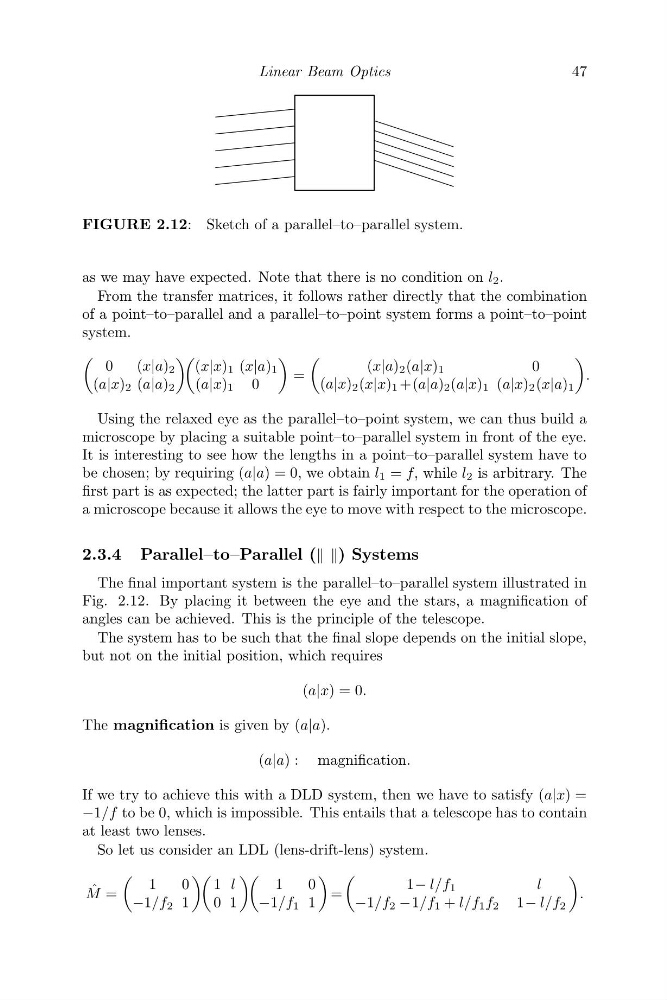
FIGURE 2.12: Sketch of a parallel–to–parallel system.
as we may have expected. Note that there is no condition on l 2 .
From the transfer matrices, it follows rather directly that the combination
of a point–to–parallel and a parallel–to–point system forms a point–to–point
system.
0
(x|a) 2
(a|x) 2 (a|a) 2
(x|x) 1 (x|a) 1
(a|x) 1 0
=
(x|a) 2 (a|x) 1
0
(a|x) 2 (x|x) 1 +(a|a) 2 (a|x) 1 (a|x) 2 (x|a) 1
.
Using the relaxed eye as the parallel–to–point system, we can thus build a
microscope by placing a suitable point–to–parallel system in front of the eye.
It is interesting to see how the lengths in a point–to–parallel system have to
be chosen; by requiring (a|a) = 0, we obtain l 1 = f, while l 2 is arbitrary. The
first part is as expected; the latter part is fairly important for the operation of
a microscope because it allows the eye to move with respect to the microscope.
2.3.4 Parallel–to–Parallel ( ) Systems
The final important system is the parallel–to–parallel system illustrated in
Fig. 2.12. By placing it between the eye and the stars, a magnification of
angles can be achieved. This is the principle of the telescope.
The system has to be such that the final slope depends on the initial slope,
but not on the initial position, which requires
(a|x) = 0.
The magnification is given by (a|a).
(a|a) : magnification.
If we try to achieve this with a DLD system, then we have to satisfy (a|x) =
−1/f to be 0, which is impossible. This entails that a telescope has to contain
at least two lenses.
So let us consider an LDL (lens-drift-lens) system.
ˆ
M =
1
0
−1/f 2 1
1 l
0 1
1
0
−1/f 1 1
=
1− l/f 1
l
−1/f 2 −1/f 1 + l/f 1 f 2 1− l/f 2
.
47
FIGURE 2.12: Sketch of a parallel–to–parallel system.
as we may have expected. Note that there is no condition on l 2 .
From the transfer matrices, it follows rather directly that the combination
of a point–to–parallel and a parallel–to–point system forms a point–to–point
system.
0
(x|a) 2
(a|x) 2 (a|a) 2
(x|x) 1 (x|a) 1
(a|x) 1 0
=
(x|a) 2 (a|x) 1
0
(a|x) 2 (x|x) 1 +(a|a) 2 (a|x) 1 (a|x) 2 (x|a) 1
.
Using the relaxed eye as the parallel–to–point system, we can thus build a
microscope by placing a suitable point–to–parallel system in front of the eye.
It is interesting to see how the lengths in a point–to–parallel system have to
be chosen; by requiring (a|a) = 0, we obtain l 1 = f, while l 2 is arbitrary. The
first part is as expected; the latter part is fairly important for the operation of
a microscope because it allows the eye to move with respect to the microscope.
2.3.4 Parallel–to–Parallel ( ) Systems
The final important system is the parallel–to–parallel system illustrated in
Fig. 2.12. By placing it between the eye and the stars, a magnification of
angles can be achieved. This is the principle of the telescope.
The system has to be such that the final slope depends on the initial slope,
but not on the initial position, which requires
(a|x) = 0.
The magnification is given by (a|a).
(a|a) : magnification.
If we try to achieve this with a DLD system, then we have to satisfy (a|x) =
−1/f to be 0, which is impossible. This entails that a telescope has to contain
at least two lenses.
So let us consider an LDL (lens-drift-lens) system.
ˆ
M =
1
0
−1/f 2 1
1 l
0 1
1
0
−1/f 1 1
=
1− l/f 1
l
−1/f 2 −1/f 1 + l/f 1 f 2 1− l/f 2
.