

Linear Beam Optics
45
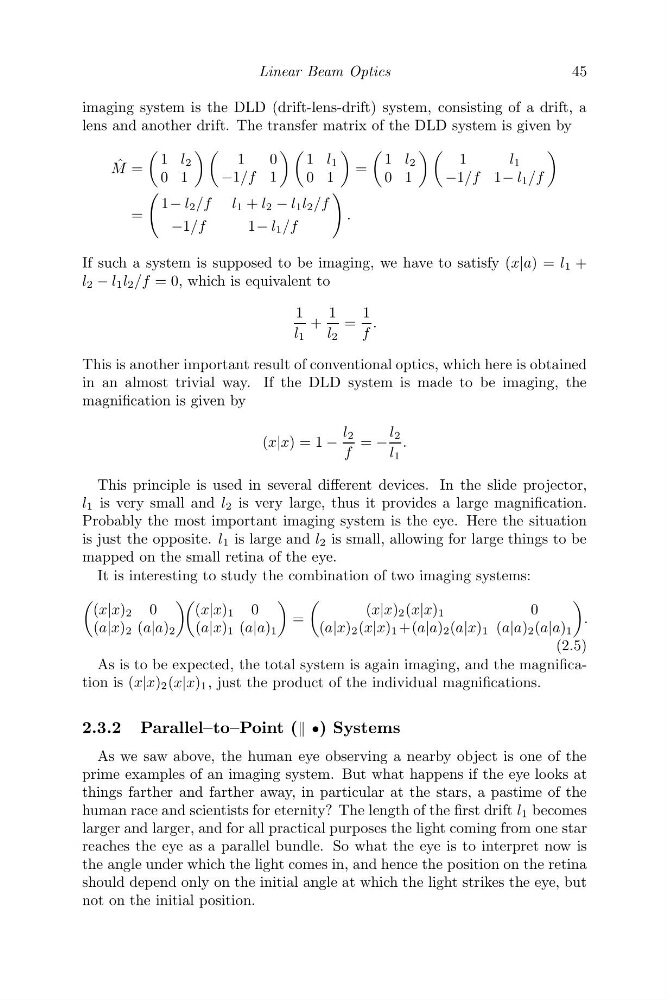
imaging system is the DLD (drift-lens-drift) system, consisting of a drift, a
lens and another drift. The transfer matrix of the DLD system is given by
ˆ
M =
1 l 2
0 1
1
0
−1/f 1
1 l 1
0 1
=
1 l 2
0 1
1
l 1
−1/f 1− l 1 /f
=
1− l 2 /f l 1 + l 2 − l 1 l 2 /f
−1/f
1− l 1 /f
.
If such a system is supposed to be imaging, we have to satisfy (x|a) = l 1 +
l 2 − l 1 l 2 /f = 0, which is equivalent to
1
l 1
+
1
l 2
=
1
f
.
This is another important result of conventional optics, which here is obtained
in an almost trivial way. If the DLD system is made to be imaging, the
magnification is given by
(x|x) = 1 −
l 2
f
= −
l 2
l 1
.
This principle is used in several different devices. In the slide projector,
l 1 is very small and l 2 is very large, thus it provides a large magnification.
Probably the most important imaging system is the eye. Here the situation
is just the opposite. l 1 is large and l 2 is small, allowing for large things to be
mapped on the small retina of the eye.
It is interesting to study the combination of two imaging systems:
(x|x) 2 0
(a|x) 2 (a|a) 2
(x|x) 1 0
(a|x) 1 (a|a) 1
=
(x|x) 2 (x|x) 1
0
(a|x) 2 (x|x) 1 +(a|a) 2 (a|x) 1 (a|a) 2 (a|a) 1
.
(2.5)
As is to be expected, the total system is again imaging, and the magnification is (x|x) 2 (x|x) 1 , just the product of the individual magnifications.
2.3.2 Parallel–to–Point ( •) Systems
As we saw above, the human eye observing a nearby object is one of the
prime examples of an imaging system. But what happens if the eye looks at
things farther and farther away, in particular at the stars, a pastime of the
human race and scientists for eternity? The length of the first drift l 1 becomes
larger and larger, and for all practical purposes the light coming from one star
reaches the eye as a parallel bundle. So what the eye is to interpret now is
the angle under which the light comes in, and hence the position on the retina
should depend only on the initial angle at which the light strikes the eye, but
not on the initial position.
45
imaging system is the DLD (drift-lens-drift) system, consisting of a drift, a
lens and another drift. The transfer matrix of the DLD system is given by
ˆ
M =
1 l 2
0 1
1
0
−1/f 1
1 l 1
0 1
=
1 l 2
0 1
1
l 1
−1/f 1− l 1 /f
=
1− l 2 /f l 1 + l 2 − l 1 l 2 /f
−1/f
1− l 1 /f
.
If such a system is supposed to be imaging, we have to satisfy (x|a) = l 1 +
l 2 − l 1 l 2 /f = 0, which is equivalent to
1
l 1
+
1
l 2
=
1
f
.
This is another important result of conventional optics, which here is obtained
in an almost trivial way. If the DLD system is made to be imaging, the
magnification is given by
(x|x) = 1 −
l 2
f
= −
l 2
l 1
.
This principle is used in several different devices. In the slide projector,
l 1 is very small and l 2 is very large, thus it provides a large magnification.
Probably the most important imaging system is the eye. Here the situation
is just the opposite. l 1 is large and l 2 is small, allowing for large things to be
mapped on the small retina of the eye.
It is interesting to study the combination of two imaging systems:
(x|x) 2 0
(a|x) 2 (a|a) 2
(x|x) 1 0
(a|x) 1 (a|a) 1
=
(x|x) 2 (x|x) 1
0
(a|x) 2 (x|x) 1 +(a|a) 2 (a|x) 1 (a|a) 2 (a|a) 1
.
(2.5)
As is to be expected, the total system is again imaging, and the magnification is (x|x) 2 (x|x) 1 , just the product of the individual magnifications.
2.3.2 Parallel–to–Point ( •) Systems
As we saw above, the human eye observing a nearby object is one of the
prime examples of an imaging system. But what happens if the eye looks at
things farther and farther away, in particular at the stars, a pastime of the
human race and scientists for eternity? The length of the first drift l 1 becomes
larger and larger, and for all practical purposes the light coming from one star
reaches the eye as a parallel bundle. So what the eye is to interpret now is
the angle under which the light comes in, and hence the position on the retina
should depend only on the initial angle at which the light strikes the eye, but
not on the initial position.