

44
An Introduction to Beam Physics
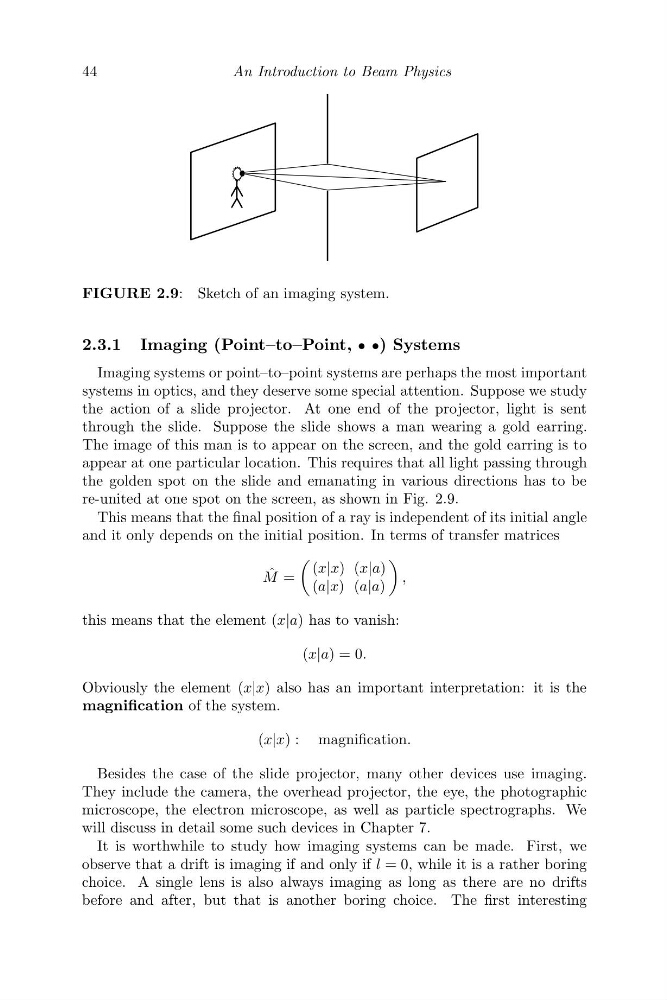
FIGURE 2.9: Sketch of an imaging system.
2.3.1 Imaging (Point–to–Point, • •) Systems
Imaging systems or point–to–point systems are perhaps the most important
systems in optics, and they deserve some special attention. Suppose we study
the action of a slide projector. At one end of the projector, light is sent
through the slide. Suppose the slide shows a man wearing a gold earring.
The image of this man is to appear on the screen, and the gold earring is to
appear at one particular location. This requires that all light passing through
the golden spot on the slide and emanating in various directions has to be
re-united at one spot on the screen, as shown in Fig. 2.9.
This means that the final position of a ray is independent of its initial angle
and it only depends on the initial position. In terms of transfer matrices
ˆ
M =
(x|x) (x|a)
(a|x) (a|a)
,
this means that the element (x|a) has to vanish:
(x|a) = 0.
Obviously the element (x|x) also has an important interpretation: it is the
magnification of the system.
(x|x) : magnification.
Besides the case of the slide projector, many other devices use imaging.
They include the camera, the overhead projector, the eye, the photographic
microscope, the electron microscope, as well as particle spectrographs. We
will discuss in detail some such devices in Chapter 7.
It is worthwhile to study how imaging systems can be made. First, we
observe that a drift is imaging if and only if l = 0, while it is a rather boring
choice. A single lens is also always imaging as long as there are no drifts
before and after, but that is another boring choice. The first interesting
An Introduction to Beam Physics
FIGURE 2.9: Sketch of an imaging system.
2.3.1 Imaging (Point–to–Point, • •) Systems
Imaging systems or point–to–point systems are perhaps the most important
systems in optics, and they deserve some special attention. Suppose we study
the action of a slide projector. At one end of the projector, light is sent
through the slide. Suppose the slide shows a man wearing a gold earring.
The image of this man is to appear on the screen, and the gold earring is to
appear at one particular location. This requires that all light passing through
the golden spot on the slide and emanating in various directions has to be
re-united at one spot on the screen, as shown in Fig. 2.9.
This means that the final position of a ray is independent of its initial angle
and it only depends on the initial position. In terms of transfer matrices
ˆ
M =
(x|x) (x|a)
(a|x) (a|a)
,
this means that the element (x|a) has to vanish:
(x|a) = 0.
Obviously the element (x|x) also has an important interpretation: it is the
magnification of the system.
(x|x) : magnification.
Besides the case of the slide projector, many other devices use imaging.
They include the camera, the overhead projector, the eye, the photographic
microscope, the electron microscope, as well as particle spectrographs. We
will discuss in detail some such devices in Chapter 7.
It is worthwhile to study how imaging systems can be made. First, we
observe that a drift is imaging if and only if l = 0, while it is a rather boring
choice. A single lens is also always imaging as long as there are no drifts
before and after, but that is another boring choice. The first interesting