

Beams and Beam Physics
29
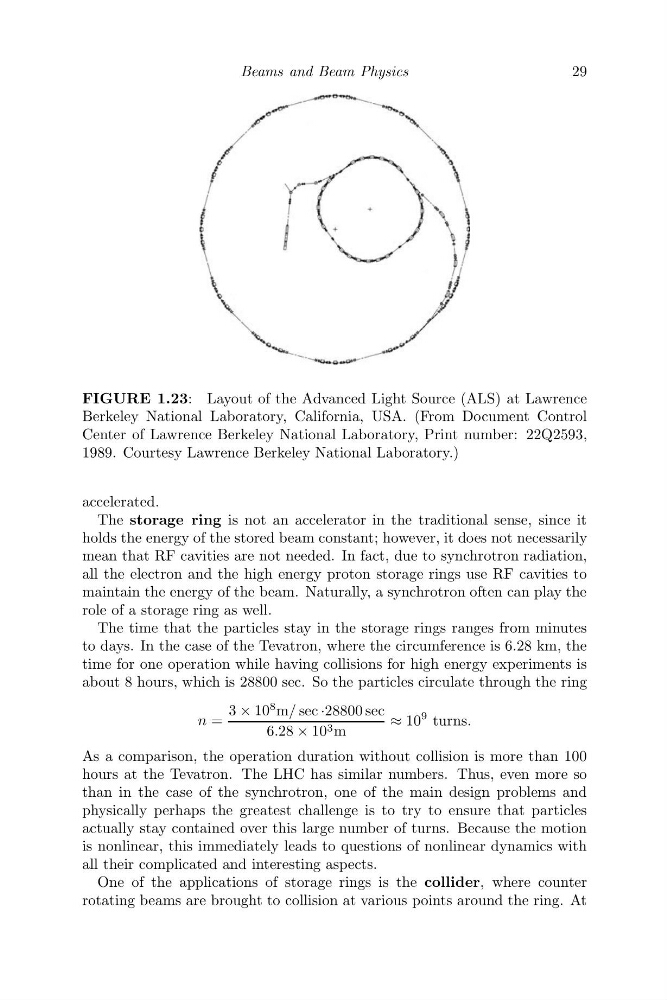
FIGURE 1.23: Layout of the Advanced Light Source (ALS) at Lawrence
Berkeley National Laboratory, California, USA. (From Document Control
Center of Lawrence Berkeley National Laboratory, Print number: 22Q2593,
1989. Courtesy Lawrence Berkeley National Laboratory.)
accelerated.
The storage ring is not an accelerator in the traditional sense, since it
holds the energy of the stored beam constant; however, it does not necessarily
mean that RF cavities are not needed. In fact, due to synchrotron radiation,
all the electron and the high energy proton storage rings use RF cavities to
maintain the energy of the beam. Naturally, a synchrotron often can play the
role of a storage ring as well.
The time that the particles stay in the storage rings ranges from minutes
to days. In the case of the Tevatron, where the circumference is 6.28 km, the
time for one operation while having collisions for high energy experiments is
about 8 hours, which is 28800 sec. So the particles circulate through the ring
n =
3 × 10
8 m/ sec ·28800 sec
6.28 × 10 3 m
≈ 10
9 turns.
As a comparison, the operation duration without collision is more than 100
hours at the Tevatron. The LHC has similar numbers. Thus, even more so
than in the case of the synchrotron, one of the main design problems and
physically perhaps the greatest challenge is to try to ensure that particles
actually stay contained over this large number of turns. Because the motion
is nonlinear, this immediately leads to questions of nonlinear dynamics with
all their complicated and interesting aspects.
One of the applications of storage rings is the collider, where counter
rotating beams are brought to collision at various points around the ring. At
29
FIGURE 1.23: Layout of the Advanced Light Source (ALS) at Lawrence
Berkeley National Laboratory, California, USA. (From Document Control
Center of Lawrence Berkeley National Laboratory, Print number: 22Q2593,
1989. Courtesy Lawrence Berkeley National Laboratory.)
accelerated.
The storage ring is not an accelerator in the traditional sense, since it
holds the energy of the stored beam constant; however, it does not necessarily
mean that RF cavities are not needed. In fact, due to synchrotron radiation,
all the electron and the high energy proton storage rings use RF cavities to
maintain the energy of the beam. Naturally, a synchrotron often can play the
role of a storage ring as well.
The time that the particles stay in the storage rings ranges from minutes
to days. In the case of the Tevatron, where the circumference is 6.28 km, the
time for one operation while having collisions for high energy experiments is
about 8 hours, which is 28800 sec. So the particles circulate through the ring
n =
3 × 10
8 m/ sec ·28800 sec
6.28 × 10 3 m
≈ 10
9 turns.
As a comparison, the operation duration without collision is more than 100
hours at the Tevatron. The LHC has similar numbers. Thus, even more so
than in the case of the synchrotron, one of the main design problems and
physically perhaps the greatest challenge is to try to ensure that particles
actually stay contained over this large number of turns. Because the motion
is nonlinear, this immediately leads to questions of nonlinear dynamics with
all their complicated and interesting aspects.
One of the applications of storage rings is the collider, where counter
rotating beams are brought to collision at various points around the ring. At