

Beams and Beam Physics
25
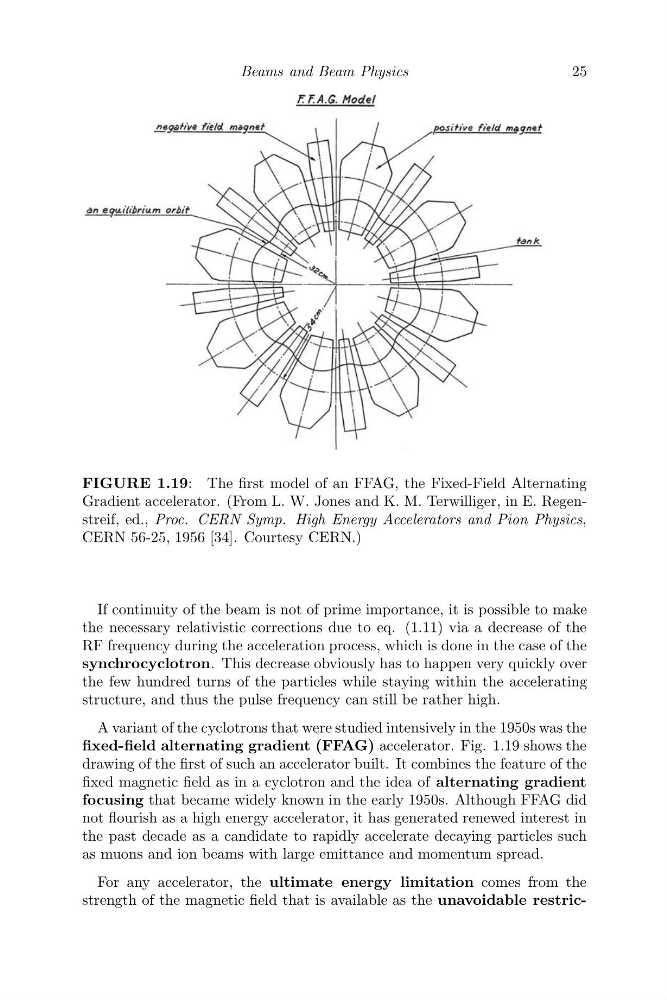
FIGURE 1.19: The first model of an FFAG, the Fixed-Field Alternating
Gradient accelerator. (From L. W. Jones and K. M. Terwilliger, in E. Regenstreif, ed., Proc. CERN Symp. High Energy Accelerators and Pion Physics,
CERN 56-25, 1956 [34]. Courtesy CERN.)
If continuity of the beam is not of prime importance, it is possible to make
the necessary relativistic corrections due to eq. (1.11) via a decrease of the
RF frequency during the acceleration process, which is done in the case of the
synchrocyclotron. This decrease obviously has to happen very quickly over
the few hundred turns of the particles while staying within the accelerating
structure, and thus the pulse frequency can still be rather high.
A variant of the cyclotrons that were studied intensively in the 1950s was the
fixed-field alternating gradient (FFAG) accelerator. Fig. 1.19 shows the
drawing of the first of such an accelerator built. It combines the feature of the
fixed magnetic field as in a cyclotron and the idea of alternating gradient
focusing that became widely known in the early 1950s. Although FFAG did
not flourish as a high energy accelerator, it has generated renewed interest in
the past decade as a candidate to rapidly accelerate decaying particles such
as muons and ion beams with large emittance and momentum spread.
For any accelerator, the ultimate energy limitation comes from the
strength of the magnetic field that is available as the unavoidable restric-
25
FIGURE 1.19: The first model of an FFAG, the Fixed-Field Alternating
Gradient accelerator. (From L. W. Jones and K. M. Terwilliger, in E. Regenstreif, ed., Proc. CERN Symp. High Energy Accelerators and Pion Physics,
CERN 56-25, 1956 [34]. Courtesy CERN.)
If continuity of the beam is not of prime importance, it is possible to make
the necessary relativistic corrections due to eq. (1.11) via a decrease of the
RF frequency during the acceleration process, which is done in the case of the
synchrocyclotron. This decrease obviously has to happen very quickly over
the few hundred turns of the particles while staying within the accelerating
structure, and thus the pulse frequency can still be rather high.
A variant of the cyclotrons that were studied intensively in the 1950s was the
fixed-field alternating gradient (FFAG) accelerator. Fig. 1.19 shows the
drawing of the first of such an accelerator built. It combines the feature of the
fixed magnetic field as in a cyclotron and the idea of alternating gradient
focusing that became widely known in the early 1950s. Although FFAG did
not flourish as a high energy accelerator, it has generated renewed interest in
the past decade as a candidate to rapidly accelerate decaying particles such
as muons and ion beams with large emittance and momentum spread.
For any accelerator, the ultimate energy limitation comes from the
strength of the magnetic field that is available as the unavoidable restric-