

22
An Introduction to Beam Physics
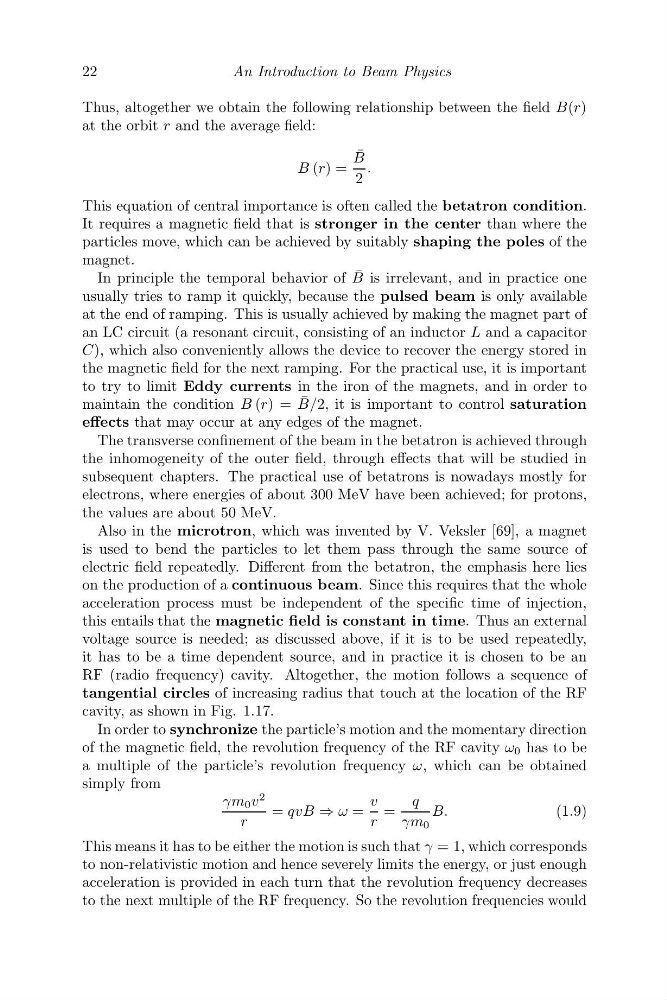
Thus, altogether we obtain the following relationship between the field B(r)
at the orbit r and the average field:
B (r) =
¯
B
2
.
This equation of central importance is often called the betatron condition.
It requires a magnetic field that is stronger in the center than where the
particles move, which can be achieved by suitably shaping the poles of the
magnet.
In principle the temporal behavior of ¯
B is irrelevant, and in practice one
usually tries to ramp it quickly, because the pulsed beam is only available
at the end of ramping. This is usually achieved by making the magnet part of
an LC circuit (a resonant circuit, consisting of an inductor L and a capacitor
C), which also conveniently allows the device to recover the energy stored in
the magnetic field for the next ramping. For the practical use, it is important
to try to limit Eddy currents in the iron of the magnets, and in order to
maintain the condition B (r) = ¯
B/2, it is important to control saturation
effects that may occur at any edges of the magnet.
The transverse confinement of the beam in the betatron is achieved through
the inhomogeneity of the outer field, through effects that will be studied in
subsequent chapters. The practical use of betatrons is nowadays mostly for
electrons, where energies of about 300 MeV have been achieved; for protons,
the values are about 50 MeV.
Also in the microtron, which was invented by V. Veksler [69], a magnet
is used to bend the particles to let them pass through the same source of
electric field repeatedly. Different from the betatron, the emphasis here lies
on the production of a continuous beam. Since this requires that the whole
acceleration process must be independent of the specific time of injection,
this entails that the magnetic field is constant in time. Thus an external
voltage source is needed; as discussed above, if it is to be used repeatedly,
it has to be a time dependent source, and in practice it is chosen to be an
RF (radio frequency) cavity. Altogether, the motion follows a sequence of
tangential circles of increasing radius that touch at the location of the RF
cavity, as shown in Fig. 1.17.
In order to synchronize the particle’s motion and the momentary direction
of the magnetic field, the revolution frequency of the RF cavity ω 0 has to be
a multiple of the particle’s revolution frequency ω, which can be obtained
simply from
γm 0 v
2
r
= qvB ⇒ ω =
v
r
=
q
γm 0
B.
(1.9)
This means it has to be either the motion is such that γ = 1, which corresponds
to non-relativistic motion and hence severely limits the energy, or just enough
acceleration is provided in each turn that the revolution frequency decreases
to the next multiple of the RF frequency. So the revolution frequencies would
An Introduction to Beam Physics
Thus, altogether we obtain the following relationship between the field B(r)
at the orbit r and the average field:
B (r) =
¯
B
2
.
This equation of central importance is often called the betatron condition.
It requires a magnetic field that is stronger in the center than where the
particles move, which can be achieved by suitably shaping the poles of the
magnet.
In principle the temporal behavior of ¯
B is irrelevant, and in practice one
usually tries to ramp it quickly, because the pulsed beam is only available
at the end of ramping. This is usually achieved by making the magnet part of
an LC circuit (a resonant circuit, consisting of an inductor L and a capacitor
C), which also conveniently allows the device to recover the energy stored in
the magnetic field for the next ramping. For the practical use, it is important
to try to limit Eddy currents in the iron of the magnets, and in order to
maintain the condition B (r) = ¯
B/2, it is important to control saturation
effects that may occur at any edges of the magnet.
The transverse confinement of the beam in the betatron is achieved through
the inhomogeneity of the outer field, through effects that will be studied in
subsequent chapters. The practical use of betatrons is nowadays mostly for
electrons, where energies of about 300 MeV have been achieved; for protons,
the values are about 50 MeV.
Also in the microtron, which was invented by V. Veksler [69], a magnet
is used to bend the particles to let them pass through the same source of
electric field repeatedly. Different from the betatron, the emphasis here lies
on the production of a continuous beam. Since this requires that the whole
acceleration process must be independent of the specific time of injection,
this entails that the magnetic field is constant in time. Thus an external
voltage source is needed; as discussed above, if it is to be used repeatedly,
it has to be a time dependent source, and in practice it is chosen to be an
RF (radio frequency) cavity. Altogether, the motion follows a sequence of
tangential circles of increasing radius that touch at the location of the RF
cavity, as shown in Fig. 1.17.
In order to synchronize the particle’s motion and the momentary direction
of the magnetic field, the revolution frequency of the RF cavity ω 0 has to be
a multiple of the particle’s revolution frequency ω, which can be obtained
simply from
γm 0 v
2
r
= qvB ⇒ ω =
v
r
=
q
γm 0
B.
(1.9)
This means it has to be either the motion is such that γ = 1, which corresponds
to non-relativistic motion and hence severely limits the energy, or just enough
acceleration is provided in each turn that the revolution frequency decreases
to the next multiple of the RF frequency. So the revolution frequencies would